



Hedgehog
Hedgehog (Hh) is composed of N-terminal and C-terminal domains that dissociate in a self-catalyzed proteolytic cleavage reaction. The N-terminal product HhNp, modified by cholesterol during self-cleavage, harbors all known Hh signaling activities. When synthesized in the absence of the C-terminal domain (and hence lacking cholesterol modification), the N-terminal domain is aberrantly targeted and released selectively into the retina.
Hedgehog signaling pathway is linked to tumorigenesis and is aberrantly activated in a variety of cancers. Hh ligands bind to and suppress the transmembrane receptor Patched (PTCH), which suppresses Smoothened (SMO), a seven-transmembrane-helix protein that positively regulates the Hh pathway.
Sonic hedgehog (Shh) is a morphogen essential to the developing nervous system that continues to play an important role in adult life by contributing to cell proliferation and differentiation, maintaining blood-brain barrier integrity, and being cytoprotective against oxidative and excitotoxic stress, all features of importance in amyotrophic lateral sclerosis (ALS).
Indian hedgehog (Ihh), a signaling molecule that plays a pivotal role in the regulation of chondrocyte proliferation, maturation, and ossification both in long-bone development and digit joint formation, has also been found to be essential for temporomandibular joint (TMJ) development.
Desert hedgehog (Dhh), one of the Hedgehog family members, is expressed by Schwann cells of peripheral nerves.
All Product Categories
-
Hedgehog Related Products (98)
Related Products (98)

-
Antibodies (2)
-
Hedgehog IN-4
 0 ImagesCat. No.: HY-153500CAS No.: 1616368-12-7
-
Neurodazine (Standard)
 0 ImagesCat. No.: HY-108439RCAS No.: 937807-66-4Neurodazine (Standard) is the analytical standard of Neurodazine (HY-108439). This product is intended for research and analytical applications. Neurodazine is a neurogenic inducer, serve as a promoter of neurogenesisin pluripotent cells. Neurodazine promotes neurogenesis by activating Wnt and Shh signaling pathways..
-
Vismodegib (Standard)
 0 ImagesSynonyms: GDC-0449 (Standard)Vismodegib (Standard) is the analytical standard of Vismodegib. This product is intended for research and analytical applications. Vismodegib (GDC-0449) is a BBB-permeable and orally active hedgehog pathway inhibitor with an IC50 of 3 nM. Vismodegib also inhibits P-gp, ABCG2 with IC50 values of 3.0 μM and 1.4 μM, respectively.
-
Jervine hydriodide
 0 ImagesCat. No.: HY-N0836ACAS No.: 60326-37-6Synonyms: 11-Ketocyclopamine hydriodideJervine hydriodide (11-Ketocyclopamine hydriodide) is an orally active steroidal alkaloid and Hedgehog signaling pathway inhibitor. Jervine hydriodide can be isolated from Veratrum californicum. Jervine hydriodide regulates Wnt, inhibits the AKT/mTOR signaling pathway, and activates the AMPK signaling pathway. Jervine hydriodide induces DNA damage, Apoptosis, Autophagy, ROS production and Mitochondrial damage. Jervine hydriodide exhibits anti-cancer and anti-inflammatory activities. Jervine hydriodide reduces tumor growth rate and weight in xenograft models. Jervine hydriodide can be used in studies related to triple-negative breast cancer, nasopharyngeal carcinoma and non-small cell lung cancer.
-
Ornidazole (Standard)
 0 ImagesSynonyms: Ro 7-0207 (Standard)Ornidazole (Standard) is the analytical standard of Ornidazole. This product is intended for research and analytical applications. Ornidazole (Ro 7-0207) is a nitroimidazole derivative with anti-trichomonad activity and in vitro activity against a variety of anaerobic bacteria. Ornidazole inhibits Sonic hedgehog (Shh) signaling pathway, exhibits antitumor activity. Ornidazole can be used in research of Crohn’s disease.
-
Hedgehog IN-8
 0 ImagesCat. No.: HY-W838042CAS No.: 314041-83-3
-
MK-4101 (Standard)
 0 ImagesCat. No.: HY-100036RCAS No.: 935273-79-3MK-4101 (Standard) is the analytical standard of MK-4101 (HY-100036). This product is intended for research and analytical applications. MK-4101 is a Smoothened (SMO) antagonist (IC50 of 1.1 μM for 293 cells ) and also a potent inhibitor of the hedgehog pathway (IC50 of 1.5 μM for mouse cells; IC50 of 1 μM for KYSE180 oesophageal cancer cells). MK-4101 has robust antitumor activity that inhibits tumor cell proliferation and induces extensive apoptosis.
-
MS-0022
 0 ImagesCat. No.: HY-123752CAS No.: 691392-89-9
-
Clobetasol
 0 ImagesCat. No.: HY-W338819CAS No.: 25122-41-2Clobetasol is a glucocorticoid and Smoothened agonist that can cross the blood-brain barrier. Clobetasol induces Smo-dependent activation of the Shh signaling pathway and nuclear translocation of Gli1. Clobetasol promotes remyelination and reduces myelin loss in lesions of neuromyelitis optica (NMO). Clobetasol may cause adrenal suppression, cushingoid appearance, and local adverse reactions including dysgeusia, xerostomia, and gastroesophageal burning. Clobetasol can be used in research related to neurodegenerative diseases, oral lichen planus, mucous membrane pemphigoid, and neuromyelitis optica.
-
MRT-92
 0 ImagesCat. No.: HY-117903ACAS No.: 1428315-82-5MRT-92 is a Smoothened (Smo) antagonist (Ki=0.7 nM) with anticancer activity. MRT-92 inhibits Hedgehog signaling pathway and rodent cerebellar granule cell proliferation by blocking overlapping binding sites in the transmembrane domain of the Smoothened receptor (IC50=0.4 nM). MRT-92 can be used in the study of cerebellar glioma.
-
GLI1-IN-3
 0 ImagesCat. No.: HY-172449GLI1-IN-3 (Compound 11a), a triterpenoid analogue, can inhibit Hedgehog signaling in GLI1 overexpression cancer cells. GLI1-IN-3 inhibits the proliferation in NSCLC and prostate cancer cell lines exhibiting hyper-activated Hh signaling. GLI1-IN-3 can also decrease the expression of endogenous GLI1 protein and its target genes associated with tumor progression and proliferation in A549 and DU-145 cancer cells.
-
MDB5
 0 ImagesCat. No.: HY-184378CAS No.: 2922221-22-3MDB5 is a Hedgehog pathway and Smoothened inhibitor that binds to the 7-TM domain of Smo. MDB5 reduces hepatic stellate cell activation, extracellular matrix-related gene expression, collagen deposition, hydroxyproline content and epithelial-mesenchymal transition, and prevents sinusoidal endothelial cell capillarization. MDB5 induces G1 and S phase cell cycle arrest, triggers apoptosis by upregulating Bax and downregulating Bcl-2, and also decreases oxygen consumption rate, glucose uptake, transglutaminase activity and fibronectin matrix assembly. MDB5 reduces the levels of liver injury markers, hepatic triglyceride deposition and hepatic steatosis, restores the tissue structure of the kidney and spleen, and inhibits pancreatic tumor growth without causing body weight loss. MDB5 can be loaded into PEG-PCC-g-DC micelles, achieving high drug loading, sustained release, improved water solubility, enhanced cellular uptake and optimized hepatic distribution, with good tolerance in mice. MDB5 is applicable to research related to alcohol-associated liver disease, liver fibrosis and pancreatic cancer.
-
SMO-IN-2
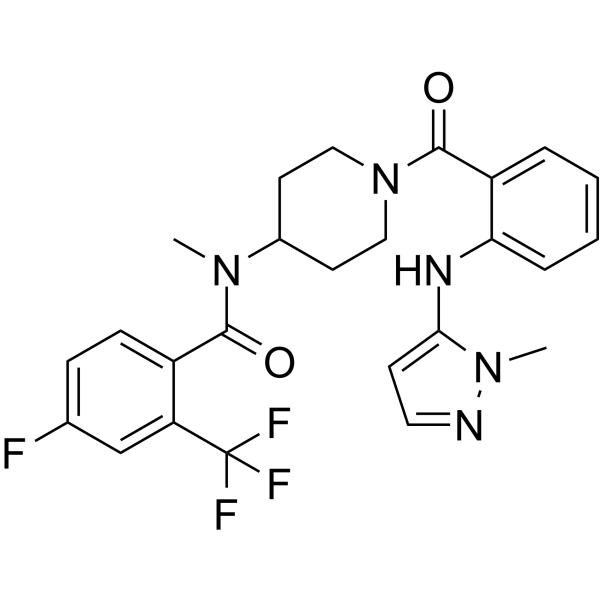 0 ImagesSMO-IN-2 is a potent smoothened (SMO) inhibitor with an IC50 value of 123.4 nM for hedgehog (Hh) signaling pathway. SMO-IN-2 has antiproliferative activity against human medulloblastoma cell line Daoy. Anticancer activity.
-
Vismodegib-d4
 0 ImagesCat. No.: HY-W705354CAS No.: 1450990-33-6Vismodegib-d4 is deuterium labeled Vismodegib. Vismodegib (GDC-0449) is an orally active hedgehog pathway inhibitor with an IC50 of 3 nM. Vismodegib also inhibits P-gp, ABCG2 with IC50 values of 3.0 μM and 1.4 μM, respectively.

-
RUSKI-201
 0 ImagesCat. No.: HY-123781CAS No.: 1458031-48-5RUSKI-201 is a potent and specific Hedgehog acyltransferase (Hhat) inhibitor, with an IC50 of 0.20 μM. RUSKI-201 is able to block Hh signaling from Shh overexpressing cells and inhibits Hh palmitoylation. RUSKI-201 is potential Hhat chemical probe in cells and can used in studies of Hhat catalytic function.
-
BRD50837
 0 ImagesCat. No.: HY-120664CAS No.: 1314295-24-3
-
SMANT hydrochloride (Standard)
 0 ImagesCat. No.: HY-108508RCAS No.: 1177600-74-6SMANT hydrochloride (Standard) is the analytical standard of SMANT (hydrochloride) (HY-108508). This product is intended for research and analytical applications. SMANT hydrochloride is a Smoothened (Smo) signaling inhibitor. SMANT hydrochloride is antagonist of Smo accumulation within the primary cilium (PC). SMANT hydrochloride has an equivalent activity in inhibiting SmoM2 (oncogenic form of Smo) and wild-type Smo.




