



Fluorescent Dye
Fluorescence is a phenomenon of photoluminescence in luminescence. When an atom is irradiated by light, some electrons around the nucleus jump from their original orbitals to higher energy orbitals under the influence of light energy, i.e., from the ground state to the first or second excited single-line state, etc. Due to the instability of the first or second excited singlet state, the electron returns from the excited singlet state to the ground state accompanied by released energy, resulting in fluorescence.
Fluorescent dyes can be covalently bound or physically adsorbed in the structure of the substance. The fluorescence properties allow for the characterization, localization and quantitative analysis of the labeled object. Fluorescent dyes have shown great potential for the detection of proteins, nucleic acids, cells, and immunoassays, attributed to the advantages in non-radioactive contamination, simple experimental operation and easy observation.
Fluorescent dyes have penetrated many fields such as pharmacology, physiology, environmental science, and information science, as well as functional studies of proteins and drug screening.
All Product Categories
-
Fluorescent Dye Related Products (4914)
Related Products (4914)

-
Antibodies (4)

-
Pigment red 176
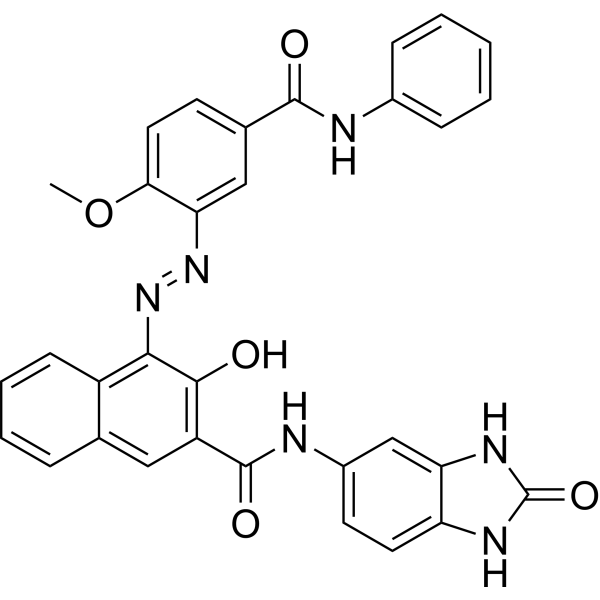 0 ImagesCat. No.: HY-D1155CAS No.: 12225-06-8Pigment Red 176 is a commonly used commercial dye for bulk coloring of plastics and synthetic fibers and for surface coatings such as paints and inks.
-
Cy3 labled Rovanersen sodium
 0 ImagesCat. No.: HY-132593ECy3 labled Rovanersen sodium is a Cy3 labled Rovanersen sodium.
-
Cy3 labled Zintevir sodium
 0 ImagesCat. No.: HY-177670DCy3 labled Zintevir sodium is a Cy3 labled Zintevir sodium.
-
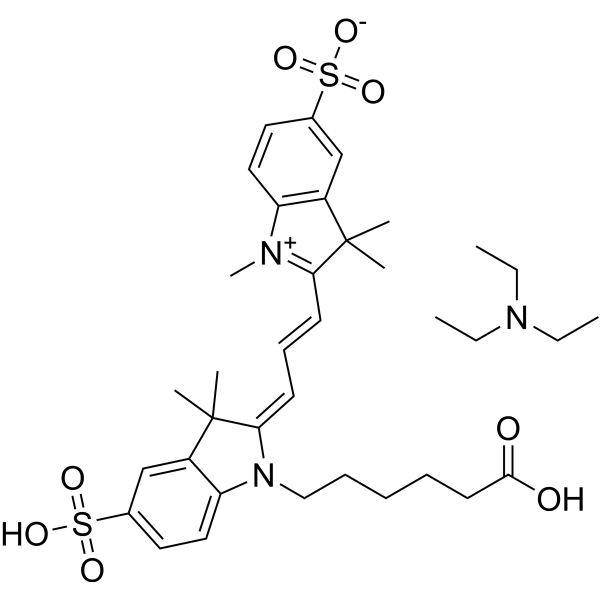
6-TAMRA cyclohexyl phosphoramidite
 0 ImagesCat. No.: HY-D3526CAS No.: 1946010-74-76-TAMRA cyclohexyl phosphoramidite is a derivative of TAMRA (tetramethylrhodamine) featuring a phosphoramidite moiety for use in oligonucleotide synthesis. It is primarily used for the synthesis of fluorescent oligonucleotide probes (Ex/Em = 553/576 nm).

-
5,5'-Dimethyl BAPTA tetrapotassium
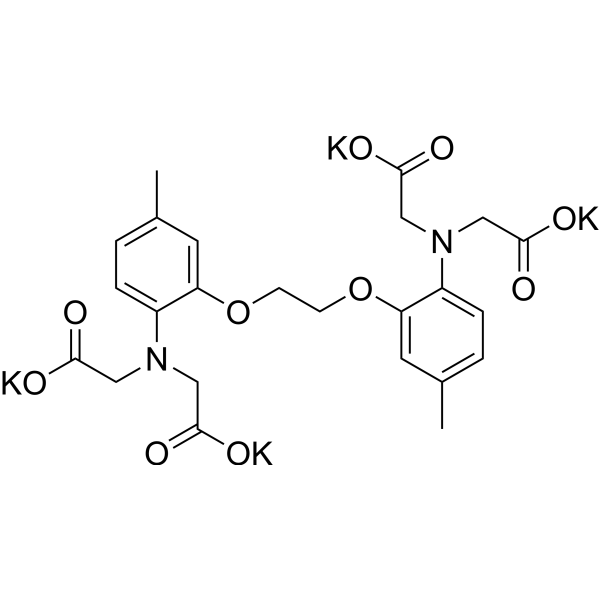 0 ImagesCat. No.: HY-D1641CAS No.: 73630-09-85,5'-Dimethyl BAPTA tetrapotassium is a water-soluble, extracellular membrane metal chelator with relative selectivity for calcium ions.
-
FITC-C6-LEHD-FMK
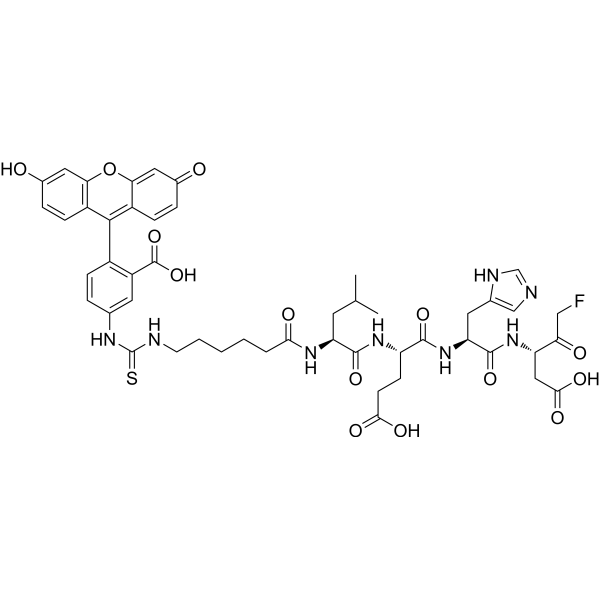 0 ImagesCat. No.: HY-D1433FITC-C6-LEHD-FMK, a fluorescently labeled caspase-9 inhibitor, can be used for detection of active caspase-9 in mammalian cells undergoing apoptosis. FITC-C6-LEHD-FMK provides a convenient means for sensitive detection of activated caspase-9 in living cells. Z-LEHD-FMK is a specific caspase-9 inhibitor.
-
Coelenteramide
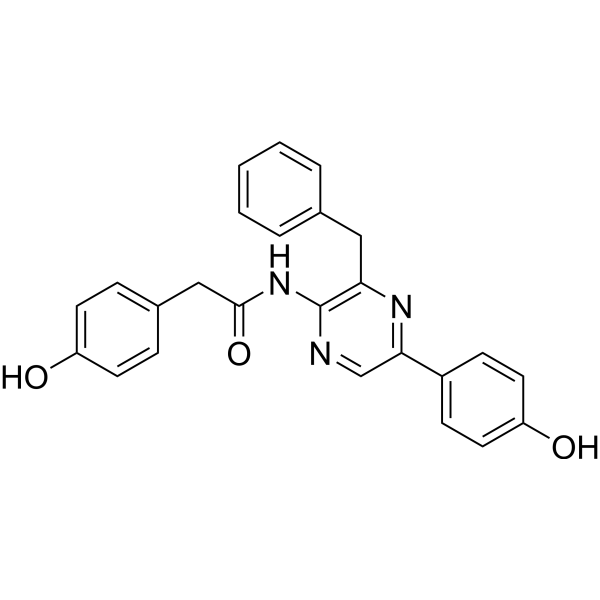 0 ImagesCat. No.: HY-145385CAS No.: 50611-86-4Coelenteramide is a oxidative product of Coelenterazine (HY-18743). Coelenteramide can form a complex with apoAequorin/Ca2+, which is known as blue fluorescent protein (BFP) and shows continuous weak luminescence with Coelenterazine like a luciferase. Coelenteramide can be used as an imaging agent.
-
Vari Fluor 660 Carboxylic acid(free acid)
 0 ImagesCat. No.: HY-D1827Synonyms: VF 660 Carboxylic acid(free acid)Vari Fluor 660 Carboxylic acid (VF 660 Carboxylic acid) free acid is a carboxylic acid derivative of Vari Fluor. Vari Fluor carboxylic acid derivatives are unactivated labeled fluorescent dyes for protein, antibody, and polysaccharide labeling that require carboxylic acid activation for use.
-
8-Methyl-2,6-diphenylethynyl-BODIPY 505/515
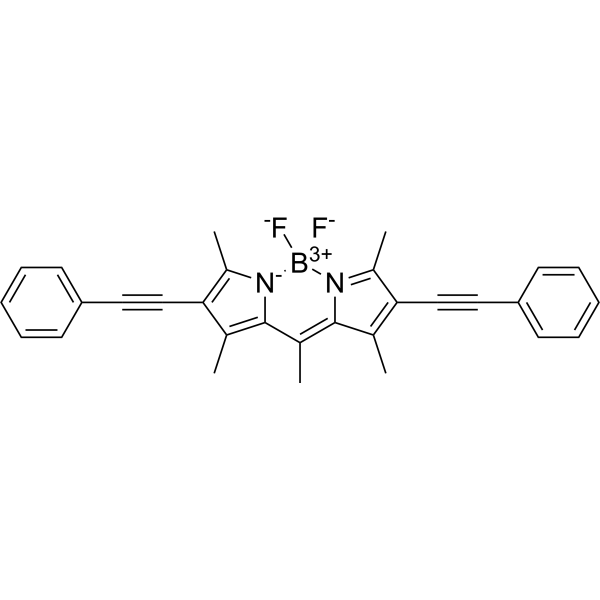 0 ImagesCat. No.: HY-D1589CAS No.: 1870842-52-68-Methyl-2,6-diphenylethynyl-BODIPY 505/515 is a fluorochrome.

-
Cy3 labled Apazunersen sodium
 0 ImagesCat. No.: HY-177615DCy3 labled Apazunersen sodium is a Cy3 labled Apazunersen sodium.

-
LHA585
 0 ImagesCat. No.: HY-D3401CAS No.: 3121511-17-6LHA585 is a fluorescent probe targeting the lipid hydrogen abstraction process for the early detection of ferroptosis (Ferroptosis). Its detection mechanism relies on the reactivity of its own 4-phenyl-3-methylbut-2-enyl moiety with biologically relevant oxidative radicals, including peroxyl radicals (ROO·), alkoxyl radicals (RO·), hydroxyl radicals (HO·), and peroxynitrite anions (ONOO−); upon hydrogen abstraction from this structure, radical rearrangement and radical cleavage occur, releasing a xanthene radical which converts into a highly fluorescent rhodamine dye in biological environments, thereby achieving a fluorescence turn-on ratio of up to 360-fold. LHA585 is non-fluorescent in its native state, possesses excellent membrane permeability due to its non-polar property, and the rhodamine dye generated after oxidation diffuses into mitochondria. The excitation wavelength of LHA585 is 561 nm, and its emission wavelength ranges from 570 to 620 nm.
-
Cyclo(-RGDfK), 5/6 FAM labeled TFA
 0 ImagesCat. No.: HY-P0023F1Cyclo(-RGDfK), 5/6 FAM labeled TFA is a Cyclo(-RGDfK) TFA (HY-P0023A) labeled with 5/6 FAM. Cyclo(-RGDfK) TFA is a potent and selective inhibitor of the αvβ3 integrin, with an IC50 of 0.94 nM. Cyclo(-RGDfK) TFA potently targets tumor microvasculature and cancer cells through the specific binding to the αvβ3 integrin on the cell surface.
-
Lycopersicon esculentum (Tomato) Lectin (FITC)
 0 ImagesCat. No.: HY-NP188Synonyms: LEL (FITC)Lycopersicon esculentum (Tomato) Lectin (FITC) is Lycopersicon esculentum (Tomato) Lectin (HY-NP071) labeled with FITC (HY-66019). Lycopersicon esculentum (Tomato) Lectin (FITC) binds to poly-N-acetyllactosamine oligosaccharides. Lycopersicon esculentum (Tomato) Lectin (FITC) is a major component of carbohydrates on the surface of endothelial and epithelial cells.

-
CyGbPF
 0 ImagesCat. No.: HY-D3181CyGbPF is a granzyme B-specific near-infrared fluorescent probe. CyGbPF can be cleaved by granzyme B to remove the peptide cage group, restoring near-infrared fluorescence. CyGbPF passively accumulates in mouse tumors, and its activated fluorescence correlates with granzyme B expression, CD8+ cytotoxic T lymphocyte populations, and CD4+ helper T lymphocyte populations in tumor tissues. CyGbPF is efficiently cleared by the kidneys, enabling the assessment of immune activation via optical urine analysis. CyGbPF allows real-time non-invasive evaluation of cancer immunotherapeutic efficacy in living animals. CyGbPF can be used in research on cancers such as breast cancer. Excitation wavelength/emission wavelength: approximately 658 nm/approximately 717 nm.




