



Taste Receptor
Taste receptors, part of the G protein-coupled receptor (GPCR) family, mediate sweet, umami, and bitter tastes. They are categorized into two families: TAS1R (T1R1, T1R2, T1R3) and TAS2R (25 human isoforms). TAS1Rs function as heterodimers: TAS1R1/TAS1R3 detects umami (L-amino acids), while TAS1R2/TAS1R3 senses sweet compounds (e.g., sucrose). TAS2Rs bind diverse bitter ligands, initiating signaling through Gα-mediated cAMP reduction and Gβγ-dependent phospholipase C (PLC) activation, leading to calcium release. Taste receptors have also been investigated in several cancers including gastrointestinal, pancreatic, breast, thyroid, acute myeloid leukemia, and head and neck squamous cell carcinoma[1].
All Product Categories
-
Taste Receptor Related Products (28)
Related Products (28)

- 1
- 2
-
Alitame hydrate
 0 ImagesCat. No.: HY-108968CAS No.: 99016-42-9Alitame (hydrate) is a high-intensity sweetener formed from the amino acids L-aspartic acid and D-alanine, and an amine derived from thietane.
-
Lactisole (Standard)
 0 ImagesBisdemethoxycucurmin (Standard) is the analytical standard of Bisdemethoxycucurmin. This product is intended for research and analytical applications. Bisdemethoxycucurmin (Curcumin III), a curcuminoid, has antioxidant and antiinflammatory activities.
-
Adenosine 5'-succinate
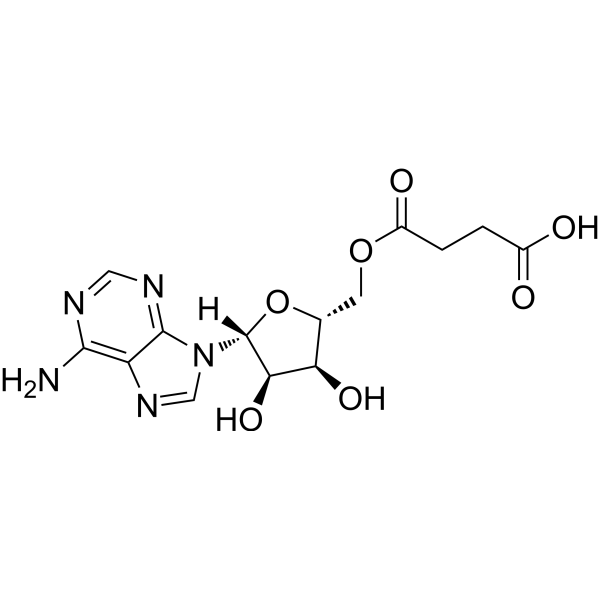 0 ImagesCat. No.: HY-136352CAS No.: 102029-71-0Adenosine 5'-succinate is a chemically AMP-related compound and potently inhibits Denatonium benzoate/taste receptor activation of transducin.
-
Dulcoside A (Standard)
 0 ImagesCat. No.: HY-N6992RCAS No.: 64432-06-0Dulcoside A (Standard) is the analytical standard of Dulcoside A. This product is intended for research and analytical applications. Dulcoside A is a glycoside that can be isolated from Stevia rebaudiana that elicits sweet and bitter taste through activation of TAS1R. Dulcoside A also exhibits anti-inflammatory activity.
-
S7958
 0 ImagesCat. No.: HY-139898CAS No.: 1217341-48-4S7958 is a selective and orally active antagonist of the TAS2R8 bitter taste receptor, with its IC50 being 0.06 μM. S7958 only has a weak inhibitory effect on TASR8 and TAS2R39, and has no significant impact on other receptors. S7958 significantly inhibits the perception of bitterness caused by substances such as coffee and drug active ingredients (API) by selectively antagonizing the human bitter taste receptor TAS2R8. S7958 can be used in the medical field to improve the research on the bitterness of oral preparations.
-
Neotame (GMP Like)
 0 ImagesCat. No.: HY-W011053GLCAS No.: 165450-17-9Neotame (GMP Like) is the GMP Like class Neotame (HY-W011053) that can be used as pharmaceutical excipients. Neotame is a derivative of Aspartame (HY-B0361) and is a flavor enhancer and low-caloric, non-nutritive, high-intensity artificial sweetener that is 7000-13,000 times sweeter than sugar. Neotame causes intestinal epithelial cell death at high concentrations. Neotame induces Apoptosis of Caco-2 cells.
-
Advantame (Standard)
 0 ImagesAdvantame (Standard) is the analytical standard of Advantame. This product is intended for research and analytical applications. Advantame is an N-substituted derivative of aspartame. Advantame is a high-intensity, low calorie sweetener. Advantame can interact with plasma protein. Advantame has the potential to produce hypotension and inhibit hERG K+ channel to produce carditoxicity. Advantame binds to T1R2/T1R3 taste GPCR to form an oligomeric functional selectivity of biased heteromers with NMBR to induce a significant sialidase activity in vitro. Advantame has maternal toxicity (gastrointestinal disturbances) in the prenatal developmental toxicity study in rabbits.
-
Nα,Nα-Bis(carboxymethyl)-L-lysine (Standard)
 0 ImagesCat. No.: HY-100047RCAS No.: 113231-05-3Nα,Nα-Bis(carboxymethyl)-L-lysine (Standard) is the analytical standard of Nα,Nα-Bis(carboxymethyl)-L-lysine (HY-100047). This product is intended for research and analytical applications. Nα,Nα-Bis(carboxymethyl)-L-lysine is a competitive inhibitor of bitter taste receptor 4, with an IC50 of 59 nM. Nα,Nα-Bis(carboxymethyl)-L-lysine can be used in bitter receptors related study.
- 1
- 2



