



Adiponectin/Acrp30 Protein, Human (HEK293, His)
Based on 1 publication(s) in Google Scholar
Adiponectin/Acrp30 Protein, Human (HEK293, His) could increase cell sensitivity to insulin and can be used as a potential protein for studying diabetic tendinopathy.
- Species: Human
- Source: HEK293
-
Storage:Stored at -20°C for 2 years from date of receipt. After reconstitution, it is stable at 4°C for 1 week or -20°C for longer (with carrier protein). It is recommended to freeze aliquots at -20°C or -80°C for extended storage.


To place orders, for customer services and technical support, please contact: MedChemExpress USA
Tel: 609-228-6898 E-mail: [email protected] [email protected]


-
 Biological Activity
-
Technical Parameters
-
Product Properties
- Documentation
- References
- Help & FAQs




Biological Activity
Description
Adiponectin/Acrp30 Protein, Human (HEK293, His) could increase cell sensitivity to insulin and can be used as a potential protein for studying diabetic tendinopathy[1].
Background
Recombinant Human Adiponectin can be used in the injured artery and attenuates vascular inflammatory response. It is reported that physiological concentrations of Recombinant Human Adiponectin suppress tumor necrosis factor-α(TNF-α)-induced endothelial adhesion molecule expression, transformation from macrophage to foam cell, and TNF-α expression in macrophages[1]. Recombinant Human Adiponectin can be used as a potential protein for treating diabetic tendinopathy promotes tenocyte progenitor cells proliferation and tenogenic differentiation in vitro[2].
Verified Bioactivity
Measured by its ability to inhibit glucose production by rat hepatocytes. The ED50 for this effect is 5.936 µg/mL, corresponding to a specific activity is 168.46 units/mg.
MCE Validation Data
-
Purity - SDS-PAGE
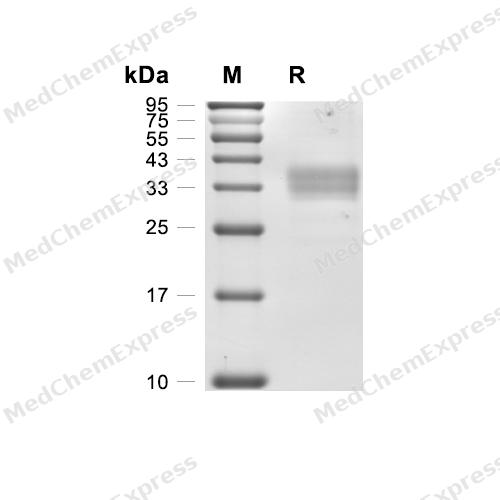
Purity - SDS-PAGE
-
Bioactivity - Cell-Based Assay
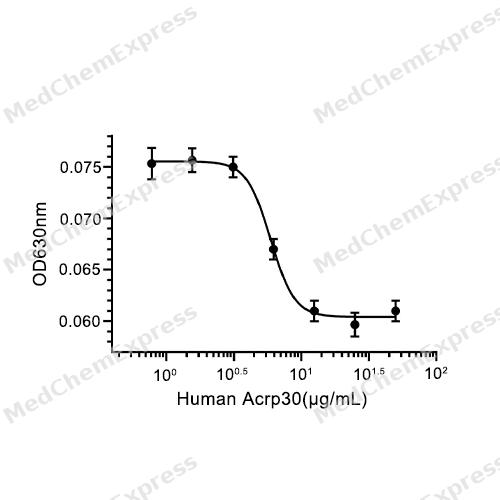
Bioactivity - Cell-Based Assay


Publications (1)
-
Journal Impact Factor
-
Most Recent
-
Diabetol Metab Syndr
Adiponectin reduces apoptosis of diabetic cardiomyocytes by regulating miR-711/TLR4 axis. [Abstract]2022 Sep 16;14(1):131. PMID: 36114541


Technical Parameters
-
Species Human
-
Source HEK293
-
Tag C-His
-
Accession
Q15848 (E19-N244)
-
Molecular Construction
-
N-term
-
Acrp30 (E19-N244)
Accession # Q15848 -
His
-
C-term
-
-
Protein Length
Full Length of Mature Protein
-
Synonyms
ADIPOQ; Adipocyte, C1Q And Collagen Domain Containing; Prev. ACDC; Adipose Specific Collagen-Like Factor; Adiponectin; Gelatin-Binding Protein 28; ACRP30; Gelatin-Binding Protein; GBP28; Adiponectin Precursor; ApM1; ADIPQTL1; Adipose Most Abundant Gene Tr
-
AA Sequence
ETTTQGPGVLLPLPKGACTGWMAGIPGHPGHNGAPGRDGRDGTPGEKGEKGDPGLIGPKGDIGETGVPGAEGPRGFPGIQGRKGEPGEGAYVYRSAFSVGLETYVTIPNMPIRFTKIFYNQQNHYDGSTGKFHCNIPGLYYFAYHITVYMKDVKVSLFKKDKAMLFTYDQYQENNVDQASGSVLLHLEVGDQVWLQVYGEGERNGLYADNDNDSTFTGFLLYHDTN
-
Molecular Weight
Approximately 30-34 kDa, based on SDS-PAGE under reducing conditions, due to the glycosylation.
-
Glycosylation
Yes
-
Purity
≥ 95%, as determined by reducing SDS-PAGE.


Product Properties
Lyophilized powder
1.Lyophilized from a 0.22 μm filtered solution of PBS, pH 7.4.
2.Lyophilized from a 0.22 μm filtered solution of 20 mM Tris-HCl, 150 mM NaCL, 10% glycerol, pH 8.0.
Please refer to the lot-specific COA for specific buffer information.
Note: For SPR assay, please replace the buffer. Primary amine components (e.g., Tris, imidazole) can affect protein-coupled chips.
<1 EU/μg, determined by LAL method.
It is not recommended to reconstitute to a concentration less than 100 μg/mL in ddH2O. For long term storage it is recommended to add a carrier protein (0.1% BSA, 5% HSA, 10% FBS or 5% Trehalose).
Stored at -20°C for 2 years from date of receipt. After reconstitution, it is stable at 4°C for 1 week or -20°C for longer (with carrier protein). It is recommended to freeze aliquots at -20°C or -80°C for extended storage.
Room temperature in continental US; may vary elsewhere.


Documentation
-
Data Sheet (263 KB)
-
SDS (252 KB)
- English - EN (252 KB)
- Français - FR (252 KB)
- Deutsch - DE (252 KB)
- Norwegian - NO (252 KB)
- Español - ES (252 KB)
- Swedish - SV (252 KB)
- Italian - IT (252 KB)
- Korean - KR (252 KB)
- Portuguese - PT (252 KB)
-
Handling Instructions (2659 KB)


References
[1]. Kumada M, et al. Adiponectin specifically increased tissue inhibitor of metalloproteinase-1 through interleukin-10 expression in human macrophages. Circulation. 2004 May 4;109(17):2046-9. [Content Brief]
[2]. Rothan HA, et al. Recombinant human adiponectin as a potential protein for treating diabetic tendinopathy promotes tenocyte progenitor cells proliferation and tenogenic differentiation in vitro. Int J Med Sci. 2013 Nov 27;10(13):1899-906. [Content Brief]

Calculators
Concentration (start) × Volume (start) = Concentration (final) × Volume (final)


 Powered by Bioz

