



GLA/alpha-Galactosidase A Protein, Human (HEK293, His)
Based on 1 Customer Validation
GLA/alpha-Galactosidase A Protein, Human (HEK293, His), a recombinant human alpha-Galactosidase A produced in HEK293 cells, has a His tag at the C-terminus. alpha-Galactosidase A is the lysosomal exoglycosidase responsible for the hydrolysis of terminal α-galactosyl residues from glycoconjugates and is the defective enzyme causing Fabry disease.
- Species: Human
- Source: HEK293
-
Storage:Stored at -80°C for 1 year from date of receipt. It is stable at -20°C for 3 months after opening. It is recommended to freeze aliquots at -80°C for extended storage. Avoid repeated freeze-thaw cycles.


To place orders, for customer services and technical support, please contact: MedChemExpress USA
Tel: 609-228-6898 E-mail: [email protected] [email protected]


-
 Biological Activity
-
Technical Parameters
-
Product Properties
- Documentation
- References
- Help & FAQs




Biological Activity
Description
GLA/alpha-Galactosidase A Protein, Human (HEK293, His), a recombinant human alpha-Galactosidase A produced in HEK293 cells, has a His tag at the C-terminus. alpha-Galactosidase A is the lysosomal exoglycosidase responsible for the hydrolysis of terminal α-galactosyl residues from glycoconjugates and is the defective enzyme causing Fabry disease[1].
Background
alpha-Galactosidase A (α-GAL, also known as α-GAL A) is responsible for the breakdown of α-galactosides in the lysosome. Defects in human alpha-Galactosidase A lead to the development of Fabry disease, a lysosomal storage disorder characterized by the buildup of α-galactosylated substrates in the tissues. alpha-Galactosidase A is an active target of clinical research: there are currently two treatment options for Fabry disease, recombinant enzyme replacement therapy and pharmacological chaperone therapy[2].
Verified Bioactivity
1.Measured by its ability to hydrolyze 4-methylumbelliferyl-alpha -D-galactopyranoside. The specific activity is 8893.70 pmol/min/μg, as measured under the described conditions.
2.Measured by its ability to hydrolyze PNPG. The specific activity is 4275 pmol/min/ug.
MCE Validation Data
-
Purity - SDS-PAGE
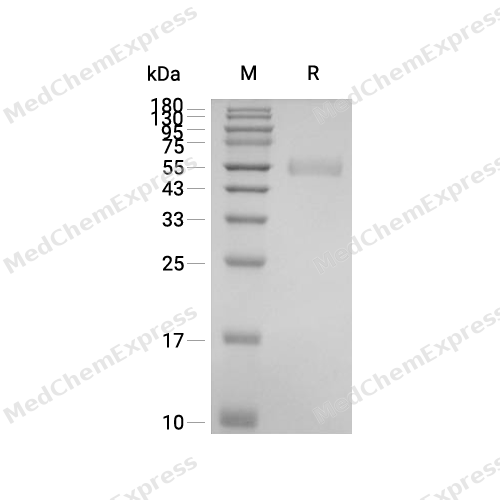
Purity - SDS-PAGE

Assay Procedure
Materials
Assay buffer: 50 mM Sodium Citrate, 50 mM NaCl, pH 4.0
Alpha-Galactosidase A Protein, Human (HEK293, His) (HY-P7492)
Substrate: 4-Methylumbelliferyl-α-D-galactopyranoside
Standard: 4-Methylumbelliferone
Procedure
1. Dilute 4-Methylumbelliferone (standard) in assay buffer to concentrations of 0, 312.5, 625, 1250, 2500, 5000 pmol.
2. Add 100 μL of each concentration to the wells.
3. Read the fluorescence in kinetic mode for 5 minutes with excitation and emission wavelengths of 365 nm and 445 nm (top read) .
4. Plot the concentration of the standard on the x-axis and the measured RFU on the y-axis to create the standard curve and obtain the standard curve equation.
5. Dilute recombinant Human GLA protein to 0.8 μg/mL in assay buffer.
6. Dilute 4-Methylumbelliferyl-α-D-galactopyranoside to 6.7 mM in assay buffer.
7. Add 50 μL of 0.8 μg/mL Human GLA to the wells and initiate the reaction by adding 50 μL of 6.7 mM substrate. Include a substrate blank with 50 μL of assay buffer and 50 μL of substrate.
8. Read the fluorescence in kinetic mode for 5 minutes with excitation and emission wavelengths of 365 nm and 445 nm.
9. Calculate specific activity:
Specific Activity (pmol/min/μg) = | Adjusted Vmax* (RFU/min) x Conversion Factor ** (pmol/RFU) |
| amount of enzyme (μg) |
*Adjusted for Substrate Blank
**Derived using calibration standard
Per Well:
Human GLA: 0.04 μg
Substrate: 3.35 mM


Technical Parameters
-
Species Human
-
Source HEK293
-
Tag C-6*His
-
Accession
P06280 (L32-L429)
-
Molecular Construction
-
N-term
-
GLA (L32-L429)
Accession # P06280 -
6*His
-
C-term
-
-
Protein Length
Full Length of Mature Protein
-
Synonyms
GLA; Alpha-D-Galactoside Galactohydrolase 1; Galactosidase Alpha; Alpha-D-Galactoside Galactohydrolase; GALA; Galactosidase, Alpha; Galactosylgalactosylglucosylceramidase GLA; Alpha-Galactosidase; Alpha-D-Galactosidase A; Agalsidase Alfa; Alpha-Galactosid
-
AA Sequence
LDNGLARTPTMGWLHWERFMCNLDCQEEPDSCISEKLFMEMAELMVSEGWKDAGYEYLCIDDCWMAPQRDSEGRLQADPQRFPHGIRQLANYVHSKGLKLGIYADVGNKTCAGFPGSFGYYDIDAQTFADWGVDLLKFDGCYCDSLENLADGYKHMSLALNRTGRSIVYSCEWPLYMWPFQKPNYTEIRQYCNHWRNFADIDDSWKSIKSILDWTSFNQERIVDVAGPGGWNDPDMLVIGNFGLSWNQQVTQMALWAIMAAPLFMSNDLRHISPQAKALLQDKDVIAINQDPLGKQGYQLRQGDNFEVWERPLSGLAWAVAMINRQEIGGPRSYTIAVASLGKGVACNPACFITQLLPVKRKLGFYEWTSRLRSHINPTGTVLLQLENTMQMSLKDLL
-
Predicted Molecular Mass
46.4 kDa
-
Molecular Weight
Approximately 50-60 kDa, based on SDS-PAGE under reducing conditions.
-
Glycosylation
Yes
-
Purity
≥ 95%, as determined by reducing SDS-PAGE.


Product Properties
Solution
Supplied as a 0.22 μm filtered solution of 20 mM Tris-HCl, 150 mM NaCl, pH 8.0.
Note: For SPR assay, please replace the buffer. Primary amine components (e.g., Tris, imidazole) can affect protein-coupled chips.
<1 EU/μg, determined by LAL method.
Stored at -80°C for 1 year from date of receipt. It is stable at -20°C for 3 months after opening. It is recommended to freeze aliquots at -80°C for extended storage. Avoid repeated freeze-thaw cycles.
Shipping with dry ice.


Documentation
-
Data Sheet (264 KB)
-
SDS (252 KB)
- English - EN (252 KB)
- Français - FR (252 KB)
- Deutsch - DE (252 KB)
- Norwegian - NO (252 KB)
- Español - ES (252 KB)
- Swedish - SV (252 KB)
- Italian - IT (252 KB)
- Korean - KR (252 KB)
- Portuguese - PT (252 KB)
-
Handling Instructions (2659 KB)


References

Calculators
Concentration (start) × Volume (start) = Concentration (final) × Volume (final)


 Powered by Bioz

