



Aminoacylase-1 Protein, Mouse (HEK293, His)
Based on 1 Customer Validation
The Aminoacylase-1 protein plays an important role in cellular processes as it catalyzes the hydrolysis of N-acetylated amino acids, promoting the conversion of these compounds into acetate and free amino acids. This enzymatic activity highlights the importance of Aminoacylase-1 in the metabolic pathways responsible for the breakdown of N-acetylated amino acids, helping to release essential amino acids and acetate as by-products. Aminoacylase-1 Protein, Mouse (HEK293, His) is the recombinant mouse-derived Aminoacylase-1 protein, expressed by HEK293 , with C-His labeled tag.
- Species: Mouse
- Source: HEK293
-
Storage:Stored at -20°C for 2 years from date of receipt. After reconstitution, it is stable at 4°C for 1 week or -20°C for longer (with carrier protein). It is recommended to freeze aliquots at -20°C or -80°C for extended storage.


To place orders, for customer services and technical support, please contact: MedChemExpress USA
Tel: 609-228-6898 E-mail: [email protected] [email protected]


-
 Biological Activity
-
Technical Parameters
-
Product Properties
- Documentation
- Help & FAQs




Biological Activity
Description
The Aminoacylase-1 protein plays an important role in cellular processes as it catalyzes the hydrolysis of N-acetylated amino acids, promoting the conversion of these compounds into acetate and free amino acids. This enzymatic activity highlights the importance of Aminoacylase-1 in the metabolic pathways responsible for the breakdown of N-acetylated amino acids, helping to release essential amino acids and acetate as by-products. Aminoacylase-1 Protein, Mouse (HEK293, His) is the recombinant mouse-derived Aminoacylase-1 protein, expressed by HEK293 , with C-His labeled tag.
Background
Aminoacylase-1 is an enzyme that catalyzes the hydrolysis of N-acetylated amino acids, leading to the production of acetate and free amino acids. This enzymatic activity is part of the process of amino acid metabolism, where N-acetylated amino acids are cleaved to release the corresponding amino acids and acetate. Aminoacylase-1's role in this hydrolytic reaction contributes to the regulation of amino acid levels and is essential for maintaining cellular homeostasis. This enzyme plays a key part in the intricate network of metabolic pathways governing amino acid utilization and is involved in processes such as protein synthesis and energy production.
Verified Bioactivity
Measured by its ability to cleave N-acetyl-L-Methione (Ac-Met). The specific activity is 19928.580 pmol/min/µg.
MCE Validation Data
-
Purity - SDS-PAGE
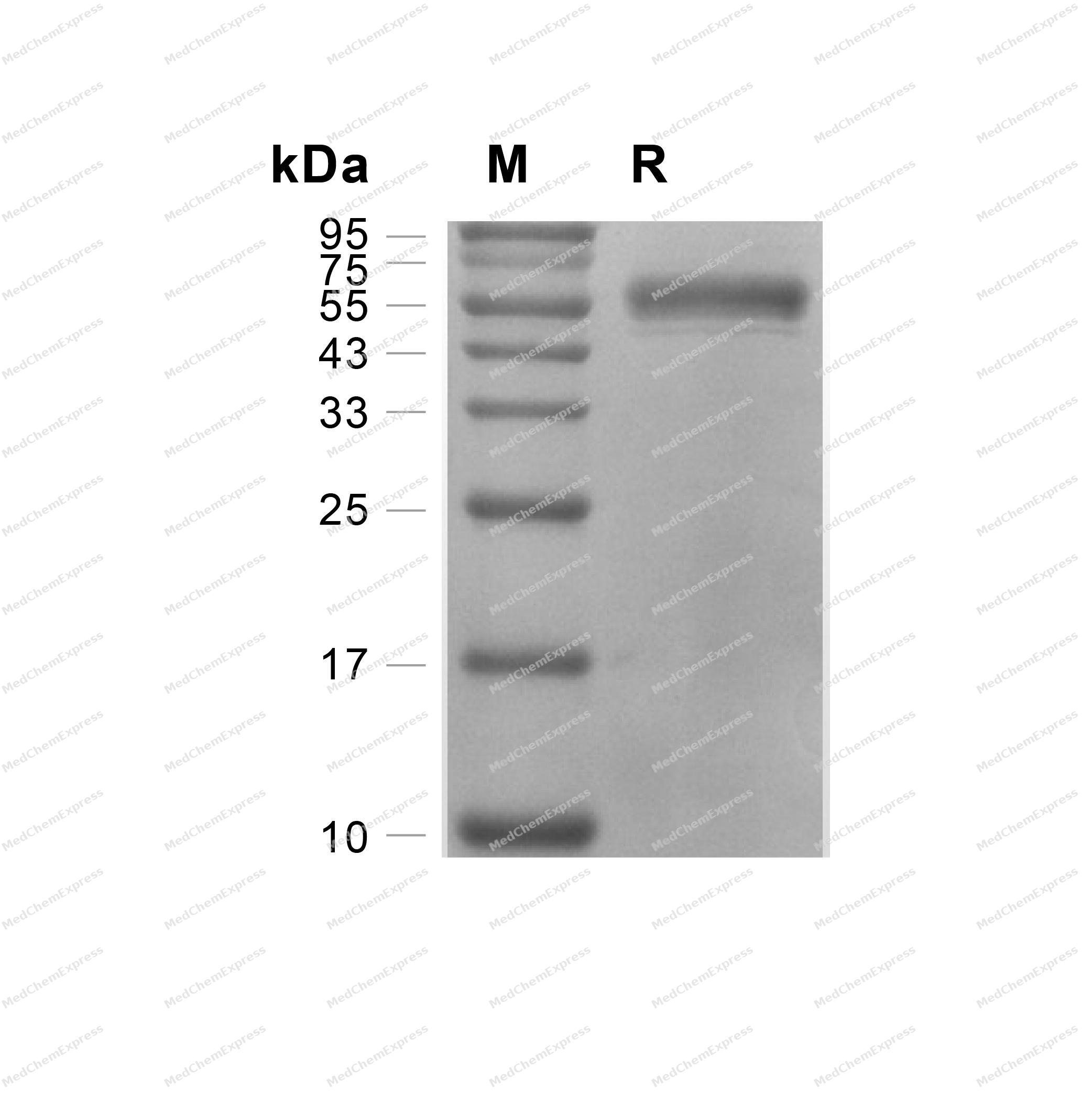
Purity - SDS-PAGE

Assay Procedure
Materials
Assay buffer: 0.1 M Potassium phosphate, pH 7.0
Aminoacylase-1 Protein, Mouse (HEK293, His) (HY-P75514)
Substrate: N-Acetyl-L-Methionine
Procedure
1. Dilute the standard in assay buffer to concentrations of 500, 250, 100, 10, 5, 1, 0.1, 0 mM. Add 100 μL of each concentration to the wells of a 96-well UV plate. Read the absorbance in endpoint mode at OD238. Plot the concentration of the standard on the x-axis and the measured RFU on the y-axis to create the standard curve.
2. Dilute the substrate to 40 mM in assay buffer.
3. Add 90 μL of 40 mM substrate to the wells of the UV plate.
4. Incubate at 25 °C for 10 minutes.
5. Dilute Mouse ACY1 protein to 200 μg/mL in assay buffer.
6. Experimental group: Mix 10 μL of 200 μg/mL Mouse ACY1 protein with 90 μL of substrate.
Control group: Mix 10 μL of assay buffer with 90 μL of substrate.
7. Read the absorbance in endpoint mode at 238 nm.
8. Calculate enzyme activity:
Specific Activity (pmol/min/μg) = | Adjusted Abs* (OD) x Conversion Factor ** (pmol/OD) |
| Incubation time (min) x amount of enzyme (μg) |
*Adjusted for Substrate Blank
**Derived using calibration standard
Per Well:
Mouse ACY1: 2 μg
Substrate: 36 mM


Technical Parameters
-
Species Mouse
-
Source HEK293
-
Tag C-His
-
Accession
Q99JW2 (M1-S408)
-
Molecular Construction
-
N-term
-
Aminoacylase-1 (M1-S408)
Accession # Q99JW2 -
His
-
C-term
-
-
Protein Length
Full Length
-
Synonyms
ACY1; Epididymis Secretory Protein Li 5; Aminoacylase 1; Aminoacylase 1 Isoform 2; N-Acyl-L-Amino-Acid Amidohydrolase; HEL-S-5; Aminoacylase-1; Acylase; ACY-1; ACY1D; N-Acyl-Aliphatic-L-Amino Acid Amidohydrolase
-
AA Sequence
MTTKDPESEHPSVTLFRQYLRICTVQPNPDYGGAITFLEERARQLGLSCQKIEVVPGFVITVLTWPGTNPSLPSILLNSHTDVVPVFKEHWHHDPFEAFKDSEGYIYARGSQDMKSVSIQYLEAVRRLKSEGHRFPRTIHMTFVPDEEVGGHKGMELFVKRPEFQALRAGFALDEGLANPTDAFTVFYSERSPWWVRVTSTGKPGHASRFIEDTAAEKLHKVISSILAFREKERQRLQANPHLKEGAVTSVNLTKLEGGVAYNVVPATMSASFDFRVAPDVDMKAFEKQLQRWCQEAGEGVTFEFAQKFTEPRMTPTDDSDPWWAAFSGACKAMNLTLEPEIFPAATDSRYIRAVGIPALGFSPMNRTPVLLHDHNERLHEDIFLRGVDIYTGLLSALASVPTLPGES
-
Molecular Weight
Approximately 55 kDa
-
Purity
≥ 95%, as determined by reducing SDS-PAGE.


Product Properties
Lyophilized powder.
Lyophilized from a 0.22 μm filtered solution of PBS, pH 7.4.
<1 EU/μg, determined by LAL method.
It is not recommended to reconstitute to a concentration less than 100 μg/mL in ddH2O. For long term storage it is recommended to add a carrier protein (0.1% BSA, 5% HSA, 10% FBS or 5% Trehalose).
Stored at -20°C for 2 years from date of receipt. After reconstitution, it is stable at 4°C for 1 week or -20°C for longer (with carrier protein). It is recommended to freeze aliquots at -20°C or -80°C for extended storage.
Room temperature in continental US; may vary elsewhere.


Documentation
-
Data Sheet (238 KB)
-
SDS (252 KB)
- English - EN (252 KB)
- Français - FR (252 KB)
- Deutsch - DE (252 KB)
- Norwegian - NO (252 KB)
- Español - ES (252 KB)
- Swedish - SV (252 KB)
- Italian - IT (252 KB)
- Korean - KR (252 KB)
- Portuguese - PT (252 KB)
-
Handling Instructions (2659 KB)

Calculators
Concentration (start) × Volume (start) = Concentration (final) × Volume (final)


 Powered by Bioz

