



Animal-Free HDGF Protein, Human (His)

Based on 1 Customer Validation
The HDGF protein acts as a transcriptional repressor and was previously thought to have mitogenic activity for fibroblasts and be a heparin-binding protein. However, recent studies have shown that it does not exhibit mitogenic activity for fibroblasts and does not bind heparin. Animal-Free HDGF Protein, Human (His) is the recombinant human-derived animal-FreeHDGF protein, expressed by E. coli , with C-His labeled tag.This product is for cell culture use only.
- Species: Human
- Source: E. coli
-
Storage:Stored at -20°C for 2 years from date of receipt. After reconstitution, it is stable at 4°C for 1 week or -20°C for longer (with carrier protein). It is recommended to freeze aliquots at -20°C or -80°C for extended storage.


To place orders, for customer services and technical support, please contact: MedChemExpress USA
Tel: 609-228-6898 E-mail: [email protected] [email protected]


-
 Biological Activity
-
Technical Parameters
-
Product Properties
- Documentation
- Help & FAQs




Biological Activity
Description
The HDGF protein acts as a transcriptional repressor and was previously thought to have mitogenic activity for fibroblasts and be a heparin-binding protein. However, recent studies have shown that it does not exhibit mitogenic activity for fibroblasts and does not bind heparin. Animal-Free HDGF Protein, Human (His) is the recombinant human-derived animal-FreeHDGF protein, expressed by E. coli , with C-His labeled tag.This product is for cell culture use only.
Background
Hepatoma-derived growth factor (HDGF) exhibits a dual role as both a transcriptional repressor and a mitogenic factor for fibroblasts. While it acts as a repressor in transcriptional regulation, influencing cellular processes, it also demonstrates mitogenic activity, particularly for fibroblasts. HDGF has been identified as a heparin-binding protein, which suggests its involvement in interactions with heparin and potentially modulating cellular responses. However, it's noteworthy that conflicting reports exist, with some studies indicating that HDGF lacks mitogenic activity for fibroblasts and does not bind to heparin. These findings highlight the complexity of HDGF's functional repertoire, showcasing its diverse roles in transcriptional control, mitogenic signaling, and potential interactions with heparin.
MCE Validation Data
-
Purity - SDS-PAGE
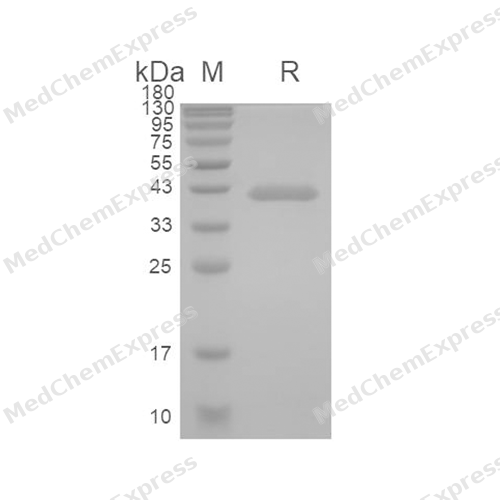
Purity - SDS-PAGE


Technical Parameters
-
Species Human
-
Source E. coli
-
Tag C-6*His
-
Accession
P51858-1 (M1-L240)
-
Molecular Construction
-
N-term
-
HDGF (M1-L240)
Accession # P51858-1 -
6*His
-
C-term
-
-
Protein Length
Full Length of Isoform-1
-
Synonyms
HDGF; Hepatoma-Derived Growth Factor; Heparin Binding Growth Factor; Hepatoma-Derived Growth Factor (High-Mobility Group Protein 1-Like); HMG1L2; High-Mobility Group Protein 1-Like; Epididymis Secretory Sperm Binding Protein; Hepatoma-Derived Growth Facto
-
AA Sequence
MSRSNRQKEYKCGDLVFAKMKGYPHWPARIDEMPEAAVKSTANKYQVFFFGTHETAFLGPKDLFPYEESKEKFGKPNKRKGFSEGLWEIENNPTVKASGYQSSQKKSCVEEPEPEPEAAEGDGDKKGNAEGSSDEEGKLVIDEPAKEKNEKGALKRRAGDLLEDSPKRPKEAENPEGEEKEAATLEVERPLPMEVEKNSTPSEPGSGRGPPQEEEEEEDEEEEATKEDAEAPGIRDHESL
-
Predicted Molecular Mass
27.6 kDa
-
Molecular Weight
Approximately 45 kDa, based on SDS-PAGE under reducing conditions.
-
Purity
≥ 95%, as determined by reducing SDS-PAGE.


Product Properties
Lyophilized powder.
Lyophilized from a 0.22 μm filtered solution of PBS, pH 7.4, trehalose.
<0.1 EU/μg, determined by LAL method.
It is recommended to reconstitute to a concentration of 100-200 μg/mL in ddH2O. For long term storage it is recommended to add a carrier protein (0.1% BSA, 5% HSA, 10% FBS or 5% Trehalose).
Stored at -20°C for 2 years from date of receipt. After reconstitution, it is stable at 4°C for 1 week or -20°C for longer (with carrier protein). It is recommended to freeze aliquots at -20°C or -80°C for extended storage.
Room temperature in continental US; may vary elsewhere.


Documentation
-
Data Sheet (236 KB)
-
SDS (254 KB)
- English - EN (254 KB)
- Français - FR (254 KB)
- Deutsch - DE (254 KB)
- Norwegian - NO (254 KB)
- Español - ES (254 KB)
- Swedish - SV (254 KB)
- Italian - IT (254 KB)
- Korean - KR (254 KB)
- Portuguese - PT (254 KB)
-
Handling Instructions (2659 KB)

Calculators
Concentration (start) × Volume (start) = Concentration (final) × Volume (final)


 Powered by Bioz

