



Amyloid Precursor/Beta-APP42 Protein, Human (His-GST)

Based on 1 Customer Validation
Amyloid Precursor/Beta-APP42 Protein, Human (His-GST) is the recombinant human-derived Amyloid Precursor/Beta-APP42 protein, expressed by E. coli , with N-His, N-GST labeled tag.
- Species: Human
- Source: E. coli
-
Storage:Stored at -20°C for 2 years from date of receipt. After reconstitution, it is stable at 4°C for 1 week or -20°C for longer (with carrier protein). It is recommended to freeze aliquots at -20°C or -80°C for extended storage.


To place orders, for customer services and technical support, please contact: MedChemExpress USA
Tel: 609-228-6898 E-mail: [email protected] [email protected]


-
 Biological Activity
-
Technical Parameters
-
Product Properties
- Documentation
- Help & FAQs




Biological Activity
Description
Amyloid Precursor/Beta-APP42 Protein, Human (His-GST) is the recombinant human-derived Amyloid Precursor/Beta-APP42 protein, expressed by E. coli , with N-His, N-GST labeled tag.
Background
APP (Amyloid Precursor Protein), also known as Protease Nexin-II, operates as a multifunctional cell surface receptor, exerting physiological effects on neurons that are crucial for neurite growth, neuronal adhesion, and axonogenesis. Its involvement in synaptogenesis is highlighted by the promotion of synaptic connections through interactions between APP molecules on adjacent cells. Beyond cell adhesion, APP plays a role in cell mobility and transcriptional regulation through protein-protein interactions. It can stimulate transcription activation by binding to APBB1-KAT5 and inhibit Notch signaling through interaction with Numb. Additionally, APP couples to apoptosis-inducing pathways, such as those mediated by G(o) and JIP, and inhibits G(o) alpha ATPase activity. Acting as a kinesin I membrane receptor, APP facilitates axonal transport of beta-secretase and presenilin 1, contributing to axonal anterograde cargo transport towards synapses. In the context of copper homeostasis, APP is involved in copper ion reduction and can induce neuronal death through copper-metallated interactions. Furthermore, APP regulates neurite outgrowth by binding to extracellular matrix components and possesses protease inhibitor activity through its BPTI domain-containing isoforms. The protein participates in the AGER-dependent pathway, activating p38 MAPK and inducing internalization of amyloid-beta peptide, leading to mitochondrial dysfunction. Additionally, APP provides Cu(2+) ions for GPC1, required for nitric oxide release and heparan sulfate degradation. It exhibits metal-chelating properties, reduces transient metals, and binds to lipoproteins, apolipoproteins, and HDL particles, thereby modulating metal-catalyzed oxidation. APP's intricate involvement in various cellular processes underscores its significance in both normal neuronal function and pathological conditions associated with neurodegenerative disorders.
Verified Bioactivity
1. Measured by its ability to inhibit trypsin cleavage of a fluorogenic peptide substrate, Mca-RPKPVE-Nval-WRK(Dnp)-NH2. The IC50 value is 1.48 nM, as measured with under the described conditions.
2. Loaded Gantenerumab (HY-P99022) on AHC2 biosensor, can bind Amyloid Precursor/Beta-APP42 Protein, Human (His-GST) with an affinity constant of 5.257E-11 M as determined in BLI assay.
MCE Validation Data
-
Purity - SDS-PAGE
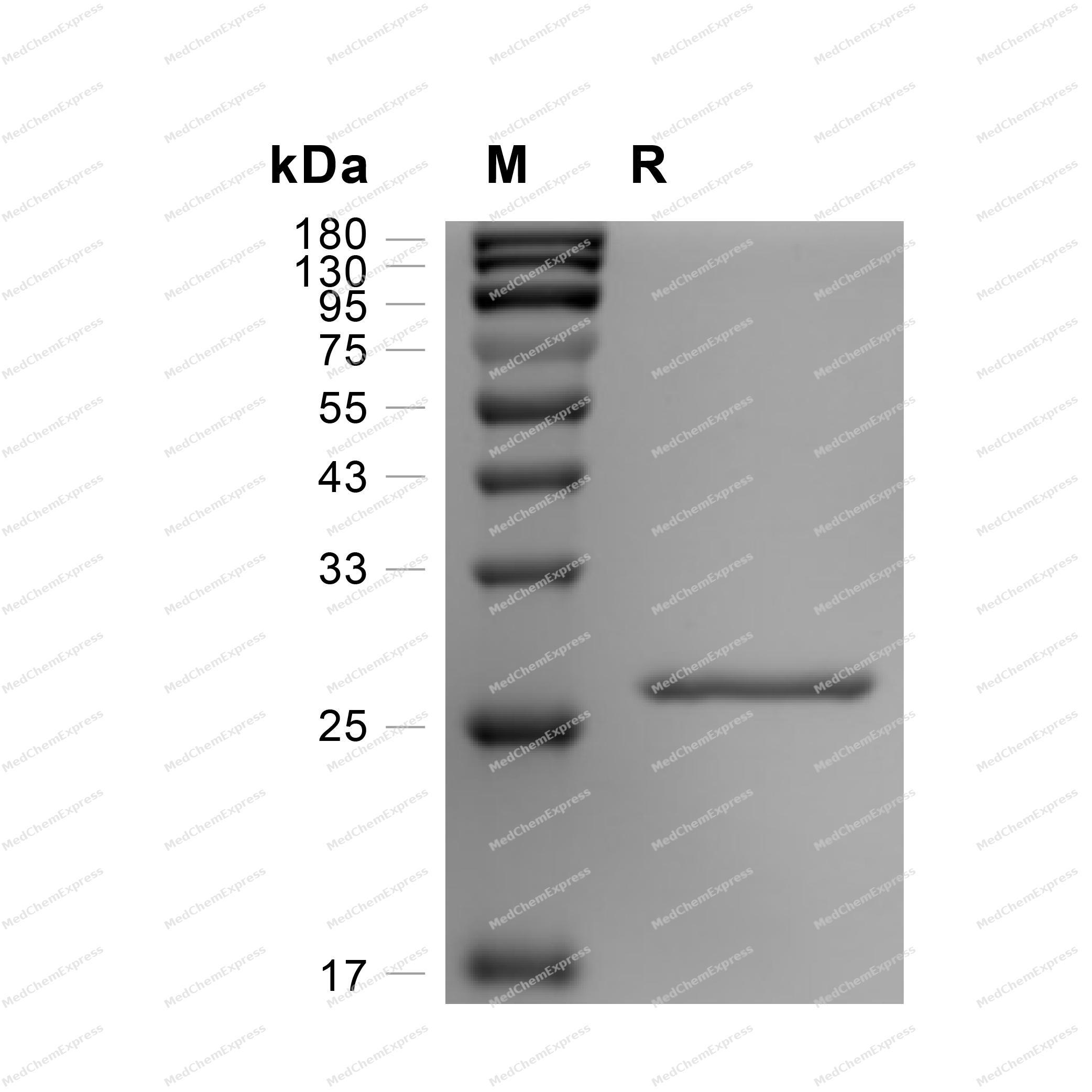
Purity - SDS-PAGE
-
Bioactivity - BLI
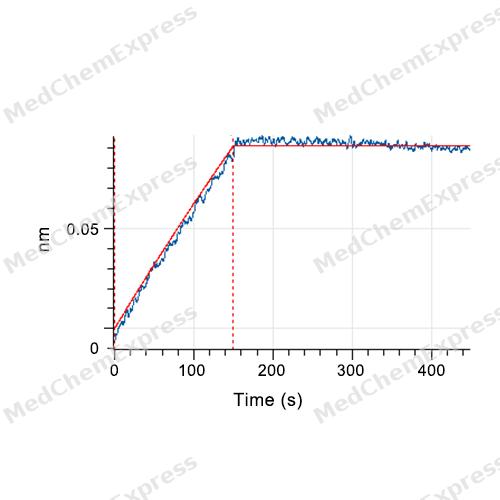
Bioactivity - BLI


Technical Parameters
-
Species Human
-
Source E. coli
-
Tag N-His;N-GST
-
Accession
P05067-1 (D672-A713)
-
Molecular Construction
-
N-term
-
His-GST
-
APP (D672-A713)
Accession # P05067-1 -
C-term
-
-
Protein Length
Full Length of APP42 Chain
-
Synonyms
APP; PreA4; Prev. AD1; CVAP; Alzheimer Disease Amyloid A4 Protein Homolog; Beta-Amyloid Precursor Protein; Amyloid-Beta Precursor Protein; Testicular Tissue Protein Li 2; Amyloid Precursor Protein; Beta-Amyloid Peptide(1-40); Alpha-SAPP; Beta-Amyloid Pept
-
AA Sequence
DAEFRHDSGYEVHHQKLVFFAEDVGSNKGAIIGLMVGGVVIA
-
Molecular Weight
Approximately 34 kDa, based on SDS-PAGE under reducing conditions.
-
Purity
≥ 95%, as determined by reducing SDS-PAGE.


Product Properties
Lyophilized powder.
Lyophilized from a 0.22 μm filtered solution of 50 mM Tris-HCl, 300 mM NaCl, 200 mM arginine, pH 7.4.
Note: For SPR assay, please replace the buffer. Primary amine components (e.g., Tris, imidazole) can affect protein-coupled chips.
<1 EU/μg, determined by LAL method.
It is not recommended to reconstitute to a concentration less than 100 μg/mL in ddH2O. For long term storage it is recommended to add a carrier protein (0.1% BSA, 5% HSA, 10% FBS or 5% Trehalose).
Stored at -20°C for 2 years from date of receipt. After reconstitution, it is stable at 4°C for 1 week or -20°C for longer (with carrier protein). It is recommended to freeze aliquots at -20°C or -80°C for extended storage.
Room temperature in continental US; may vary elsewhere.


Documentation
-
Data Sheet (237 KB)
-
SDS (252 KB)
- English - EN (252 KB)
- Français - FR (252 KB)
- Deutsch - DE (252 KB)
- Norwegian - NO (252 KB)
- Español - ES (252 KB)
- Swedish - SV (252 KB)
- Italian - IT (252 KB)
- Korean - KR (252 KB)
- Portuguese - PT (252 KB)
-
Handling Instructions (2659 KB)

Calculators
Concentration (start) × Volume (start) = Concentration (final) × Volume (final)


 Powered by Bioz

