



AQP1 Protein, Human (GST)

Based on 1 Customer Validation
The AQP1 protein forms water-specific channels that allow water to cross red blood cells and renal proximal tubule membranes. AQP1 Protein, Human (GST) is the recombinant human-derived AQP1 protein, expressed by E. coli , with N-GST labeled tag.
- Species: Human
- Source: E. coli
-
Storage:Stored at -20°C for 2 years from date of receipt. After reconstitution, it is stable at 4°C for 1 week or -20°C for longer (with carrier protein). It is recommended to freeze aliquots at -20°C or -80°C for extended storage.


To place orders, for customer services and technical support, please contact: MedChemExpress USA
Tel: 609-228-6898 E-mail: [email protected] [email protected]


-
 Biological Activity
-
Technical Parameters
-
Product Properties
- Documentation
- Help & FAQs




Biological Activity
Description
The AQP1 protein forms water-specific channels that allow water to cross red blood cells and renal proximal tubule membranes. AQP1 Protein, Human (GST) is the recombinant human-derived AQP1 protein, expressed by E. coli , with N-GST labeled tag.
Background
AQP1, a water-specific channel, plays a pivotal role in enhancing the permeability of plasma membranes in red blood cells and kidney proximal tubules, allowing water movement along osmotic gradients. It forms homotetramers and is a key component of the ankyrin-1 complex, a multiprotein assembly crucial for maintaining the stability and shape of erythrocyte membranes. In the erythrocyte, the ankyrin-1 complex consists of AQP1 along with ANK1, RHCE, RHAG, SLC4A1, EPB42, GYPA, and GYPB. AQP1's functional versatility is further highlighted by its interaction with EPHB2, contributing to endolymph production in the inner ear. Additionally, AQP1 participates in complexes involving STOM. The protein establishes interactions both via its N-terminal region with ANK1 and via its C-terminal region with EPB42, emphasizing its engagement in various cellular processes and protein assemblies.
MCE Validation Data
-
Purity - SDS-PAGE
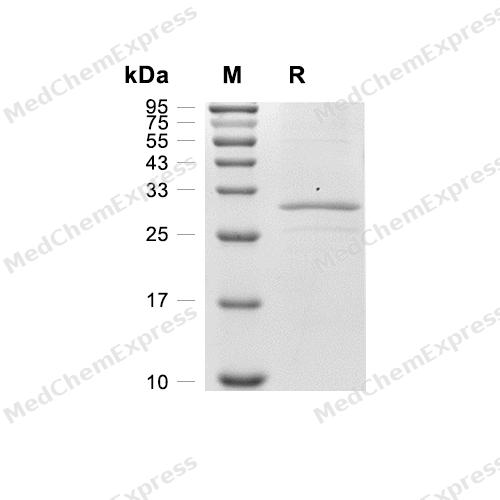
Purity - SDS-PAGE


Technical Parameters
-
Species Human
-
Source E. coli
-
Tag N-GST
-
Accession
P29972 (G220-K269)
-
Molecular Construction
-
N-term
-
GST
-
AQP1 (G220-K269)
Accession # P29972 -
C-term
-
-
Protein Length
Partial
-
Synonyms
AQP1; Aquaporin 1 (Channel-Forming Integral Protein, 28kDa); Prev. CO; Aquaporin 1, Colton Blood Group Antigen; CHIP28; Aquaporin 1 Splice Variant 2; Aquaporin-CHIP; Colton Blood Group Antigen; Aquaporin-1; Bloodgroup CO Protein; Aquaporin 1 (Channel-Form
-
AA Sequence
GALAVLIYDFILAPRSSDLTDRVKVWTSGQVEEYDLDADDINSRVEMKPK
-
Molecular Weight
Approximately 31 kDa, based on SDS-PAGE under reducing conditions.
-
Purity
≥ 90%, as determined by reducing SDS-PAGE.


Product Properties
Lyophilized powder.
1.Lyophilized from a 0.22 μm filtered solution of 50 mM Tris-HCl, 300 mM NaCl, pH 7.4.
Note: For SPR assay, please replace the buffer. Primary amine components (e.g., Tris, imidazole) can affect protein-coupled chips.
<1 EU/μg, determined by LAL method.
It is not recommended to reconstitute to a concentration less than 100 μg/mL in ddH2O.
Stored at -20°C for 2 years from date of receipt. After reconstitution, it is stable at 4°C for 1 week or -20°C for longer (with carrier protein). It is recommended to freeze aliquots at -20°C or -80°C for extended storage.
Room temperature in continental US; may vary elsewhere.


Documentation
-
Data Sheet (259 KB)
-
SDS (252 KB)
- English - EN (252 KB)
- Français - FR (252 KB)
- Deutsch - DE (252 KB)
- Norwegian - NO (252 KB)
- Español - ES (252 KB)
- Swedish - SV (252 KB)
- Italian - IT (252 KB)
- Korean - KR (252 KB)
- Portuguese - PT (252 KB)
-
Handling Instructions (2659 KB)

Calculators
Concentration (start) × Volume (start) = Concentration (final) × Volume (final)


 Powered by Bioz

