



Beta-glucuronidase/GUSB Protein, E.coli (N-His, solution)

Based on 1 Customer Validation
The beta-glucuronidase/GUSB protein displays activity with PNPG and 4-methylumbelliferyl-glucuronide. It scavenges glucuronate from various xenobiotic and endobiotic glucuronides in the GI tract, utilizing diverse carbon sources. As part of the GI microbiome, it can reactivate glucuronide drug conjugates, potentially harming the GI tract. Beta-glucuronidase/GUSB Protein, E.coli (N-His, solution) is the recombinant E. coli-derived Beta-glucuronidase/GUSB protein, expressed by E. coli , with N-6*His labeled tag.
- Species: E.coli
- Source: E. coli
-
Storage:Stored at -80°C for 1 year from date of receipt. It is stable at -20°C for 3 months after opening. It is recommended to freeze aliquots at -80°C for extended storage. Avoid repeated freeze-thaw cycles.


To place orders, for customer services and technical support, please contact: MedChemExpress USA
Tel: 609-228-6898 E-mail: [email protected] [email protected]


-
 Biological Activity
-
Technical Parameters
-
Product Properties
- Documentation
- Help & FAQs




Biological Activity
Description
The beta-glucuronidase/GUSB protein displays activity with PNPG and 4-methylumbelliferyl-glucuronide. It scavenges glucuronate from various xenobiotic and endobiotic glucuronides in the GI tract, utilizing diverse carbon sources. As part of the GI microbiome, it can reactivate glucuronide drug conjugates, potentially harming the GI tract. Beta-glucuronidase/GUSB Protein, E.coli (N-His, solution) is the recombinant E. coli-derived Beta-glucuronidase/GUSB protein, expressed by E. coli , with N-6*His labeled tag.
Background
Beta-glucuronidase/GUSB protein exhibits beta-glucuronidase activity, demonstrated with the artificial substrate p-nitrophenyl-beta-D-glucuronide (PNPG) and 4-methylumbelliferyl-glucuronide. This enzymatic capability suggests that GUSB is likely adept at scavenging glucuronate from a variety of chemically distinct xenobiotic and endobiotic glucuronides present in the gastrointestinal (GI) tract, thus utilizing diverse sources of carbon. As a constituent of the GI microbiome, GUSB plays a crucial role in the reactivation of glucuronide drug conjugates. However, the reactivated compounds can pose a significant threat to the GI tract, emphasizing the potential impact of GUSB in drug metabolism and the intricate interplay between microbial enzymes and host physiology in the gastrointestinal environment.
Verified Bioactivity
Measured by its ability to hydrolyze Phenolphthalein Glucuronide. The specific activity is ≥1029.5 pmol/min/μg.
MCE Validation Data
-
Purity - SDS-PAGE
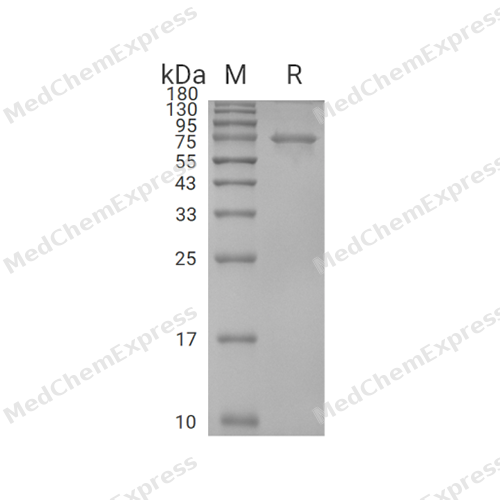
Purity - SDS-PAGE


Technical Parameters
-
Species E.coli
-
Source E. coli
-
Tag N-6*His
-
Accession
P05804 (M1-Q603)
-
Gene ID946149 [NCBI]
-
Molecular Construction
-
N-term
-
6*His
-
GUSB (M1-Q603)
Accession # P05804 -
C-term
-
-
Protein Length
Full Length
-
Synonyms
uidA; gurA; gusA; b1617; JW1609; Beta-glucuronidase; GUS; EC 3.2.1.31; Beta-D-glucuronoside glucuronosohydrolase; EcGUS; UID
-
AA Sequence
MLRPVETPTREIKKLDGLWAFSLDRENCGIDQRWWESALQESRAIAVPGSFNDQFADADIRNYAGNVWYQREVFIPKGWAGQRIVLRFDAVTHYGKVWVNNQEVMEHQGGYTPFEADVTPYVIAGKSVRITVCVNNELNWQTIPPGMVITDENGKKKQSYFHDFFNYAGIHRSVMLYTTPNTWVDDITVVTHVAQDCNHASVDWQVVANGDVSVELRDADQQVVATGQGTSGTLQVVNPHLWQPGEGYLYELCVTAKSQTECDIYPLRVGIRSVAVKGEQFLINHKPFYFTGFGRHEDADLRGKGFDNVLMVHDHALMDWIGANSYRTSHYPYAEEMLDWADEHGIVVIDETAAVGFNLSLGIGFEAGNKPKELYSEEAVNGETQQAHLQAIKELIARDKNHPSVVMWSIANEPDTRPQGAREYFAPLAEATRKLDPTRPITCVNVMFCDAHTDTISDLFDVLCLNRYYGWYVQSGDLETAEKVLEKELLAWQEKLHQPIIITEYGVDTLAGLHSMYTDMWSEEYQCAWLDMYHRVFDRVSAVVGEQVWNFADFATSQGILRVGGNKKGIFTRDRKPKSAAFLLQKRWTGMNFGEKPQQGGKQ
-
Predicted Molecular Mass
69.9 kDa
-
Molecular Weight
Approximately 75 kDa, based on SDS-PAGE under reducing conditions.
-
Purity
≥ 95%, as determined by reducing SDS-PAGE.


Product Properties
Solution
Supplied as a 0.2 μm filtered solution of PBS, pH 7.4 or 20mM Hepes-NaOH, 12% Trehalose, 4%Mannitol, 0.05% Tween80, pH 8.0.
<1 EU/μg, determined by LAL method.
Stored at -80°C for 1 year from date of receipt. It is stable at -20°C for 3 months after opening. It is recommended to freeze aliquots at -80°C for extended storage. Avoid repeated freeze-thaw cycles.
Shipping with dry ice.


Documentation
-
Data Sheet (239 KB)
-
SDS (252 KB)
- English - EN (252 KB)
- Français - FR (252 KB)
- Deutsch - DE (252 KB)
- Norwegian - NO (252 KB)
- Español - ES (252 KB)
- Swedish - SV (252 KB)
- Italian - IT (252 KB)
- Korean - KR (252 KB)
- Portuguese - PT (252 KB)
-
Handling Instructions (2659 KB)

Calculators
Concentration (start) × Volume (start) = Concentration (final) × Volume (final)


 Powered by Bioz

