



Biglycan Protein, Human (HEK293, His)

Based on 1 Customer Validation
Biglycan Protein, Human (HEK293, His) is a recombinant human Biglycan produced in HEK293 cells with a His tag. Biglycan, a small leucine-rich proteoglycan, acts as a danger signal and is classically thought to promote macrophage recruitment via Toll-like receptors (TLR) 2 and 4.
- Species: Human
- Source: HEK293
-
Storage:Stored at -20°C for 2 years from date of receipt. After reconstitution, it is stable at 4°C for 1 week or -20°C for longer (with carrier protein). It is recommended to freeze aliquots at -20°C or -80°C for extended storage.


To place orders, for customer services and technical support, please contact: MedChemExpress USA
Tel: 609-228-6898 E-mail: [email protected] [email protected]


-
 Biological Activity
-
Technical Parameters
-
Product Properties
- Documentation
- References
- Help & FAQs




Biological Activity
Description
Biglycan Protein, Human (HEK293, His) is a recombinant human Biglycan produced in HEK293 cells with a His tag. Biglycan, a small leucine-rich proteoglycan, acts as a danger signal and is classically thought to promote macrophage recruitment via Toll-like receptors (TLR) 2 and 4[1].
Background
Biglycan, a member of the family of small leucine-rich proteoglycans, is composed of glycosaminoglycan side chains covalently bound to a central core protein. It resides at the cell surface or in the pericellular space of various tissues. Biglycan has been implicated in the development and progression of human cancers[2].
Verified Bioactivity
1. Measured by its ability to inhibit the cell growth of NIH-3T3 cells. The ED50 this effect is 1.427 μg/mL, corresponding to a specific activity is 700.7708 units/mg.
2. Measured by its ability to inhibit the cell growth of 3T3-L1 cells. The ED50 for this effect is 1.0-6.0 μg/mL, corresponding to a specific activity is 169-300 units/mg.
MCE Validation Data
-
Purity - SDS-PAGE
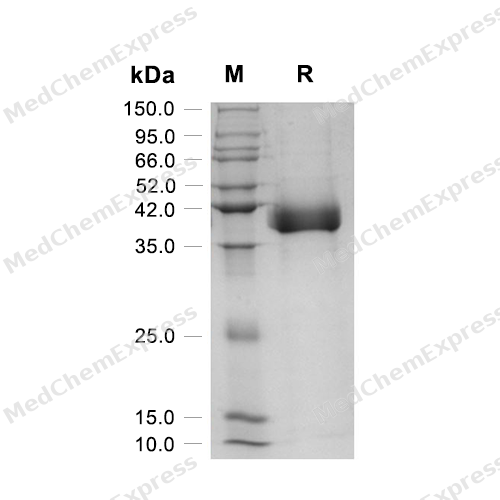
Purity - SDS-PAGE
-
Bioactivity - Cell-Based Assay
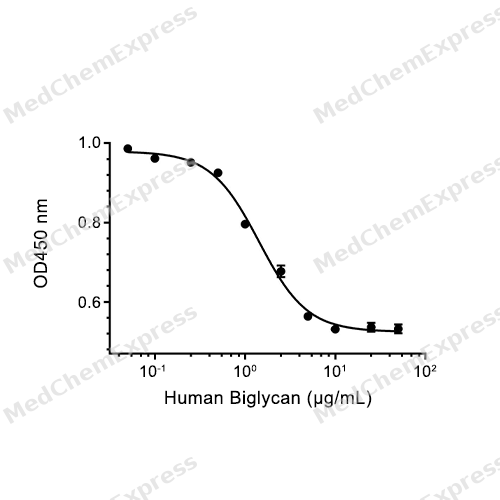
Bioactivity - Cell-Based Assay


Technical Parameters
-
Species Human
-
Source HEK293
-
Tag C-6*His
-
Accession
P21810 (E20-K368)
-
Molecular Construction
-
N-term
-
Biglycan (E20-K368)
Accession # P21810 -
6*His
-
C-term
-
-
Protein Length
Full Length of Mature Protein
-
Synonyms
BGN; Small Leucine-Rich Protein 1A; Biglycan; Bone/Cartilage Proteoglycan I; SLRR1A; Biglycan Proteoglycan; DSPG1; SEMDX; PG-S1; MRLS; Dermatan Sulphate Proteoglycan I; PGI; Bone/Cartilage Proteoglycan-I
-
AA Sequence
EQRGFWDFTLDDGPFMMNDEEASGADTSGVLDPDSVTPTYSAMCPFGCHCHLRVVQCSDLGLKSVPKEISPDTTLLDLQNNDISELRKDDFKGLQHLYALVLVNNKISKIHEKAFSPLRKLQKLYISKNHLVEIPPNLPSSLVELRIHDNRIRKVPKGVFSGLRNMNCIEMGGNPLENSGFEPGAFDGLKLNYLRISEAKLTGIPKDLPETLNELHLDHNKIQAIELEDLLRYSKLYRLGLGHNQIRMIENGSLSFLPTLRELHLDNNKLARVPSGLPDLKLLQVVYLHSNNITKVGVNDFCPMGFGVKRAYYNGISLFNNPVPYWEVQPATFRCVTDRLAIQFGNYKK
-
Molecular Weight
Approximately 40-90 kDa, based on SDS-PAGE under reducing conditions.
-
Glycosylation
Yes
-
Purity
≥ 95%, as determined by reducing SDS-PAGE.


Product Properties
Lyophilized powder
1.Lyophilized from a 0.22 μm filtered solution of 20 mM PB, 150 mM NaCl, pH 7.2.
2.Lyophilized from a 0.22 μm filtered solution of 20 mM PB, 150 mM NaCl, pH 7.4.
3.Lyophilized from a 0.22 μm filtered solution of PBS, pH 7.4.
Please refer to the lot-specific COA for specific buffer information.
<1 EU/μg, determined by LAL method.
It is not recommended to reconstitute to a concentration less than 100 μg/mL in ddH2O. For long term storage it is recommended to add a carrier protein (0.1% BSA, 5% HSA, 10% FBS or 5% Trehalose).
Stored at -20°C for 2 years from date of receipt. After reconstitution, it is stable at 4°C for 1 week or -20°C for longer (with carrier protein). It is recommended to freeze aliquots at -20°C or -80°C for extended storage.
Room temperature in continental US; may vary elsewhere.


Documentation
-
Data Sheet (263 KB)
-
SDS (252 KB)
- English - EN (252 KB)
- Français - FR (252 KB)
- Deutsch - DE (252 KB)
- Norwegian - NO (252 KB)
- Español - ES (252 KB)
- Swedish - SV (252 KB)
- Italian - IT (252 KB)
- Korean - KR (252 KB)
- Portuguese - PT (252 KB)
-
Handling Instructions (2659 KB)


References
[1]. Wang B, et al. Biglycan expression correlates with aggressiveness and poor prognosis of gastric cancer. Exp Biol Med (Maywood). 2011;236(11):1247-1253. [Content Brief]
[2]. Poluzzi C, et al. Biglycan evokes autophagy in macrophages via a novel CD44/Toll-like receptor 4 signaling axis in ischemia/reperfusion injury. Kidney Int. 2019;95(3):540-562. [Content Brief]

Calculators
Concentration (start) × Volume (start) = Concentration (final) × Volume (final)


 Powered by Bioz

