



Can f 4 Protein, Canine (HEK293, His)

Based on 1 Customer Validation
Can f 4 Protein, Canine (HEK293, His), an IgE-binding dog dander protein, is an important respiratory allergen. Can f 4 Protein is a dog allergen of the lipocalin family. Can f 4 Protein, Canine (HEK293, His) is the recombinant canine-derived Can f 4 protein, expressed by HEK293 , with C-6*His labeled tag.
- Species: Canine
- Source: HEK293
-
Storage:Stored at -20°C for 2 years from date of receipt. After reconstitution, it is stable at 4°C for 1 week or -20°C for longer (with carrier protein). It is recommended to freeze aliquots at -20°C or -80°C for extended storage.


To place orders, for customer services and technical support, please contact: MedChemExpress USA
Tel: 609-228-6898 E-mail: [email protected] [email protected]


-
 Biological Activity
-
Technical Parameters
-
Product Properties
- Documentation
- Help & FAQs




Biological Activity
Description
Can f 4 Protein, Canine (HEK293, His), an IgE-binding dog dander protein, is an important respiratory allergen. Can f 4 Protein is a dog allergen of the lipocalin family[1]. Can f 4 Protein, Canine (HEK293, His) is the recombinant canine-derived Can f 4 protein, expressed by HEK293 , with C-6*His labeled tag.
Background
Dog dander is a common cause of respiratory allergy, with symptoms including rhinitis, conjunctivitis and bronchial asthma. Extracts of dog hair and dander contain a complexity of allergenic and non-allergenic proteins. To date, the IgE reactivity of 4 dog allergens of the lipocalin protein family, Canf1, Canf2, Canf4, and Canf6, as well as the dog serum albumin Canf3 and the dog prostatic kallikrein Canf5, has been characterized in detail. The size and the amino acid composition of the ligand-binding pocket indicate that Canf4 is capable of binding only relatively small hydrophobic molecules which are different from those that Canf2 is able to bind. The crystal structure of Canf4 contained both monomeric and dimeric forms of the allergen, suggesting that Canf4 is able to form transient (weak) dimers. The dimeric structure of Canf4 is formed when the ends of four β-strands are packed against the same strands from the second monomer[1][2].
MCE Validation Data
-
Purity - SDS-PAGE
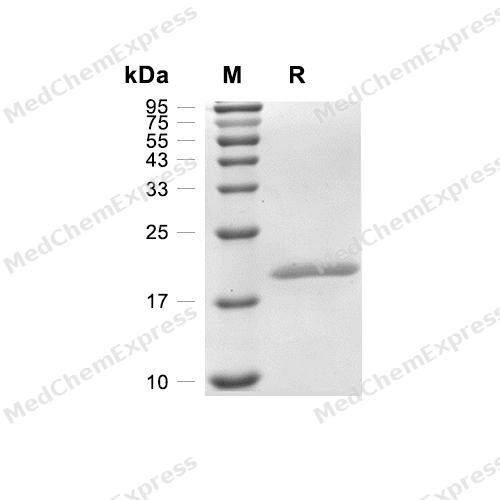
Purity - SDS-PAGE


Technical Parameters
-
Species Canine
-
Source HEK293
-
Tag C-6*His
-
Accession
NP_001177855.1 (Q17-E174)
-
Gene ID100463491 [NCBI]
-
Molecular Construction
-
N-term
-
Canf4 (Q17-E174)
Accession # NP_001177855.1 -
6*His
-
C-term
-
-
Protein Length
Full Length of Mature Protein
-
Synonyms
allergen Can f 4; Can f 4 variant allergen; odorant binding protein
-
AA Sequence
QLPLPNVLTQVSGPWKTLYISSNNLDKIGDNGPFRIYMRGINVDIPRLKMSFNFYVKVDGECVENSVGASIGRDNLIKGEYNGGNYFRIIDMTPNALIGYDVNVDSKGKITKVALLMGRGAHVNEEDIAKFKKLSREKGIPEENIIYLGDTDNCPNHE
-
Molecular Weight
Approximately 19 kDa.
-
Purity
≥ 95%, as determined by reducing SDS-PAGE.


Product Properties
Lyophilized powder.
Lyophilized from a 0.22 μm filtered solution of 50 mM Tris, 100 mM NaCl, pH 8.0.
Note: For SPR assay, please replace the buffer. Primary amine components (e.g., Tris, imidazole) can affect protein-coupled chips.
<1 EU/μg, determined by LAL method.
It is not recommended to reconstitute to a concentration less than 100 μg/mL in ddH2O. For long term storage it is recommended to add a carrier protein (0.1% BSA, 5% HSA, 10% FBS or 5% Trehalose).
Stored at -20°C for 2 years from date of receipt. After reconstitution, it is stable at 4°C for 1 week or -20°C for longer (with carrier protein). It is recommended to freeze aliquots at -20°C or -80°C for extended storage.
Room temperature in continental US; may vary elsewhere.


Documentation
-
Data Sheet (236 KB)
-
SDS (251 KB)
- English - EN (251 KB)
- Français - FR (251 KB)
- Deutsch - DE (251 KB)
- Norwegian - NO (251 KB)
- Español - ES (251 KB)
- Swedish - SV (251 KB)
- Italian - IT (251 KB)
- Korean - KR (251 KB)
- Portuguese - PT (251 KB)
-
Handling Instructions (2659 KB)

Calculators
Concentration (start) × Volume (start) = Concentration (final) × Volume (final)


 Powered by Bioz

