



Carbonic Anhydrase 13 Protein, Human (His)

Based on 1 Customer Validation
Carbonic Anhydrase 13 Protein, Human (His) expresses in E. coli with a His tag at the N-terminus. Human Carbonic Anhydrase 13, a member of the human carbonic anhydrase (hCA), can control pH and ion balance regulation.
- Species: Human
- Source: E. coli
-
Storage:Stored at -80°C for 1 year from date of receipt. It is stable at -20°C for 3 months after opening. It is recommended to freeze aliquots at -80°C for extended storage. Avoid repeated freeze-thaw cycles.


To place orders, for customer services and technical support, please contact: MedChemExpress USA
Tel: 609-228-6898 E-mail: [email protected] [email protected]


-
 Biological Activity
-
Technical Parameters
-
Product Properties
- Documentation
- References
- Help & FAQs




Biological Activity
Description
Carbonic Anhydrase 13 Protein, Human (His) expresses in E. coli with a His tag at the N-terminus. Human Carbonic Anhydrase 13, a member of the human carbonic anhydrase (hCA), can control pH and ion balance regulation[1].
Background
The cytosolic isoform XIII is a recently discovered member of the human carbonic anhydrase (hCA, EC 4.2.1.1) family. It is selectively expressed among other tissues in the reproductive organs, where it may control pH and ion balance regulation, ensuring thus proper fertilization conditions[1].
Verified Bioactivity
Measured by its esterase activity. The specific activity is 186.42 pmol/min/µg that incubate at room temperature in kinetic mode for 5 minutes.
MCE Validation Data
-
Purity - SDS-PAGE
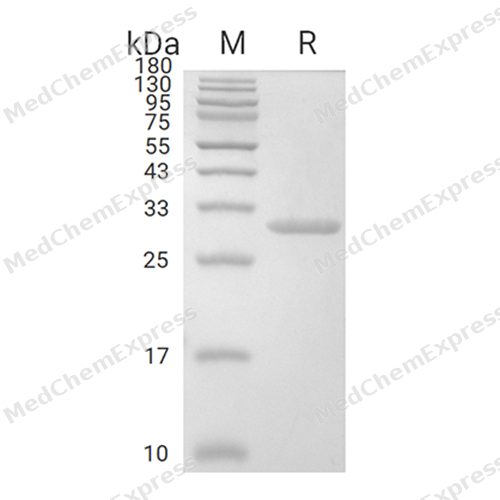
Purity - SDS-PAGE

Assay Procedure
Materials
Assay buffer: 12.5 mM Tris, 75 mM NaCl, pH 7.5
Carbonic Anhydrase 13 Protein, Human (His) (HY-P7726)
Substrate: 4-Nitrophenyl Acetate, dissolved in 2 mM DMSO
Standard: 4-Nitrophenol
Procedure
1.Standard Preparation: Dilute 4-Nitrophenol in assay buffer to concentrations of 100、50、25、12.5、6.25、3.125、1.5625、0 μmol/L. Dispense 100 μL of each standard concentration into a 96-well plate. Read at 400 nm wavelength (top read) for 5 minutes in kinetic mode. Plot the standard curve with standard concentration on the y-axis and measured OD on the x-axis to derive the standard curve equation.
2. Dilute the protein sample to 100 μg/mL using assay buffer.
3. Dilute the substrate to 2 mM using assay buffer.
4. Add 50 μL of the test protein to a 96-well plate and add 50 μL of 2 μM substrate to initiate the reaction. Add 50 μL of assay buffer and 50 μL of 2 μM substrate to the blank wells.
5. Read at 400 nm wavelength (top read) for 5 minutes in kinetic mode.
6. Calculate enzyme activity:
Specific Activity (pmol/min/μg) = | Adjusted Vmax* (RFU/min) x Conversion Factor ** (pmol/RFU) |
| amount of enzyme (μg) |
*Adjusted for Substrate Blank
**Derived using calibration standard
Per Well:
Human Carbonic Anhydrase 13: 5 μg
Substrate: 1 mM


Technical Parameters
-
Species Human
-
Source E. coli
-
Tag C-6*His
-
Accession
Q8N1Q1 (M1-F261)
-
Molecular Construction
-
N-term
-
CA13 (M1-F261)
Accession # Q8N1Q1 -
6*His
-
C-term
-
-
Protein Length
Full Length of Carbonic anhydrase 13 Chain
-
Synonyms
CA13; Carbonate Dehydratase XIII; Carbonic Anhydrase 13; FLJ37995; Carbonic Anhydrase XIII; MGC59868; CAXIII; CA-XIII
-
AA Sequence
MSRLSWGYREHNGPIHWKEFFPIADGDQQSPIEIKTKEVKYDSSLRPLSIKYDPSSAKIISNSGHSFNVDFDDTENKSVLRGGPLTGSYRLRQVHLHWGSADDHGSEHIVDGVSYAAELHVVHWNSDKYPSFVEAAHEPDGLAVLGVFLQIGEPNSQLQKITDTLDSIKEKGKQTRFTNFDLLSLLPPSWDYWTYPGSLTVPPLLESVTWIVLKQPINISSQQLAKFRSLLCTAEGEAAAFLVSNHRPPQPLKGRKVRASF
-
Predicted Molecular Mass
30.5 kDa
-
Molecular Weight
Approximately 32 kDa, based on SDS-PAGE under reducing conditions.
-
Purity
≥ 95%, as determined by reducing SDS-PAGE.


Product Properties
Solution
Supplied as a 0.22 μm filtered solution of 20 mM Tris-HCl, 150 mM NaCl, pH 7.5.
Note: For SPR assay, please replace the buffer. Primary amine components (e.g., Tris, imidazole) can affect protein-coupled chips.
<1 EU/μg, determined by LAL method.
Stored at -80°C for 1 year from date of receipt. It is stable at -20°C for 3 months after opening. It is recommended to freeze aliquots at -80°C for extended storage. Avoid repeated freeze-thaw cycles.
Shipping with dry ice.


Documentation
-
Data Sheet (261 KB)
-
SDS (252 KB)
- English - EN (252 KB)
- Français - FR (252 KB)
- Deutsch - DE (252 KB)
- Norwegian - NO (252 KB)
- Español - ES (252 KB)
- Swedish - SV (252 KB)
- Italian - IT (252 KB)
- Korean - KR (252 KB)
- Portuguese - PT (252 KB)
-
Handling Instructions (2659 KB)


References

Calculators
Concentration (start) × Volume (start) = Concentration (final) × Volume (final)


 Powered by Bioz

