



Cardiotrophin-1/CTF1 Protein, Mouse (HEK293)
Cardiotrophin-1/CTF1 Protein, Mouse (HEK293, His), a member of IL-6 family of cytokines, is required for cardiac myocyte maturation and plays an important role in the differentiation, development, and survival of neural stem cells.
- Species: Mouse
- Source: HEK293
-
Storage:Stored at -20°C for 2 years from date of receipt. After reconstitution, it is stable at 4°C for 1 week or -20°C for longer (with carrier protein). It is recommended to freeze aliquots at -20°C or -80°C for extended storage.


To place orders, for customer services and technical support, please contact: MedChemExpress USA
Tel: 609-228-6898 E-mail: [email protected] [email protected]


-
 Biological Activity
-
Technical Parameters
-
Product Properties
- Documentation
- References
- Help & FAQs




Biological Activity
Description
Cardiotrophin-1/CTF1 Protein, Mouse (HEK293, His), a member of IL-6 family of cytokines, is required for cardiac myocyte maturation and plays an important role in the differentiation, development, and survival of neural stem cells.
Background
Cardiotrophin-1 (CT-1) is required for cardiac myocyte maturation and is capable of promoting cell survival in neonatal rat cardiomyocytes subjected to serum deprivation through an antiapoptotic pathway mediated by MAPK, ERK1/2CT1[1]. CT-1 exhibits impressive neuroprotective effects and delay the procession of motor neuron degenerative disorders by prolonging the median neuronal survival time, improving motor function and promoting regeneration in neonatal rat motor neurons in mouse models of amyotrophic lateral sclerosis, progressive motor neuropathy and spinal muscular atrophy and in adult rats with spinal cord injuries[2].
MCE Validation Data
-
Purity - SDS-PAGE
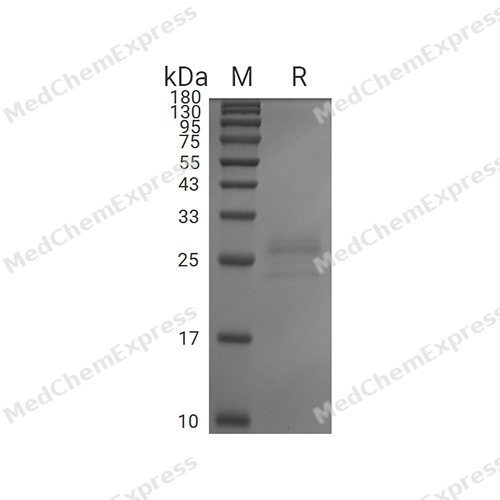
Purity - SDS-PAGE


Technical Parameters
-
Species Mouse
-
Source HEK293
-
Tag Tag Free
-
Accession
Q60753 (S2-A203)
-
Molecular Construction
-
N-term
-
CTF1 (S2-A203)
Accession # Q60753 -
C-term
-
-
Protein Length
Full Length
-
Synonyms
CTF1; CT1; Cardiotrophin 1; Cardiotrophin-1; CT-1; Cardiophin 1
-
AA Sequence
SQREGSLEDHQTDSSISFLPHLEAKIRQTHNLARLLTKYAEQLLEEYVQQQGEPFGLPGFSPPRLPLAGLSGPAPSHAGLPVSERLRQDAAALSVLPALLDAVRRRQAELNPRAPRLLRSLEDAARQVRALGAAVETVLAALGAAARGPGPEPVTVATLFTANSTAGIFSAKVLGFHVCGLYGEWVSRTEGDLGQLVPGGVA
-
Molecular Weight
Approximately 22-27 kDa, based on SDS-PAGE under non reducing (N) conditions.
-
Purity
≥ 95%, as determined by reducing SDS-PAGE.


Product Properties
Lyophilized powder.
<0.2 EU/μg, determined by LAL method.
It is not recommended to reconstitute to a concentration less than 100 μg/mL in ddH2O. For long term storage it is recommended to add a carrier protein (0.1% BSA, 5% HSA, 10% FBS or 5% Trehalose).
Stored at -20°C for 2 years from date of receipt. After reconstitution, it is stable at 4°C for 1 week or -20°C for longer (with carrier protein). It is recommended to freeze aliquots at -20°C or -80°C for extended storage.
Room temperature in continental US; may vary elsewhere.


Documentation
-
Data Sheet (263 KB)
-
SDS (251 KB)
- English - EN (251 KB)
- Français - FR (251 KB)
- Deutsch - DE (251 KB)
- Norwegian - NO (251 KB)
- Español - ES (251 KB)
- Swedish - SV (251 KB)
- Italian - IT (251 KB)
- Korean - KR (251 KB)
- Portuguese - PT (251 KB)
-
Handling Instructions (2659 KB)


References
[1]. López-Yoldi M, et al. Cardiotrophin-1: A multifaceted cytokine. Cytokine Growth Factor Rev. 2015 Oct;26(5):523-32. [Content Brief]
[2]. Peng L, et al. Cardiotrophin-1 stimulates the neural differentiation of human umbilical cord blood-derived mesenchymal stem cells and survival of differentiated cells through PI3K/Akt-dependent signaling pathways. Cytotechnology. 2017 Dec;69(6):933-941. [Content Brief]

Calculators
Concentration (start) × Volume (start) = Concentration (final) × Volume (final)


 Powered by Bioz

