



DC-SIGN/CD209 Protein, Rhesus Macaque (HEK293, His)

Based on 1 Customer Validation
DC-SIGN/CD209 Protein, is a C-type lectin receptor present on the surface of both macrophages and dendritic cells (DCs), serves as a pivotal pathogen-recognition receptor, playing a crucial role in initiating the primary immune response. It mediates endocytosis and subsequent degradation of pathogens within lysosomal compartments. On DCs, it acts as a high-affinity receptor for ICAM2 and ICAM3, binding to mannose-like carbohydrates. DC-SIGN/CD209 Protein, Rhesus Macaque (HEK293, His) is the recombinant Rhesus Macaque-derived DC-SIGN/CD209 protein, expressed by HEK293 , with N-His labeled tag.
- Species: Rhesus Macaque
- Source: HEK293
-
Storage:Stored at -20°C for 2 years from date of receipt. After reconstitution, it is stable at 4°C for 1 week or -20°C for longer (with carrier protein). It is recommended to freeze aliquots at -20°C or -80°C for extended storage.


To place orders, for customer services and technical support, please contact: MedChemExpress USA
Tel: 609-228-6898 E-mail: [email protected] [email protected]


-
 Biological Activity
-
Technical Parameters
-
Product Properties
- Documentation
- Help & FAQs




Biological Activity
Description
DC-SIGN/CD209 Protein, is a C-type lectin receptor present on the surface of both macrophages and dendritic cells (DCs), serves as a pivotal pathogen-recognition receptor, playing a crucial role in initiating the primary immune response. It mediates endocytosis and subsequent degradation of pathogens within lysosomal compartments. On DCs, it acts as a high-affinity receptor for ICAM2 and ICAM3, binding to mannose-like carbohydrates. DC-SIGN/CD209 Protein, Rhesus Macaque (HEK293, His) is the recombinant Rhesus Macaque-derived DC-SIGN/CD209 protein, expressed by HEK293 , with N-His labeled tag.
Background
DC-SIGN/CD209 protein, is a C-type lectin receptor present on the surface of both macrophages and dendritic cells (DCs), serves as a pivotal pathogen-recognition receptor, playing a crucial role in initiating the primary immune response. This receptor is implicated in the endocytosis of pathogens, leading to their subsequent degradation within lysosomal compartments. Following this process, DC-SIGN returns to the cell membrane surface, presenting pathogen-derived antigens to resting T-cells through MHC class II proteins, thereby triggering the adaptive immune response. On DCs, it acts as a high-affinity receptor for ICAM2 and ICAM3, binding to mannose-like carbohydrates. Notably, DC-SIGN may function as a DC rolling receptor, facilitating the transendothelial migration of DC precursors from the bloodstream to tissues by interacting with endothelial ICAM2. Furthermore, it appears to modulate DC-induced T-cell proliferation through its binding to ICAM3 on T-cells within the immunological synapse formed between DCs and T-cells[1][2].
Verified Bioactivity
Measured by its binding ability in a functional ELISA. Immobilized Recombinant Rhesus Macaque DC-SIGN at 2 μg/mL can bind gp120. The ED50 for this effect is 1.092 μg/mL.
MCE Validation Data
-
Purity - SDS-PAGE
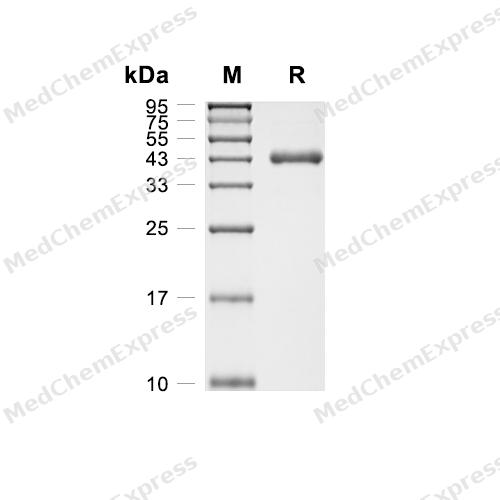
Purity - SDS-PAGE
-
Bioactivity - ELISA
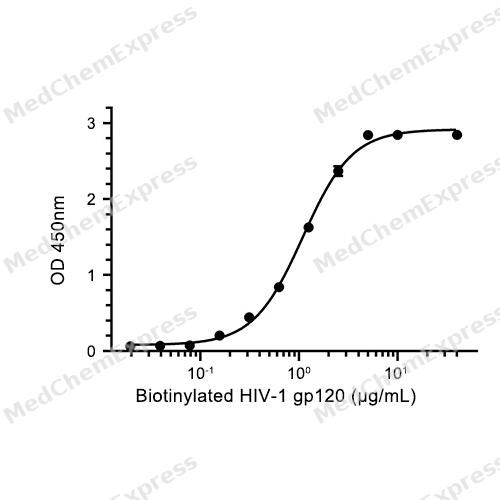
Bioactivity - ELISA


Technical Parameters
-
Species Rhesus Macaque
-
Source HEK293
-
Tag N-6*His
-
Accession
AAK74185.1 (K62-E381)
-
Molecular Construction
-
N-term
-
His
-
CD209 (K62-E381)
Accession # AAK74185.1 -
C-term
-
-
Protein Length
Partial
-
Synonyms
CD209; Dendritic Cell-Specific ICAM-3-Grabbing Non-Integrin 1; CD209 Molecule; C-Type Lectin Domain Family 4 Member L; DC-SIGN1; Dendritic Cell-Specific Intracellular Adhesion Molecules (ICAM)-3 Grabbing Non-Integrin; DC-SIGN; Dendritic Cell-Specific Inte
-
AA Sequence
KVPSSLSQGQSKQDAIYQNLTQLKVAVSELSEKSKQQEIYQELTRLKAAVGELPEKSKQQEIYEELTRLKAAVGELPEKSKLQEIYQELTRLKAAVGELPEKSKQQEIYQELSRLKAAVGDLPEKSKQQEIYQKLTQLKAAVDGLPDRSKQQEIYQELIQLKAAVERLCRPCPWEWTFFQGNCYFMSNSQRNWHNSITACQEVGAQLVVIKSAEEQNFLQLQSSRSNRFTWMGLSDLNHEGTWQWVDGSPLLPSFKQYWNKGEPNNIGEEDCAEFSGNGWNDDKCNLAKFWICKKSAASCSGDEERLLSPAPTTPNPPPE
-
Molecular Weight
Approximately 44 kDa, based on SDS-PAGE under reducing conditions, due to the glycosylation.
-
Glycosylation
Yes
-
Purity
≥ 95%, as determined by reducing SDS-PAGE.


Product Properties
Lyophilized powder.
Lyophilized from a 0.22 μm filtered solution of PBS, pH 7.4.
<1 EU/μg, determined by LAL method.
It is not recommended to reconstitute to a concentration less than 100 μg/mL in ddH2O. For long term storage it is recommended to add a carrier protein (0.1% BSA, 5% HSA, 10% FBS or 5% Trehalose).
Stored at -20°C for 2 years from date of receipt. After reconstitution, it is stable at 4°C for 1 week or -20°C for longer (with carrier protein). It is recommended to freeze aliquots at -20°C or -80°C for extended storage.
Room temperature in continental US; may vary elsewhere.


Documentation
-
Data Sheet (238 KB)
-
SDS (251 KB)
- English - EN (251 KB)
- Français - FR (251 KB)
- Deutsch - DE (251 KB)
- Norwegian - NO (251 KB)
- Español - ES (251 KB)
- Swedish - SV (251 KB)
- Italian - IT (251 KB)
- Korean - KR (251 KB)
- Portuguese - PT (251 KB)
-
Handling Instructions (2659 KB)

Calculators
Concentration (start) × Volume (start) = Concentration (final) × Volume (final)


 Powered by Bioz

