



EDA2R/XEDAR Protein, Mouse (HEK293, His)

Based on 1 Customer Validation
The EDA2R/XEDAR protein is a receptor for EDA isoform A2 (but not A1) and plays a key role in activating the NF-kappa-B and JNK pathways. This activation involves binding to TRAF3 and TRAF6, as indicated by protein similarity. EDA2R/XEDAR Protein, Mouse (HEK293, His) is the recombinant mouse-derived EDA2R/XEDAR protein, expressed by HEK293 , with C-6*His labeled tag.
- Species: Mouse
- Source: HEK293
-
Storage:Stored at -20°C for 2 years from date of receipt. After reconstitution, it is stable at 4°C for 1 week or -20°C for longer (with carrier protein). It is recommended to freeze aliquots at -20°C or -80°C for extended storage.


To place orders, for customer services and technical support, please contact: MedChemExpress USA
Tel: 609-228-6898 E-mail: [email protected] [email protected]


-
 Biological Activity
-
Technical Parameters
-
Product Properties
- Documentation
- Help & FAQs




Biological Activity
Description
The EDA2R/XEDAR protein is a receptor for EDA isoform A2 (but not A1) and plays a key role in activating the NF-kappa-B and JNK pathways. This activation involves binding to TRAF3 and TRAF6, as indicated by protein similarity. EDA2R/XEDAR Protein, Mouse (HEK293, His) is the recombinant mouse-derived EDA2R/XEDAR protein, expressed by HEK293 , with C-6*His labeled tag.
Background
EDA2R/XEDAR Protein, identified as a receptor for EDA isoform A2 (but not A1), plays a pivotal role in mediating the activation of the NF-kappa-B and JNK pathways. The activation process appears to involve the binding of EDA2R/XEDAR to TRAF3 and TRAF6, as suggested by similarity with related proteins. Additionally, EDA2R/XEDAR associates with TRAF1, TRAF3, and TRAF6, further indicating its involvement in signaling pathways associated with immune and inflammatory responses. The intricate interactions and activation mechanisms underscore the significance of EDA2R/XEDAR in cellular signaling cascades, with potential implications in various physiological processes and cellular responses.
Verified Bioactivity
Immobilized Mouse EDA2R at 0.1 μg/mL (100 μL/well) can bind Recombinant Human EDA-A2. The ED50 for this effect is 9.596 ng/mL.
MCE Validation Data
-
Purity - SDS-PAGE
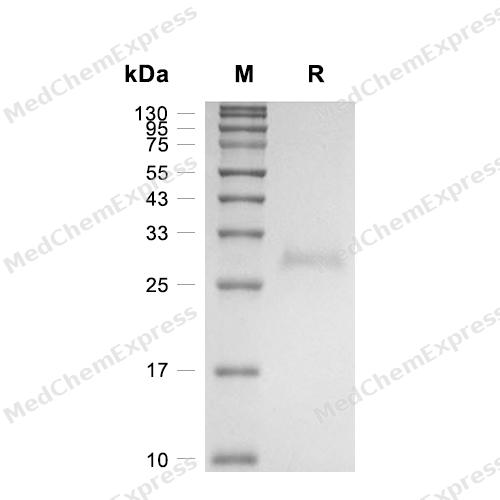
Purity - SDS-PAGE
-
Bioactivity - ELISA
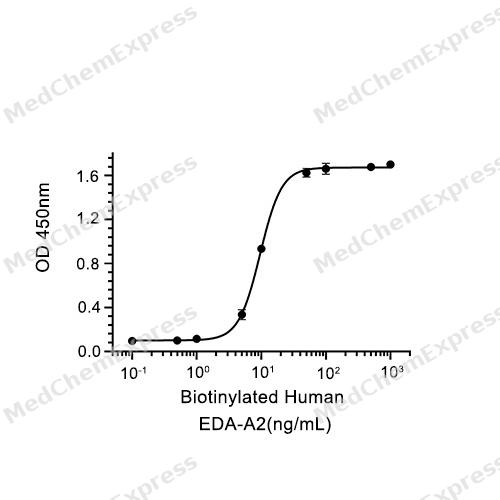
Bioactivity - ELISA


Technical Parameters
-
Species Mouse
-
Source HEK293
-
Tag C-6*His
-
Accession
Q8BX35 (M1-T138)
-
Molecular Construction
-
N-term
-
EDA2R (M1-T138)
Accession # Q8BX35 -
6*His
-
C-term
-
-
Protein Length
Extracellular Domain
-
Synonyms
EDA2R; Tumor Necrosis Factor Receptor Superfamily Member 27; Ectodysplasin A2 Receptor; X-Linked Ectodysplasin-A2 Receptor; TNFRSF27; X-Linked EDA Receptor; XEDAR; EDA-A2 Receptor; EDA-A2R; Tumor Necrosis Factor Receptor Superfamily Member XEDAR; EDAA2R
-
AA Sequence
MDCQENEYRDQWGRCVTCQQCGPGQELSKDCGYGEGGDAHCIVCPPRKYKSTWGHHRCQTCITCAVINRVQKANCTNTSNAICGDCLPRFYRKTRIGGLQDQECIPCTKQTPSSEVQCTFQLSLVKVDAHTVPPREAT
-
Molecular Weight
Approximately 22-29 kDa, based on SDS-PAGE under reducing conditions.
-
Glycosylation
Yes
-
Purity
≥ 95%, as determined by reducing SDS-PAGE.


Product Properties
Lyophilized powder
Lyophilized from a 0.2 μm filtered solution of PBS, pH 7.4 or PBS, pH 6.5, 8% trehalose.
<1 EU/μg, determined by LAL method.
It is not recommended to reconstitute to a concentration less than 100 μg/mL in ddH2O. For long term storage it is recommended to add a carrier protein (0.1% BSA, 5% HSA, 10% FBS or 5% Trehalose).
Stored at -20°C for 2 years from date of receipt. After reconstitution, it is stable at 4°C for 1 week or -20°C for longer (with carrier protein). It is recommended to freeze aliquots at -20°C or -80°C for extended storage.
Room temperature in continental US; may vary elsewhere.


Documentation
-
Data Sheet (236 KB)
-
SDS (252 KB)
- English - EN (252 KB)
- Français - FR (252 KB)
- Deutsch - DE (252 KB)
- Norwegian - NO (252 KB)
- Español - ES (252 KB)
- Swedish - SV (252 KB)
- Italian - IT (252 KB)
- Korean - KR (252 KB)
- Portuguese - PT (252 KB)
-
Handling Instructions (2659 KB)

Calculators
Concentration (start) × Volume (start) = Concentration (final) × Volume (final)


 Powered by Bioz

