



GDF-11/BMP-11 Protein, Human (HEK293, solution)
Based on 1 Customer Validation
The GDF-11/BMP-11 protein is a secreted signaling protein that globally regulates anterior/posterior axis patterning during development and plays a key role in mesoderm and neural tissue patterning. GDF-11/BMP-11 is critical for vertebral and orofacial development and signals through type 2 activin receptors (ACVR2A and ACVR2B) and type 1 activin receptors (ACVR1B, ACVR1C and TGFBR1), leading to SMAD2 and SMAD3 phosphorylation. GDF-11/BMP-11 Protein, Human (HEK293, solution) is the recombinant human-derived GDF-11/BMP-11 protein, expressed by HEK293 , with tag free.
- Species: Human
- Source: HEK293
-
Storage:Stored at -80°C for 1 year from date of receipt. It is stable at -20°C for 3 months after opening. It is recommended to freeze aliquots at -80°C for extended storage. Avoid repeated freeze-thaw cycles.


To place orders, for customer services and technical support, please contact: MedChemExpress USA
Tel: 609-228-6898 E-mail: [email protected] [email protected]


-
 Biological Activity
-
Technical Parameters
-
Product Properties
- Documentation
- Help & FAQs







Biological Activity
Description
The GDF-11/BMP-11 protein is a secreted signaling protein that globally regulates anterior/posterior axis patterning during development and plays a key role in mesoderm and neural tissue patterning. GDF-11/BMP-11 is critical for vertebral and orofacial development and signals through type 2 activin receptors (ACVR2A and ACVR2B) and type 1 activin receptors (ACVR1B, ACVR1C and TGFBR1), leading to SMAD2 and SMAD3 phosphorylation. GDF-11/BMP-11 Protein, Human (HEK293, solution) is the recombinant human-derived GDF-11/BMP-11 protein, expressed by HEK293 , with tag free.
Background
GDF-11/BMP-11 is a secreted signaling protein with a global regulatory impact on anterior/posterior axial patterning during development and is implicated in critical roles in mesodermal and neural tissue patterning. Essential for proper vertebral and orofacial development, GDF-11/BMP-11 transmits signals through activin receptors type-2 (ACVR2A and ACVR2B) and activin receptors type-1 (ACVR1B, ACVR1C, and TGFBR1), leading to the phosphorylation of SMAD2 and SMAD3. The protein forms homodimers through disulfide linkages and interacts directly with ACVR2A, ACVR2B, ACVR1B, TGFBR1, and ACVR1C, the latter in an ACVR2B-dependent manner. Additionally, GDF-11/BMP-11 engages with FST isoform 2/FS-288, highlighting its intricate interactions with key receptors in the signaling pathway.
In Vitro
GDF-11/BMP-11 (5, 10, 20, and 40 ng/mL; 7 d) maintains the colony and cellular morphology of undifferentiated human embryonic stem cells (hESC), maintains POU5f1, NANOG, TRA-1-60, and SSEA4 expression, and displays increased SMAD2/3 phosphorylation in serum-free medium at 20 ng/mL concentration[4].
GDF-11/BMP-11 (50-400 ng/mL; 2 d) induces browning of 3T3-L1 adipocytes via coordination of multiple signalling pathways, including mTORC1-COX2 and p38MAPK-PGC-1α as non-canonical pathways, as well as Smad1/5/8 as a canonical pathway[5].
Verified Bioactivity
Luspatercept immobilized on CM5 Sensor Chip can bind Human GDF-11 Protein with an affinity constant of 18 nM as determined in SPR assay.
MCE Validation Data
-
Purity - SDS-PAGE
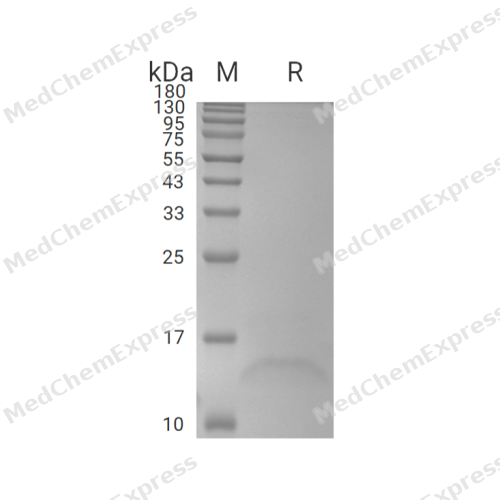
Purity - SDS-PAGE


Technical Parameters
-
Species Human
-
Source HEK293
-
Tag Tag Free
-
Accession
O95390 (N299-S407)
-
Molecular Construction
-
N-term
-
BMP-11 (N299-S407)
Accession # O95390 -
C-term
-
-
Protein Length
Full Length of Mature Protein
-
Synonyms
GDF11; Growth/Differentiation Factor 11; Growth Differentiation Factor 11; Bone Morphogenetic Protein 11; BMP-11; GDF-11; BMP11; VHO
-
AA Sequence
NLGLDCDEHSSESRCCRYPLTVDFEAFGWDWIIAPKRYKANYCSGQCEYMFMQKYPHTHLVQQANPRGSAGPCCTPTKMSPINMLYFNDKQQIIYGKIPGMVVDRCGCS
-
Predicted Molecular Mass
12.5 kDa
-
Molecular Weight
Approximately 13-20 kDa, based on SDS-PAGE under reducing conditions.
-
Structure/Form
Disulfide-linked homodimer
-
Purity
≥ 95%, as determined by reducing SDS-PAGE.


Product Properties
Solution
Supplied as a 0.22 μm filtered solution of 20 mM Tris-HCl, 50% glycerol, pH 7.4.
Note: For SPR assay, please replace the buffer. Primary amine components (e.g., Tris, imidazole) can affect protein-coupled chips.
<1 EU/μg, determined by LAL method.
Stored at -80°C for 1 year from date of receipt. It is stable at -20°C for 3 months after opening. It is recommended to freeze aliquots at -80°C for extended storage. Avoid repeated freeze-thaw cycles.
Shipping with dry ice.


Documentation
-
Data Sheet (236 KB)
-
SDS (252 KB)
- English - EN (252 KB)
- Français - FR (252 KB)
- Deutsch - DE (252 KB)
- Norwegian - NO (252 KB)
- Español - ES (252 KB)
- Swedish - SV (252 KB)
- Italian - IT (252 KB)
- Korean - KR (252 KB)
- Portuguese - PT (252 KB)
-
Handling Instructions (2659 KB)

Calculators
Concentration (start) × Volume (start) = Concentration (final) × Volume (final)


 Powered by Bioz

