



GFP Protein, Aequorea victoria (His)
Based on 2 publication(s) in Google Scholar
The green fluorescent protein (GFP), Aequorea victoria is a protein that exhibits green fluorescence when exposed to light in the blue to ultraviolet range, found in organisms including Aequorea victoria, corals, sea anemones, zoanithids, copepods and lancelets. GFP Protein has a major excitation peak at a wavelength of 395 nm and a minor one at 475 nm, while its emission peak is at 509 nm, which is in the lower green portion of the visible spectrum. GFP Protein acts as an energy transfer receptor and actively transduces the blue chemiluminescence of the protein aequorin into green fluorescent light by energy transfer, which is used as expression of reporter genes. GFP Protein, Aequorea victoria (His) is a recombinant jellyfish Aequorea victoria GFP protein with N-6*His labeled tag that consists of 238 amino acids, which is expressed in E. coli .
- Species: Others
- Source: E. coli
-
Storage:Stored at -20°C for 2 years from date of receipt. After reconstitution, it is stable at 4°C for 1 week or -20°C for longer (with carrier protein). It is recommended to freeze aliquots at -20°C or -80°C for extended storage.


To place orders, for customer services and technical support, please contact: MedChemExpress USA
Tel: 609-228-6898 E-mail: [email protected] [email protected]


-
 Biological Activity
-
Technical Parameters
-
Product Properties
- Documentation
- References
- Help & FAQs


-
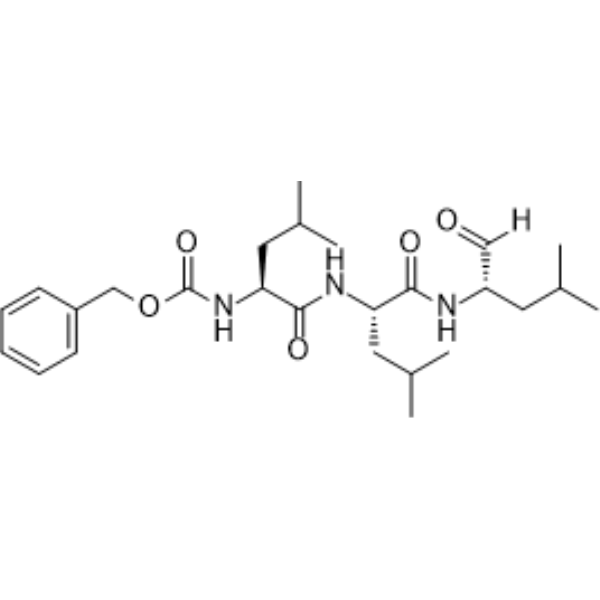
HY-13259
MG-132Proteasome Inhibitor -
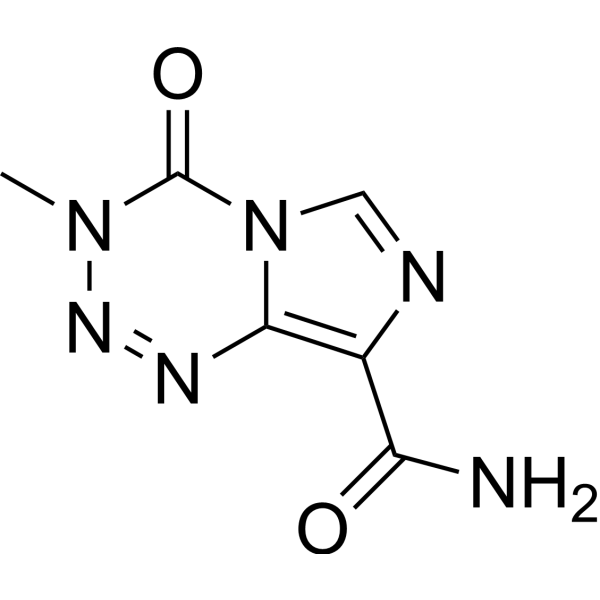
HY-17364
TemozolomideDNA Alkylator -
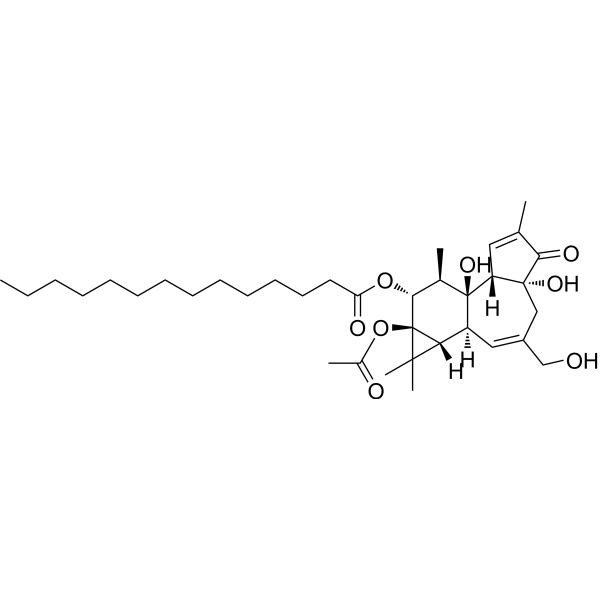
HY-18739
Phorbol 12-myristate 13-acetatePKC Activator -
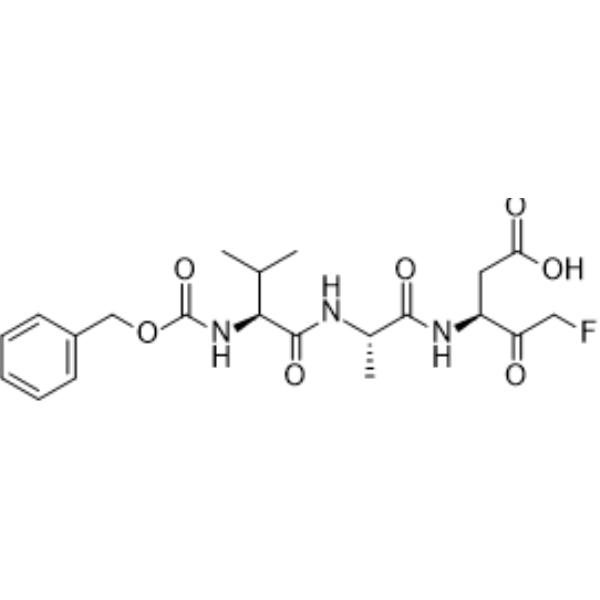
HY-16658B
Z-VAD-FMKPan-Caspase Inhibitor -

HY-P701170
FOXO3 Protein, Human (HEK293, His) -
HY-D0814
DAPI dihydrochlorideFluorescent DNA Stain -
HY-D2270
Halo tag TMRFluorescent Dye -
HY-50905
DovitinibMultiple RTK Inhibitor -

HY-K0301
Cell Counting Kit-8 -
HY-P71824
HSP70/DnaK Protein, E. coli (P.pastoris, His) -
HY-P7532
Apolipoprotein E/APOE Protein, Mouse (HEK293, His) -
HY-P703068
RFP Protein, Discosoma sp. (His)


Biological Activity
Description
The green fluorescent protein (GFP), Aequorea victoria is a protein that exhibits green fluorescence when exposed to light in the blue to ultraviolet range, found in organisms including Aequorea victoria, corals, sea anemones, zoanithids, copepods and lancelets. GFP Protein has a major excitation peak at a wavelength of 395 nm and a minor one at 475 nm, while its emission peak is at 509 nm, which is in the lower green portion of the visible spectrum. GFP Protein acts as an energy transfer receptor and actively transduces the blue chemiluminescence of the protein aequorin into green fluorescent light by energy transfer, which is used as expression of reporter genes. GFP Protein, Aequorea victoria (His) is a recombinant jellyfish Aequorea victoria GFP protein with N-6*His labeled tag that consists of 238 amino acids, which is expressed in E. coli [1][2][3][4][5][6][7].
Background
GFP fluorescence occurs when aequorin interacts with Ca2+ ions, inducing a blue glow in Aequorea victoria. Some of this luminescent energy is transferred to the GFP, shifting the overall color towards green, making GFP protein enabling the visualization of specific proteins and cellular structures in living organisms[3].
GFP Protein has a β barrel structure consisting of eleven β-strands with a pleated sheet arrangement, with an α helix containing the covalently bonded chromophore 4-(p-hydroxybenzylidene)imidazolidin-5-one (HBI) running through the center[4].
In a live cell imaging experiment, on the one hand, GFP Protein directly attaches to a protein of interest to indicate a successful transfection of a gene of interest. On the other hand, GFP Protein that containing a mutation where the fluorescence will change from green to yellow over time is used to study the state of protein production such as recently activated, continuously activated or recently deactivated[6].
GFP Protein is used widely in cancer research to label and track cancer cells. GFP Protein-labelled cancer cells have been used to model metastasis, the process by which cancer cells spread to distant organs[7].
In Vitro
GFP Protein (Aequorea victoria) acts as a pollutant marker. There is a decrease in both GFP Protein and cellular density as pollutant levels increases, indicating that cellular activity has decreased[5].
In Vivo
Zebrafish that are injected with GFP Protein (Aequorea victoria) are approximately twenty times more susceptible to recognize cellular stresses than zebrafish that are not injected with GFP Protein (Aequorea victoria)[5].
Tumor dissemination and metastasis occur at distinct times during tumor progression in the bi-transgenic MMTV-PyMT and β-actin-enhanced green fluorescent protein (GFP) mice[7].
Verified Bioactivity
Prepare a 150 μL recombinant GFP with various concentrations (0.00074 nM - 6.21 μM) in assay buffer and equilibrate to 25°C. Read at excitation wavelengths 485 nm and emission 535 nm.
MCE Validation Data
-
Purity - SDS-PAGE
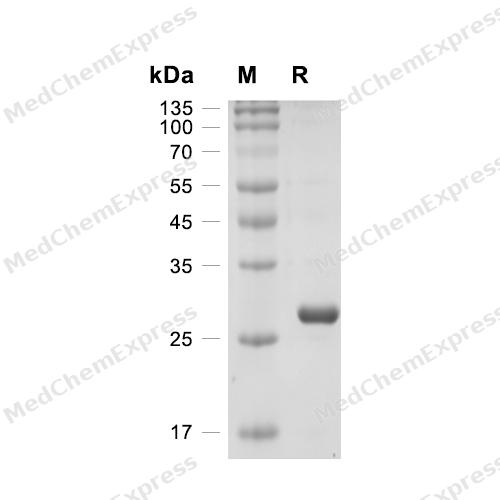
Purity - SDS-PAGE
-
Bioactivity - Biochemical Activity Assay
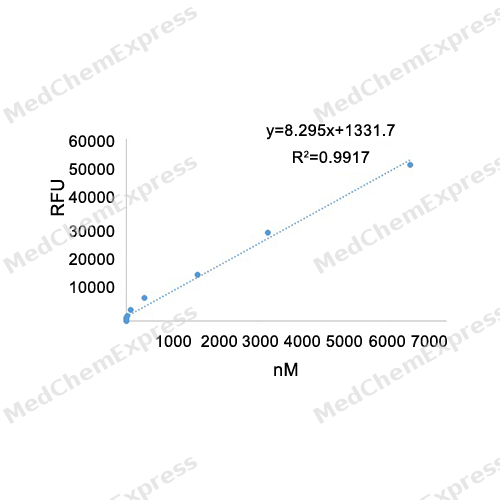
Bioactivity - Biochemical Activity Assay


Publications (2)
-
Journal Impact Factor
-
Most Recent
-
Nat Commun
2026 Jun 9. PMID: 42259798 -
Anal Chem
MBD-Functionalized Magnetic Nanoparticles for Direct Enrichment of Plasma Methylated DNA in High-Sensitivity Liquid Biopsy. [Abstract]2026 Apr 14;98(14):10750-10759. PMID: 41922298


Technical Parameters
-
Species Others
-
Source E. coli
-
Tag N-6*His
-
Accession
P42212 (M1-K238)
-
Gene ID/
-
Molecular Construction
-
N-term
-
6*His
-
GFP (M1-K238)
Accession # P42212 -
C-term
-
-
Protein Length
Full Length
-
Synonyms
gfp; GFP; Green fluorescent protein
-
AA Sequence
MSKGEELFTGVVPILVELDGDVNGHKFSVSGEGEGDATYGKLTLKFICTTGKLPVPWPTLVTTFSYGVQCFSRYPDHMKQHDFFKSAMPEGYVQERTIFFKDDGNYKTRAEVKFEGDTLVNRIELKGIDFKEDGNILGHKLEYNYNSHNVYIMADKQKNGIKVNFKIRHNIEDGSVQLADHYQQNTPIGDGPVLLPDNHYLSTQSALSKDPNEKRDHMVLLEFVTAAGITHGMDELYK
-
Molecular Weight
Approximately 27-31 kDa, based on SDS-PAGE under reducing conditions.
-
Purity
≥ 90%, as determined by reducing SDS-PAGE.


Product Properties
Lyophilized powder
1.Lyophilized from a 0.22 μm filtered solution of 50 mM Tris-HCl, 300 mM NaCl, pH 7.4, 5% trehalose, 5% mannitol, 0.01% Tween 80.
2.Lyophilized from a 0.22 μm filtered solution of 20 mM Tris-HCl, 0.5 M NaCl, 6% trehalose, pH 8.0.
3.Lyophilized from a 0.22 μm filtered solution of PBS, pH 7.4, 8% trehalose.
Please refer to the lot-specific COA for specific buffer information.
Note: For SPR assay, please replace the buffer. Primary amine components (e.g., Tris, imidazole) can affect protein-coupled chips.
<1 EU/μg, determined by LAL method.
It is not recommended to reconstitute to a concentration less than 100 μg/mL in ddH2O.
Stored at -20°C for 2 years from date of receipt. After reconstitution, it is stable at 4°C for 1 week or -20°C for longer (with carrier protein). It is recommended to freeze aliquots at -20°C or -80°C for extended storage.
Room temperature in continental US; may vary elsewhere.


Documentation
-
Data Sheet (265 KB)
-
SDS (251 KB)
- English - EN (251 KB)
- Français - FR (251 KB)
- Deutsch - DE (251 KB)
- Norwegian - NO (251 KB)
- Español - ES (251 KB)
- Swedish - SV (251 KB)
- Italian - IT (251 KB)
- Korean - KR (251 KB)
- Portuguese - PT (251 KB)
-
Handling Instructions (2659 KB)


References
[1]. Prendergast FG, et al. Chemical and physical properties of aequorin and the green fluorescent protein isolated from Aequorea forskålea. Biochemistry. 1978 Aug 22;17(17):3448-53. [Content Brief]
[2]. Phillips GJ. Green fluorescent protein-a bright idea for the study of bacterial protein localization. FEMS Microbiol Lett. 2001 Oct 16;204(1):9-18. [Content Brief]
[3]. Morise H, et al. Intermolecular energy transfer in the bioluminescent system of Aequorea. Biochemistry. 1974 Jun 4;13(12):2656-62. [Content Brief]
[4]. Ormö M, et al. Crystal structure of the Aequorea victoria green fluorescent protein. Science. 1996 Sep 6;273(5280):1392-5. [Content Brief]
[6]. Terskikh A, et al. "Fluorescent timer": protein that changes color with time. Science. 2000 Nov 24;290(5496):1585-8. [Content Brief]
[7]. Kouros-Mehr H, et al. GATA-3 links tumor differentiation and dissemination in a luminal breast cancer model. Cancer Cell. 2008 Feb;13(2):141-52. [Content Brief]

Calculators
Concentration (start) × Volume (start) = Concentration (final) × Volume (final)


 Powered by Bioz

