



GZMA/Granzyme A Protein, Human (HEK293, His)
Based on 2 publication(s) in Google Scholar
GZMA/granzyme A is enriched in cytotoxic T cells and natural killer cells and can induce caspase-independent pyroptosis after delivery to target cells. With substrate specificity for lysine or arginine residues, GZMA cleaves APEX1 and the nucleosome assembly protein SET, thereby disrupting their activity. GZMA/Granzyme A Protein, Human (HEK293, His) is the recombinant human-derived GZMA/Granzyme A protein, expressed by HEK293 , with C-His labeled tag.
- Species: Human
- Source: HEK293
-
Storage:Stored at -20°C for 2 years from date of receipt. After reconstitution, it is stable at 4°C for 1 week or -20°C for longer (with carrier protein). It is recommended to freeze aliquots at -20°C or -80°C for extended storage.


To place orders, for customer services and technical support, please contact: MedChemExpress USA
Tel: 609-228-6898 E-mail: [email protected] [email protected]


-
 Biological Activity
-
Technical Parameters
-
Product Properties
- Documentation
- Help & FAQs




Biological Activity
Description
GZMA/granzyme A is enriched in cytotoxic T cells and natural killer cells and can induce caspase-independent pyroptosis after delivery to target cells. With substrate specificity for lysine or arginine residues, GZMA cleaves APEX1 and the nucleosome assembly protein SET, thereby disrupting their activity. GZMA/Granzyme A Protein, Human (HEK293, His) is the recombinant human-derived GZMA/Granzyme A protein, expressed by HEK293 , with C-His labeled tag.
Background
Granzyme A (GZMA) is a highly abundant protease found in the cytosolic granules of cytotoxic T-cells and natural killer cells, playing a crucial role in immune defense mechanisms. When delivered into the target cell through the immunological synapse, GZMA activates caspase-independent pyroptosis. It exhibits a substrate specificity for cleavage after lysine or arginine residues. Notably, GZMA cleaves APEX1 after 'Lys-31,' disrupting its oxidative repair activity. Additionally, it targets the nucleosome assembly protein SET, cleaving it after 'Lys-189.' This cleavage event disrupts SET's nucleosome assembly activity and facilitates the translocation of the SET complex into the nucleus, where it is involved in nicking and degrading DNA. The multifunctional activities of GZMA underscore its significance in orchestrating diverse cellular processes during immune responses.
Verified Bioactivity
Measured by its ability to cleave a colorimetric peptide substrate, N-carbobenzyloxy-Gly-Arg-ThioBenzyl ester (Z-GR-SBzl), in the presence of 5,5'-Dithio-bis (2-nitrobenzoic acid) (DTNB). The specific activity is >5000 pmol/min/µg, as measured under the described conditions. (Activation description: The proenzyme needs to be activated by Lysyl endopeptidase for an activated form.)
MCE Validation Data
-
Purity - SDS-PAGE
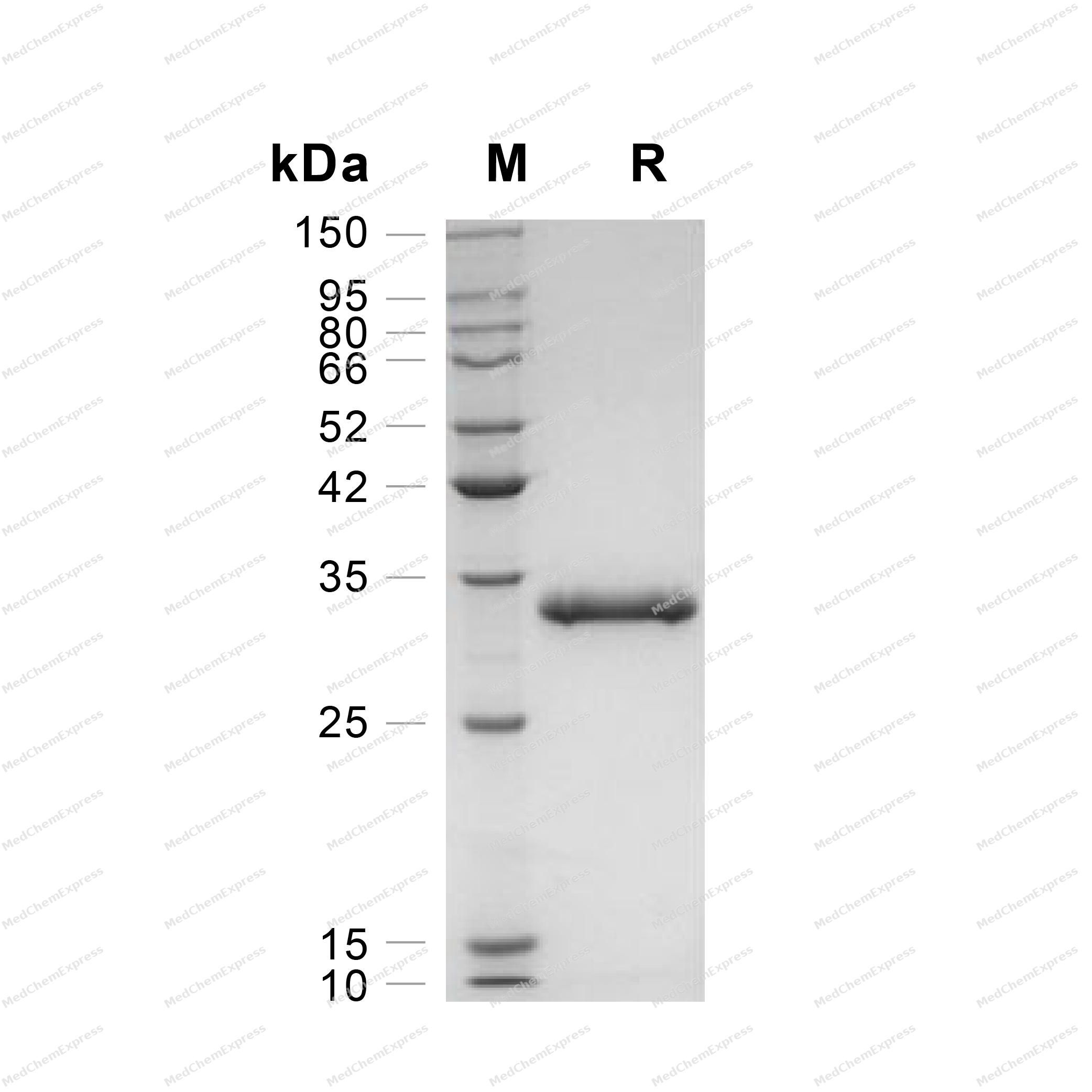
Purity - SDS-PAGE


Publications (2)
-
Journal Impact Factor
-
Most Recent
-
Nat Commun
Cathepsin L as a dual-target to mitigate muscle wasting while enhancing anti-tumor efficacy of anti-PD-L1. [Abstract]2025 Nov 28;16(1):10706. PMID: 41315185 -
Nat Commun
Granzyme K+CD8+ T cells interact with fibroblasts to promote neutrophilic inflammation in nasal polyps. [Abstract]2024 Nov 29;15(1):10413. PMID: 39614076


Technical Parameters
-
Species Human
-
Source HEK293
-
Tag C-His
-
Accession
P12544-1/NP_006135.1 (E27-V262)
-
Molecular Construction
-
N-term
-
GZMA (E27-V262)
Accession # P12544-1/NP_006135.1 -
His
-
C-term
-
-
Protein Length
Full Length of Isoform-1 (with Propeptide)
-
Synonyms
GZMA; Cytotoxic T-Lymphocyte Proteinase 1; Prev. CTLA3; Granzyme 1; Prev. HFSP; H Factor; CTL Tryptase; HF; Fragmentin-1; Granzyme A (Cytotoxic T-Lymphocyte-Associated Serine Esterase-3; Hanukah Factor Serine Protease); Granzyme A (Granzyme 1, Cytotoxic T
-
AA Sequence
EKIIGGNEVTPHSRPYMVLLSLDRKTICAGALIAKDWVLTAAHCNLNKRSQVILGAHSITREEPTKQIMLVKKEFPYPCYDPATREGDLKLLQLTEKAKINKYVTILHLPKKGDDVKPGTMCQVAGWGRTHNSASWSDTLREVNITIIDRKVCNDRNHYNFNPVIGMNMVCAGSLRGGRDSCNGDSGSPLLCEGVFRGVTSFGLENKCGDPRGPGVYILLSKKHLNWIIMTIKGAV
-
Molecular Weight
Approximately 27-33 kDa, based on SDS-PAGE under reducing conditions, due to the glycosylation.
-
Glycosylation
Yes
-
Purity
≥ 95%, as determined by reducing SDS-PAGE.


Product Properties
Lyophilized powder
1.Lyophilized from a 0.22 μm filtered solution of PBS, pH 7.4, 5% trehalose, 5% mannitol, 0.01% Tween 80.
2.Lyophilized from a 0.22 μm filtered solution of 20 mM PB, 150 mM NaCl, pH 7.4.
3.Lyophilized from a 0.22 μm filtered solution of PBS, pH 7.4, 8% trehalose.
Please refer to the lot-specific COA for specific buffer information.
<1 EU/μg, determined by LAL method.
It is not recommended to reconstitute to a concentration less than 100 μg/mL in ddH2O.
Stored at -20°C for 2 years from date of receipt. After reconstitution, it is stable at 4°C for 1 week or -20°C for longer (with carrier protein). It is recommended to freeze aliquots at -20°C or -80°C for extended storage.
Room temperature in continental US; may vary elsewhere.


Documentation
-
Data Sheet (237 KB)
-
SDS (254 KB)
- English - EN (254 KB)
- Français - FR (254 KB)
- Deutsch - DE (254 KB)
- Norwegian - NO (254 KB)
- Español - ES (254 KB)
- Swedish - SV (254 KB)
- Italian - IT (254 KB)
- Korean - KR (254 KB)
- Portuguese - PT (254 KB)
-
Handling Instructions (2659 KB)

Calculators
Concentration (start) × Volume (start) = Concentration (final) × Volume (final)


 Powered by Bioz

