



HSPB8 Protein, Human (His)
Based on 1 publication(s) in Google Scholar
The HSPB8 protein exhibits temperature-dependent chaperone activity and functions as a monomer in its molecular form.It interacts with other cellular proteins to form complexes critical for cellular homeostasis.HSPB8 Protein, Human (His) is the recombinant human-derived HSPB8 protein, expressed by E.coli , with C-6*His labeled tag.
- Species: Human
- Source: E. coli
-
Storage:Stored at -80°C for 1 year from date of receipt. It is stable at -20°C for 3 months after opening. It is recommended to freeze aliquots at -80°C for extended storage. Avoid repeated freeze-thaw cycles.


To place orders, for customer services and technical support, please contact: MedChemExpress USA
Tel: 609-228-6898 E-mail: [email protected] [email protected]


-
 Biological Activity
-
Technical Parameters
-
Product Properties
- Documentation
- Help & FAQs




Biological Activity
Description
The HSPB8 protein exhibits temperature-dependent chaperone activity and functions as a monomer in its molecular form.It interacts with other cellular proteins to form complexes critical for cellular homeostasis.HSPB8 Protein, Human (His) is the recombinant human-derived HSPB8 protein, expressed by E.coli , with C-6*His labeled tag.
Background
HSPB8 (Heat Shock Protein Family B [Small] Member 8) exhibits temperature-dependent chaperone activity, functioning as a monomer. It interacts with HSPB1, suggesting potential collaborative roles in cellular protein folding and quality control mechanisms. Additionally, HSPB8 interacts with DNAJB6, indicating its involvement in the broader network of chaperone proteins. The interaction with BAG3 further emphasizes its role in protein homeostasis, as BAG3 is associated with the regulation of protein degradation processes. These interactions collectively highlight the versatility of HSPB8 in cellular stress responses and protein quality control, positioning it as a key player in maintaining proteostasis.
MCE Validation Data
-
Purity - SDS-PAGE
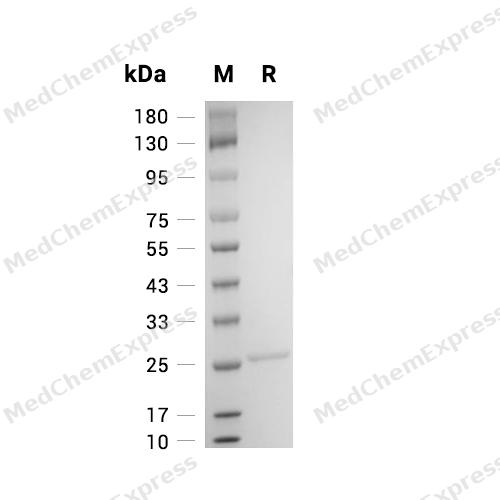
Purity - SDS-PAGE


Publications (1)
-
Journal Impact Factor
-
Most Recent


Technical Parameters
-
Species Human
-
Source E. coli
-
Tag C-6*His
-
Accession
Q9UJY1 (M1-T196)
-
Molecular Construction
-
N-term
-
HSPB8 (M1-T196)
Accession # Q9UJY1 -
6*His
-
C-term
-
-
Protein Length
Full Length
-
Synonyms
HSPB8; Alpha-Crystallin C Chain; Heat Shock Protein Family B (Small) Member 8; Protein Kinase H11; E2IG1; HSPB8-N1; HSP22; HSPB8-N2; CMT2L; DHMN2; H11; HMN2A; Small Stress Protein-Like Protein HSP22; HMND2; Heat Shock Protein Family B Member 8; MFM13; Hea
-
AA Sequence
MADGQMPFSCHYPSRLRRDPFRDSPLSSRLLDDGFGMDPFPDDLTASWPDWALPRLSSAWPGTLRSGMVPRGPTATARFGVPAEGRTPPPFPGEPWKVCVNVHSFKPEELMVKTKDGYVEVSGKHEEKQQEGGIVSKNFTKKIQLPAEVDPVTVFASLSPEGLLIIEAPQVPPYSTFGESSFNNELPQDSQEVTCT
-
Predicted Molecular Mass
22.7 kDa
-
Molecular Weight
Approximately 23 kDa, based on SDS-PAGE under reducing conditions.
-
Purity
≥ 90%, as determined by reducing SDS-PAGE.


Product Properties
Solution
Supplied as a 0.22 μm filtered solution of 20 mM PB, 150 mM NaCl, 5 mM EDTA, pH 7.4.
<1 EU/μg, determined by LAL method.
Stored at -80°C for 1 year from date of receipt. It is stable at -20°C for 3 months after opening. It is recommended to freeze aliquots at -80°C for extended storage. Avoid repeated freeze-thaw cycles.
Shipping with dry ice.


Documentation
-
Data Sheet (236 KB)
-
SDS (252 KB)
- English - EN (252 KB)
- Français - FR (252 KB)
- Deutsch - DE (252 KB)
- Norwegian - NO (252 KB)
- Español - ES (252 KB)
- Swedish - SV (252 KB)
- Italian - IT (252 KB)
- Korean - KR (252 KB)
- Portuguese - PT (252 KB)
-
Handling Instructions (2659 KB)

Calculators
Concentration (start) × Volume (start) = Concentration (final) × Volume (final)


 Powered by Bioz

