



Hyaluronan Lyase Protein, S. agActiae (His)

Based on 1 Customer Validation
Hyaluronate lyase is a polysaccharide-derived carboxylase, also known as a diffusion factor or mucin. This enzyme can cleave hyaluronic acid salts at the β-D-GalNAc-(1→4)-β-D-GlcA glycosidic bond site through a β-elimination reaction, and the resulting unsaturated disaccharide can initiate downstream reaction pathways. Hyaluronan Lyase Protein, S. agActiae (His) is a recombinant hyaluronic acid lyase protein with the N-6*His tag.
- Species: Others
- Source: E. coli
-
Storage:Stored at -80°C for 1 year from date of receipt. It is stable at -20°C for 3 months after opening. It is recommended to freeze aliquots at -80°C for extended storage. Avoid repeated freeze-thaw cycles.


To place orders, for customer services and technical support, please contact: MedChemExpress USA
Tel: 609-228-6898 E-mail: [email protected] [email protected]


-
 Biological Activity
-
Technical Parameters
-
Product Properties
- Documentation
- References
- Help & FAQs




Biological Activity
Description
Hyaluronate lyase is a polysaccharide-derived carboxylase, also known as a diffusion factor or mucin. This enzyme can cleave hyaluronic acid salts at the β-D-GalNAc-(1→4)-β-D-GlcA glycosidic bond site through a β-elimination reaction, and the resulting unsaturated disaccharide can initiate downstream reaction pathways. Hyaluronan Lyase Protein, S. agActiae (His) is a recombinant hyaluronic acid lyase protein with the N-6*His tag[1][2].
Background
Hyaluronate lyase belongs to the polysaccharide lyase family and degrades acidic polysaccharides to generate unsaturated oligosaccharides through an elimination enzyme mechanism. Hyaluronate lyase is a prokaryotic elimination enzyme type of hyaluronidase, primarily derived from microorganisms such as bacteria, fungi, and bacteriophages. Most hyaluronate lyases cleave the β-1,4 glycosidic bonds of hyaluronic acid, chondroitin, and chondroitin sulfate via a β-elimination reaction. A few strains of this enzyme can act on both β-1,4 and β-1,3 glycosidic bonds simultaneously, producing different oligosaccharide products. Hyaluronate lyase specifically cleaves the β-D-GalNAc-(1→4)-β-D-GlcA glycosidic bond of hyaluronic acid, degrading it into specific unsaturated disaccharides and activating downstream reaction pathways. In bacteriophages, hyaluronate lyase binds to the bacterial cell particles and is not secreted, facilitating bacteriophage infection of streptococci and assisting streptococci in invading host tissues. Hyaluronate lyase is expressed in Streptococcus equi subsp. porcineus, where it helps the bacteria obtain nutrients and mediates pathogenicity. Hyaluronate lyase belongs to a different enzyme family than other types of hyaluronidase, exhibits low sequence homology, and shows significant differences in cleavage sites, catalytic mechanisms, and products[1][2].
In Vitro
Hyaluronan Lyase (HylB) (0.05 mg/mL; 37 °C, different pH conditions) exhibits enzymatic activity for hyaluronan degradation, with the optimal activity at pH 6.5, and lower activity than HylD at pH 6.0 while higher activity at pH 7.5[2].
Hyaluronan Lyase (inoculated on hyaluronic acid agar plates) mediates the degradation of hyaluronic acid, and its degradation ability is weaker than that of HylD from Streptococcus equi subsp. veterinary; it also regulates the expression of related metabolic genes, assisting the strain in using hyaluronic acid as a carbon source for growth[2].
Verified Bioactivity
Measured by its ability to cleave the native substrate Hyaluronan. The specific activity is 2.4×10⁵-3×10⁵ pmol/min/μg, as measured under the described conditions.
MCE Validation Data
-
Purity - SDS-PAGE
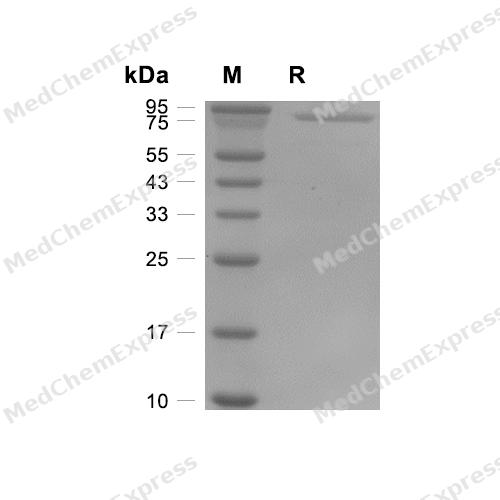
Purity - SDS-PAGE


Technical Parameters
-
Species Others
-
Source E. coli
-
Tag N-6*His
-
Accession
NP_688206 (S259-I1072)
-
Gene ID3685697
-
Molecular Construction
-
N-term
-
6*His
-
Hyaluronan Lyase (S259-I1072)
Accession # NP_688206 -
C-term
-
-
Protein Length
Partial
-
Synonyms
Hyaluronidase; SAG1197
-
AA Sequence
SEHPQPVTTQIEKSVNTALNKNYVFNKADYQYTLTNPSLGKIVGGILYPNATGSTTVKISDKSGKIIKEVPLSVTASTEDNFTKLLDKWNDVTIGNHVYDTNDSNMQKLNQKLDETNAKNIEAIKLDSNRTFLWKDLDNLNNSAQLTATYRRLEDLAKQITNPHSTIYKNEKAIRTVKESLAWLHQNFYNVNKDIEGSANWWDFEIGVPRSITGTLALMYNYFTDAEIKTYTDPIEHFVPDAGFFRKTLVNPFKALGGNLVDMGRVKIIEGLLRKDNTIIEKTSHSLKNLFTTATKAEGFYADGSYIDHTNVAYTGAYGNVLIDGLTQLLPIIQETDYKISNQELDMVYKWINQSFLPLIVKGELMDMSRGRSISREAASSHAAAVEVLRGFLRLANMSNEERNLDLKSTIKTIITSNKFYNVFNNLKSYSDIANMNKLLNDSTVATKPLKSNLSTFNSMDRLAYYNAEKDFGFALSLHSKRTLNYEGMNDENTRGWYTGDGMFYLYNSDQSHYSNHFWPTVNPYKMAGTTEKDAKREDTTKDFMSKHSKDAKEKTGQVTGASDFVGSVKLNDHFALAAMDFTNWDRTLTAQKGWVILNDKIVFLGSNIKNTNGIGNVSTTIDQRKDDSKTPYTTYVNGKTVDLKQASSQQFTDTKSVFLESKEPGRNIGYIFFKNSTIDIERKEQTGTWNSINRTSKNTSIVSNPFITISQKHDNKGDSYDYMMVPNIDRTSFDKLANSKEVELLENSSKQQVIYDKNSQTWAVIKHDNQESLINNQFKMNKAGLYLVQKVGNDYQNVYYQPQSMTKTDQLAI
-
Molecular Weight
Approximately 86 kDa, based on SDS-PAGE under reducing conditions.
-
Purity
≥ 95%, as determined by reducing SDS-PAGE.


Product Properties
Solution
Supplied as a 0.22 μm filtered solution of 50 mM Tris-HCl, 300 mM NaCL, pH 7.4.
Note: For SPR assay, please replace the buffer. Primary amine components (e.g., Tris, imidazole) can affect protein-coupled chips.
<1 EU/μg, determined by LAL method.
Stored at -80°C for 1 year from date of receipt. It is stable at -20°C for 3 months after opening. It is recommended to freeze aliquots at -80°C for extended storage. Avoid repeated freeze-thaw cycles.
Shipping with dry ice.


Documentation
-
Data Sheet (267 KB)
-
SDS (251 KB)
- English - EN (251 KB)
- Français - FR (251 KB)
- Deutsch - DE (251 KB)
- Norwegian - NO (251 KB)
- Español - ES (251 KB)
- Swedish - SV (251 KB)
- Italian - IT (251 KB)
- Korean - KR (251 KB)
- Portuguese - PT (251 KB)
-
Handling Instructions (2659 KB)


References

Calculators
Concentration (start) × Volume (start) = Concentration (final) × Volume (final)


 Powered by Bioz

