



IFN-alpha 1/IFNA13 Protein, Human (HEK293, His)
Based on 1 publication(s) in Google Scholar
IFN-alpha 1 (IFNA1), belongs to type I interferon family, is produced by macrophages with antiviral activities. IFN-alpha 1 involves in the activation of JAK1 and TYK2 pathway, exerts function by inhibiting viral replication as well as modulating immune response. IFN-alpha 1/IFNA13 Protein, Human (HEK293, His) is produced in HEK293 cells with a C-Terminal His-tag.
- Species: Human
- Source: HEK293
-
Storage:Stored at -20°C for 2 years from date of receipt. After reconstitution, it is stable at 4°C for 1 week or -20°C for longer (with carrier protein). It is recommended to freeze aliquots at -20°C or -80°C for extended storage.


To place orders, for customer services and technical support, please contact: MedChemExpress USA
Tel: 609-228-6898 E-mail: [email protected] [email protected]


-
 Biological Activity
-
Technical Parameters
-
Product Properties
- Documentation
- References
- Help & FAQs


-

HY-P7058
TNF-alpha/TNFSF2 Protein, Human -
HY-P70610
IFN-gamma Protein, Human (HEK293) -
HY-P70445
IL-4 Protein, Human -
HY-P7118
TGF beta 1/TGFB1 Protein, Human (CHO) -
HY-P73128
IFN-beta Protein, Human (CHO) -
HY-P7025
IFN-gamma Protein, Human -
HY-P7044
IL-6 Protein, Human -
HY-P73130
IFN-beta Protein, Mouse (HEK293) -
HY-P73129
IFN-beta Protein, Human (HEK293, Fc)


Biological Activity
Description
IFN-alpha 1 (IFNA1), belongs to type I interferon family, is produced by macrophages with antiviral activities[1]. IFN-alpha 1 involves in the activation of JAK1 and TYK2 pathway[4], exerts function by inhibiting viral replication as well as modulating immune response[3]. IFN-alpha 1/IFNA13 Protein, Human (HEK293, His) is produced in HEK293 cells with a C-Terminal His-tag.
Background
IFN-alpha 1 (IFNA1; IFN-α1), belongs to the alpha/beta interferon family, is produced by macrophages with antiviral activities[1]. Interferon (IFN) is originally identified as a substance ‘interfering’ with viral replication in vitro. IFN-α/β and related molecules are classified as type I IFNs, as for the other two types of type II IFN (IFN-γ) and type III IFNs (IFN-λ), respectively[2].
IFNs binds to one of three type-specific receptors, which leads to the activation of JAK1 and TYK2[3]. This signal transduction results in phosphorylation of STAT1 and STAT2 and eventually in an association with IFN regulatory factor 9 (IRF9) and formation of the IFN-stimulated gene factor 3 (ISGF3) complex. Thus the ISGF3 complex induces transcription of IFN-stimulated genes (ISGs), with subsequent immunomodulatory effects on both innate and adaptive immune responses[4].
The interactions of type I IFN with the immune system is important for the generation of a durable antitumor response through its effects on dendritic cells (DC)[5]. IFN has been widely used for animal disease model, and the sequence of amino acids in IFNA1 protein of human is very different from mouse (62.96%).
In Vitro
IFN-alpha induces highly active dendritic cells (DC) rapidly generated from blood monocytes in vitro, suitable for therapeutic vaccination of cancer research[5].
Verified Bioactivity
1. Measured by its ability to inhibit the proliferation of TF-1 human erythroleukemic cells. The ED50 this effect is 0.327 ng/mL, corresponding to a specific activity is 3.058×10⁶ units/mg.
2. Human IFN-alpha 1 immobilized on CM5 Chip can bind IFNAR2 with an affinity constant of 19.04 nM as determined in a SPR assay.
3. Measured by its ability to inhibit the proliferation of Daudi cells. The ED50 for this effect is 1.543 ng/mL, corresponding to a specific activity is 6.481×10⁵ Unit/mg.
MCE Validation Data
-
Purity - SDS-PAGE
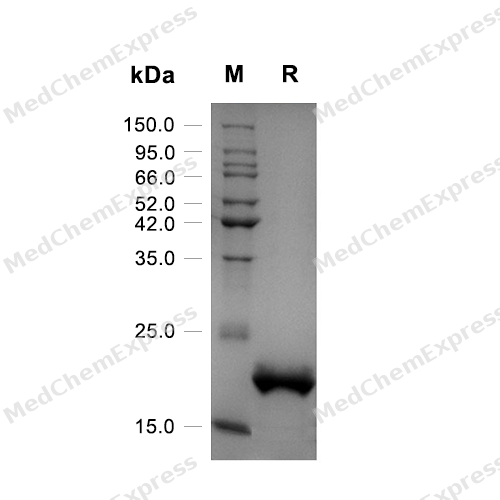
Purity - SDS-PAGE


Publications (1)
-
Journal Impact Factor
-
Most Recent
-
J Inflamm Res
Hyperoside Attenuates Lupus Nephritis-Associated Mesangial Cell Apoptosis via the P53/XAF1 Pathway: Integrative Bioinformatics and In Vitro Validation. [Abstract]2026 Mar 12:19:586751. PMID: 41847430


Technical Parameters
-
Species Human
-
Source HEK293
-
Tag C-6*His
-
Accession
P01562 (C24-E189)
-
Molecular Construction
-
N-term
-
IFNA1 (C24-E189)
Accession # P01562 -
6*His
-
C-term
-
-
Protein Length
Full Length of Mature Protein
-
Synonyms
IFNA1; Interferon Alpha-1; Interferon Alpha 1; Interferon Alpha-D; IFN-AlphaD; Interferon-Alpha1; IFN-ALPHA; IFN-Alpha-1; IFNA13; LeIF D; IFNA@; Interferon Alpha-1/13; IFL; IFN-Alpha-1/13; IFN; IFN-Alpha 1b; Interferon Alpha 1b
-
AA Sequence
CDLPETHSLDNRRTLMLLAQMSRISPSSCLMDRHDFGFPQEEFDGNQFQKAPAISVLHELIQQIFNLFTTKDSSAAWDEDLLDKFCTELYQQLNDLEACVMQEERVGETPLMNADSILAVKKYFRRITLYLTEKKYSPCAWEVVRAEIMRSLSLSTNLQERLRRKE
-
Predicted Molecular Mass
20.2 kDa
-
Molecular Weight
Approximately 17-24 kDa, based on SDS-PAGE under reducing conditions, due to the glycosylation.
-
Purity
≥ 95%, as determined by reducing SDS-PAGE.


Product Properties
Lyophilized powder
1.Lyophilized from a 0.22 μm filtered solution of 20 mM PB, 150 mM NaCl, pH 7.4.
2.Lyophilized from a 0.22 μm filtered solution of PBS, pH 7.4.
Please refer to the lot-specific COA for specific buffer information.
<1 EU/μg, determined by LAL method.
It is not recommended to reconstitute to a concentration less than 100 μg/mL in ddH2O. For long term storage it is recommended to add a carrier protein (0.1% BSA, 5% HSA, 10% FBS or 5% Trehalose).
Stored at -20°C for 2 years from date of receipt. After reconstitution, it is stable at 4°C for 1 week or -20°C for longer (with carrier protein). It is recommended to freeze aliquots at -20°C or -80°C for extended storage.
Room temperature in continental US; may vary elsewhere.


Documentation
-
Data Sheet (265 KB)
-
SDS (252 KB)
- English - EN (252 KB)
- Français - FR (252 KB)
- Deutsch - DE (252 KB)
- Norwegian - NO (252 KB)
- Español - ES (252 KB)
- Swedish - SV (252 KB)
- Italian - IT (252 KB)
- Korean - KR (252 KB)
- Portuguese - PT (252 KB)
-
Handling Instructions (2659 KB)


References
[1]. Zoon KC, et al. Purification and characterization of multiple components of human lymphoblastoid interferon-alpha. J Biol Chem. 1992 Jul 25;267(21):15210-6. [Content Brief]
[2]. Zhang SY, et al. Inborn errors of interferon (IFN)-mediated immunity in humans: insights into the respective roles of IFN-alpha/beta, IFN-gamma, and IFN-lambda in host defense. Immunol Rev. 2008 Dec;226:29-40. [Content Brief]
[3]. Gibbert K, et al. IFN-α subtypes: distinct biological activities in anti-viral therapy. Br J Pharmacol. 2013 Mar;168(5):1048-58. [Content Brief]
[4]. De Ceuninck F, et al. IFN-α: A key therapeutic target for multiple autoimmune rheumatic diseases. Drug Discov Today. 2021 Oct;26(10):2465-2473. [Content Brief]
[5]. Lapenta C, et al. IFN-Alpha-Mediated Differentiation of Dendritic Cells for Cancer Immunotherapy: Advances and Perspectives. Vaccines (Basel). 2020 Oct 19;8(4):617. [Content Brief]

Calculators
Concentration (start) × Volume (start) = Concentration (final) × Volume (final)


 Powered by Bioz

