



Integrin alpha 2B beta 3 Protein, Human (HEK293, His)
Based on 1 publication(s) in Google Scholar
Integrin alpha 2B beta 3 Protein, found on platelets, plays a crucial role in blood clotting. It binds to fibrinogen, facilitating platelet aggregation and forming stable clots. Understanding the functions of Integrin alpha 2B beta 3 Protein can help in developing therapies for clotting disorders and improving hemostasis. Integrin alpha 2B beta 3 Protein, Human (HEK293, His) is a recombinant protein dimer complex containing human-derived Integrin alpha 2B beta 3 protein, expressed by HEK293 , with C-His labeled tag. Integrin alpha 2B beta 3 Protein, Human (HEK293, His), has molecular weight of 95-115 kDa.
- Species: Human
- Source: HEK293
-
Storage:Stored at -20°C for 2 years from date of receipt. After reconstitution, it is stable at 4°C for 1 week or -20°C for longer (with carrier protein). It is recommended to freeze aliquots at -20°C or -80°C for extended storage.


To place orders, for customer services and technical support, please contact: MedChemExpress USA
Tel: 609-228-6898 E-mail: [email protected] [email protected]


-
 Biological Activity
-
Technical Parameters
-
Product Properties
- Documentation
- Help & FAQs





Biological Activity
Description
Integrin alpha 2B beta 3 Protein, found on platelets, plays a crucial role in blood clotting. It binds to fibrinogen, facilitating platelet aggregation and forming stable clots. Understanding the functions of Integrin alpha 2B beta 3 Protein can help in developing therapies for clotting disorders and improving hemostasis. Integrin alpha 2B beta 3 Protein, Human (HEK293, His) is a recombinant protein dimer complex containing human-derived Integrin alpha 2B beta 3 protein, expressed by HEK293 , with C-His labeled tag. Integrin alpha 2B beta 3 Protein, Human (HEK293, His), has molecular weight of 95-115 kDa.
Background
Integrin alpha-IIb/beta-3 serves as a versatile receptor, recognizing a diverse range of ligands such as fibronectin, fibrinogen, plasminogen, prothrombin, thrombospondin, and vitronectin. Its recognition motif includes the sequence R-G-D and the specific sequence H-H-L-G-G-G-A-K-Q-A-G-D-V in fibrinogen gamma chain. Upon activation, integrin alpha-IIb/beta-3 mediates platelet-platelet interaction through the binding of soluble fibrinogen, initiating rapid platelet aggregation that forms a physical plug on the ruptured endothelial cell surface. This heterodimeric integrin comprises an alpha subunit, consisting of heavy and light chains linked by a disulfide bond, and a beta subunit (beta-3) that associates with the alpha-IIb subunit. Integrin alpha-IIb/beta-3 engages in direct interactions with various proteins, including RNF181, CIB1, CIB2, CIB3, and CIB4, with some interactions being calcium and magnesium-dependent. Additionally, it interacts with PPIA/CYPA in a manner influenced by reactive oxygen species (ROS), PPIase activity, and thrombin presence.
Verified Bioactivity
1.Loaded Abciximab (HY-P9934) on AHC2 biosensor, can bind Integrin alpha 2B beta 3 Protein, Human (HEK293, His) with an affinity constant of 2.475E-09 M as determined in BLI assay.
2.Immobilized Anti-GPIIb/IIIa at 2 μg/mL (100 μL/well) can bind Human Integrin alpha 2B beta 3 Protein. The ED50 for this effect is 21.64 ng/mL.
MCE Validation Data
-
Purity - SDS-PAGE
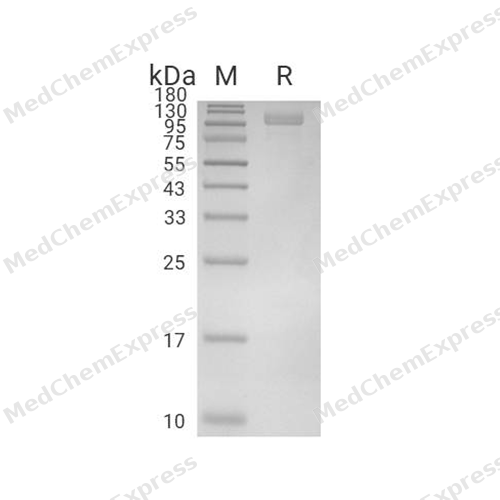
Purity - SDS-PAGE
-
Bioactivity - ELISA
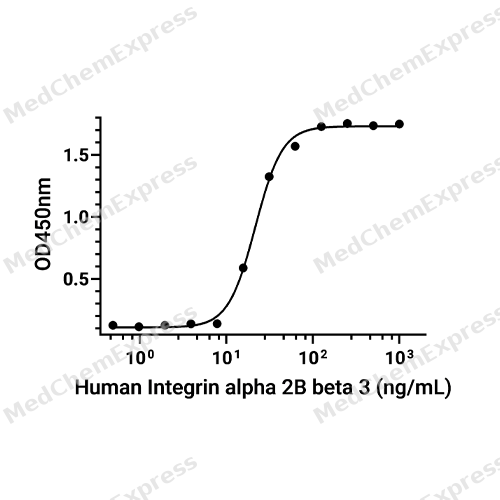
Bioactivity - ELISA
-
Bioactivity - BLI
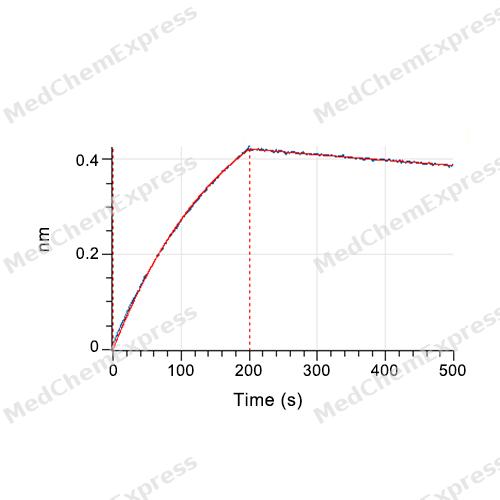
Bioactivity - BLI


Publications (1)
-
Journal Impact Factor
-
Most Recent
-
Genomics Proteomics Bioinformatics
Plasma Proteomic Profiling Reveals ITGA2B as A Key Regulator of Heart Health in High-altitude Settlers. [Abstract]2025 May 30;23(2):qzaf030. PMID: 40198259


Technical Parameters
-
Species Human
-
Source HEK293
-
Tag C-8*His
-
Synonyms
ITGA2B; Platelet Fibrinogen Receptor, Alpha Subunit; Prev. GP2B; Platelet Glycoprotein IIb; GPIIb; AlphaIIb Protein; Integrin Alpha-IIb; Glycoprotein IIb; PPP1R93; CD41 Antigen; CD41B; BDPLT16; CD41; BDPLT2; Integrin, Alpha 2b (Platelet Glycoprotein IIb O
-
AA Sequence
ITGA2B:
LNLDPVQLTFYAGPNGSQFGFSLDFHKDSHGRVAIVVGAPRTLGPSQEETGGVFLCPWRAEGGQCPSLLFDLRDETRNVGSQTLQTFKARQGLGASVVSWSDVIVACAPWQHWNVLEKTEEAEKTPVGSCFLAQPESGRRAEYSPCRGNTLSRIYVENDFSWDKRYCEAGFSSVVTQAGELVLGAPGGYYFLGLLAQAPVADIFSSYRPGILLWHVSSQSLSFDSSNPEYFDGYWGYSVAVGEFDGDLNTTEYVVGAPTWSWTLGAVEILDSYYQRLHRLRGEQMASYFGHSVAVTDVNGDGRHDLLVGAPLYMESRADRKLAEVGRVYLFLQPRGPHALGAPSLLLTGTQLYGRFGSAIAPLGDLDRDGYNDIAVAAPYGGPSGRGQVLVFLGQSEGLRSRPSQVLDSPFPTGSAFGFSLRGAVDIDDNGYPDLIVGAYGANQVAVYRAQPVVKASVQLLVQDSLNPAVKSCVLPQTKTPVSCFNIQMCVGATGHNIPQKLSLNAELQLDRQKPRQGRRVLLLGSQQAGTTLNLDLGGKHSPICHTTMAFLRDEADFRDKLSPIVLSLNVSLPPTEAGMAPAVVLHGDTHVQEQTRIVLDCGEDDVCVPQLQLTASVTGSPLLVGADNVLELQMDAANEGEGAYEAELAVHLPQGAHYMRALSNVEGFERLICNQKKENETRVVLCELGNPMKKNAQIGIAMLVSVGNLEEAGESVSFQLQIRSKNSQNPNSKIVLLDVPVRAEAQVELRGNSFPASLVVAAEEGEREQNSLDSWGPKVEHTYELHNNGPGTVNGLHLSIHLPGQSQPSDLLYILDIQPQGGLQCFPQPPVNPLKVDWGLPIPSPSPIHPAHHKRDRRQIFLPEPEQPSRLQDPVLVSCDSAPCTVVQCDLQEMARGQRAMVTVLAFLWLPSLYQRPLDQFVLQSHAWFNVSSLPYAVPPLSLPRGEAQ
VWTQLLRALE ITGB3:
GPNICTTRGVSSCQQCLAVSPMCAWCSDEALPLGSPRCDLKENLLKDNCAPESIEFPVSEARVLEDRPLSDKGSGDSSQVTQVSPQRIALRLRPDDSKNFSIQVRQVEDYPVDIYYLMDLSYSMKDDLWSIQNLGTKLATQMRKLTSNLRIGFGAFVDKPVSPYMYISPPEALENPCYDMKTTCLPMFGYKHVLTLTDQVTRFNEEVKKQSVSRNRDAPEGGFDAIMQATVCDEKIGWRNDASHLLVFTTDAKTHIALDGRLAGIVQPNDGQCHVGSDNHYSASTTMDYPSLGLMTEKLSQKNINLIFAVTENVVNLYQNYSELIPGTTVGVLSMDSSNVLQLIVDAYGKIRSKVELEVRDLPEELSLSFNATCLNNEVIPGLKSCMGLKIGDTVSFSIEAKVRGCPQEKEKSFTIKPVGFKDSLIVQVTFDCDCACQAQAEPNSHRCNNGNGTFECGVCRCGPGWLGSQCECSEEDYRPSQQDECSPREGQPVCSQRGECLCGQCVCHSSDFGKITGKYCECDDFSCVRYKGEMCSGHGQCSCGDCLCDSDWTGYYCNCTTRTDTCMSSNGLLCSGRGKCECGSCVCIQPGSYGDTCEKCPTCPDACTFKKECVECKKFDRGALHDENTCNRYCRDEIESVKELKDTGKDAVNCTYKNEDDCVVRFQYYEDSSGKSILYVVEEPECPKGPD -
Molecular Weight
Approximately 95-120 kDa, based on SDS-PAGE under reducing conditions, due to the glycosylation.
-
Glycosylation
Yes
-
Purity
≥ 95%, as determined by reducing SDS-PAGE or Bis-Tris PAGE.


Product Properties
Lyophilized powder
Lyophilized from a 0.22 μm filtered solution of PBS, pH 7.4, 8% trehalose.
<1 EU/μg, determined by LAL method.
It is not recommended to reconstitute to a concentration less than 100 μg/mL in ddH2O.
Stored at -20°C for 2 years from date of receipt. After reconstitution, it is stable at 4°C for 1 week or -20°C for longer (with carrier protein). It is recommended to freeze aliquots at -20°C or -80°C for extended storage.
Room temperature in continental US; may vary elsewhere.


Documentation
-
Data Sheet (248 KB)
-
SDS (251 KB)
- English - EN (251 KB)
- Français - FR (251 KB)
- Deutsch - DE (251 KB)
- Norwegian - NO (251 KB)
- Español - ES (251 KB)
- Swedish - SV (251 KB)
- Italian - IT (251 KB)
- Korean - KR (251 KB)
- Portuguese - PT (251 KB)
-
Handling Instructions (2659 KB)

Calculators
Concentration (start) × Volume (start) = Concentration (final) × Volume (final)


 Powered by Bioz

