



MAPKSP1 Protein, Human (His)
The MAPKSP1 protein, also known as porphobilinogen deaminase (HMBS), is crucial in the heme biosynthetic pathway and catalyzes the sequential polymerization of four porphobilinogen molecules to form hydroxymethyl bixane. The process begins with the assembly of the dipyrromethane cofactor of porphobilinogen or preuroporphyrinogen. MAPKSP1 Protein, Human (His) is the recombinant human-derived MAPKSP1 protein, expressed by E. coli , with N-6*His labeled tag.
- Species: Human
- Source: E. coli
-
Storage:Stored at -80°C for 1 year from date of receipt. It is stable at -20°C for 3 months after opening. It is recommended to freeze aliquots at -80°C for extended storage. Avoid repeated freeze-thaw cycles.


To place orders, for customer services and technical support, please contact: MedChemExpress USA
Tel: 609-228-6898 E-mail: [email protected] [email protected]


-
 Biological Activity
-
Technical Parameters
-
Product Properties
- Documentation
- Help & FAQs




Biological Activity
Description
The MAPKSP1 protein, also known as porphobilinogen deaminase (HMBS), is crucial in the heme biosynthetic pathway and catalyzes the sequential polymerization of four porphobilinogen molecules to form hydroxymethyl bixane. The process begins with the assembly of the dipyrromethane cofactor of porphobilinogen or preuroporphyrinogen. MAPKSP1 Protein, Human (His) is the recombinant human-derived MAPKSP1 protein, expressed by E. coli , with N-6*His labeled tag.
Background
HMBS, also known as Porphobilinogen deaminase, plays a crucial role in the heme biosynthetic pathway by catalyzing the sequential polymerization of four molecules of porphobilinogen, resulting in the formation of hydroxymethylbilane, also referred to as preuroporphyrinogen. The catalytic process commences with the assembly of the dipyrromethane cofactor, formed either from two molecules of porphobilinogen or from preuroporphyrinogen, by the apoenzyme. The covalently linked cofactor serves as a primer, orchestrating the assembly of the tetrapyrrole product around it. In the final step of catalysis, the product, preuroporphyrinogen, is released, while the cofactor remains bound to the holodeaminase intact, highlighting the intricate and essential role of HMBS in the synthesis of heme.
MCE Validation Data
-
Purity - SDS-PAGE
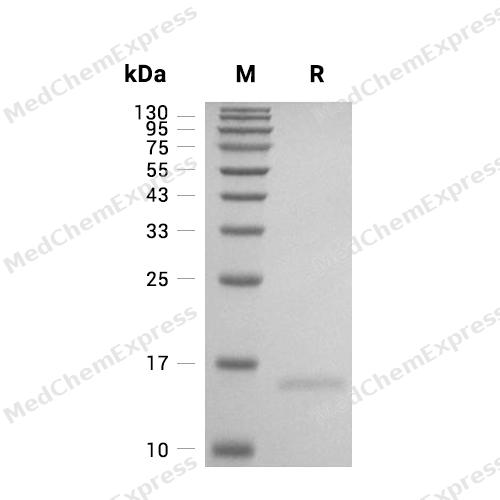
Purity - SDS-PAGE


Technical Parameters
-
Species Human
-
Source E. coli
-
Tag N-6*His
-
Accession
Q9UHA4 (M1-S124)
-
Molecular Construction
-
N-term
-
6*His
-
MAPKSP1 (M1-S124)
Accession # Q9UHA4 -
C-term
-
-
Protein Length
Full Length
-
Synonyms
LAMTOR3; Mitogen-Activated Protein Kinase Scaffold Protein 1; Prev. MAP2K1IP1; MAPK Scaffold Protein 1; Prev. MAPKSP1; Mitogen-Activated Protein Kinase Kinase 1-Interacting Protein 1; Ragulator3; MEK Binding Partner 1; MAPBP; MEK-Binding Partner 1; MP1; M
-
AA Sequence
MADDLKRFLYKKLPSVEGLHAIVVSDRDGVPVIKVANDNAPEHALRPGFLSTFALATDQGSKLGLSKNKSIICYYNTYQVVQFNRLPLVVSFIASSSANTGLIVSLEKELAPLFEELRQVVEVS
-
Predicted Molecular Mass
15.8 kDa
-
Molecular Weight
Approximately 15 kDa, based on SDS-PAGE under reducing conditions.
-
Purity
≥ 95%, as determined by reducing SDS-PAGE.


Product Properties
Solution
<1 EU/μg, determined by LAL method.
Stored at -80°C for 1 year from date of receipt. It is stable at -20°C for 3 months after opening. It is recommended to freeze aliquots at -80°C for extended storage. Avoid repeated freeze-thaw cycles.
Shipping with dry ice.


Documentation
-
Data Sheet (235 KB)
-
SDS (251 KB)
- English - EN (251 KB)
- Français - FR (251 KB)
- Deutsch - DE (251 KB)
- Norwegian - NO (251 KB)
- Español - ES (251 KB)
- Swedish - SV (251 KB)
- Italian - IT (251 KB)
- Korean - KR (251 KB)
- Portuguese - PT (251 KB)
-
Handling Instructions (2659 KB)

Calculators
Concentration (start) × Volume (start) = Concentration (final) × Volume (final)


 Powered by Bioz

