



Nucleoprotein/NP Protein, Influenza A virus H3N2 (His-SUMO)

Based on 1 Customer Validation
The Nucleoprotein/NP Protein in the influenza virus is crucial for viral replication and transcription. It binds to viral RNA, forming a ribonucleoprotein complex necessary for genome replication. NP Protein also interacts with host proteins, facilitating viral pathogenesis and immune evasion. Understanding NP Protein's functions can aid in developing antiviral strategies against influenza infections. Nucleoprotein/NP Protein, Influenza A virus H3N2 (His-SUMO) is the recombinant Virus-derived Nucleoprotein/NP protein, expressed by E. coli , with N-SUMO, N-6*His labeled tag.
- Species: Virus
- Source: E. coli
-
Storage:Stored at -20°C for 2 years from date of receipt. After reconstitution, it is stable at 4°C for 1 week or -20°C for longer (with carrier protein). It is recommended to freeze aliquots at -20°C or -80°C for extended storage.


To place orders, for customer services and technical support, please contact: MedChemExpress USA
Tel: 609-228-6898 E-mail: [email protected] [email protected]


-
 Biological Activity
-
Technical Parameters
-
Product Properties
- Documentation
- Help & FAQs




Biological Activity
Description
The Nucleoprotein/NP Protein in the influenza virus is crucial for viral replication and transcription. It binds to viral RNA, forming a ribonucleoprotein complex necessary for genome replication. NP Protein also interacts with host proteins, facilitating viral pathogenesis and immune evasion. Understanding NP Protein's functions can aid in developing antiviral strategies against influenza infections. Nucleoprotein/NP Protein, Influenza A virus H3N2 (His-SUMO) is the recombinant Virus-derived Nucleoprotein/NP protein, expressed by E. coli , with N-SUMO, N-6*His labeled tag.
Background
Furthermore, the protein plays a role in repressing the innate antiviral response by facilitating the formation of the NMI-IFI35 complex through ubiquitination of NMI. During viral infection, it promotes cell pyroptosis by mediating ubiquitination of ISG12a/IFI27 and facilitating its translocation into the mitochondria, leading to CASP3 activation. It also mediates polyubiquitination of G3BP1 in response to heat shock, resulting in stress granule disassembly.
MCE Validation Data
-
Purity - SDS-PAGE
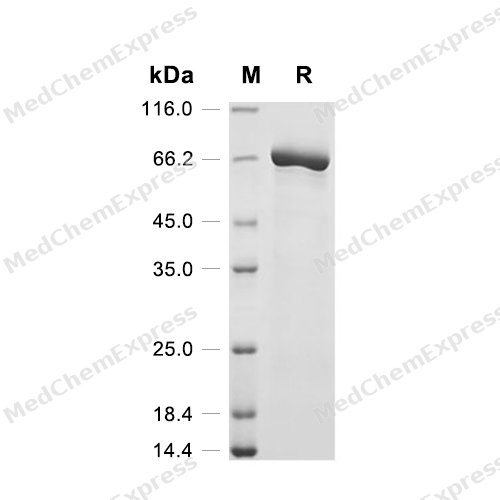
Purity - SDS-PAGE


Technical Parameters
-
Species Virus
-
Source E. coli
-
Tag N-SUMO;N-6*His
-
Accession
P69291 (M1-N498)
-
Gene ID/
-
Molecular Construction
-
N-term
-
6*His-SUMO
-
Nucleoprotein (M1-N498)
Accession # P69291 -
C-term
-
-
Protein Length
Full Length
-
Synonyms
NP; Nucleoprotein; Nucleocapsid protein; Protein N
-
AA Sequence
MASQGTKRSYEQMETDGERQNATEIRASVGKMIDGIGRFYIQMCTELKLSDYEGRLIQNSLTVERMVLSAFDERRNRYLEEHPSAGKDPKKTGGPIYKRVGGRWMRELVLYDKEEIRRIWRQANNGDDATRGLTHMMIWHSNLNDTTYQRTRALVRTGMDPRMCSLMQGSTLPRRSGAAGAAVKGIGTMVMELIRMIKRGINDRNFWRGENGRKTRSAYERMCNILKGKFQTAAQRAMMDQVRESRNPGNAEIEDLIFSARSALILRGSVAHKSCLPACVYGPAVSSGYDFEKEGYSLVGIDPFKLLQNSQVYSLIRPNENPAHKSQLVWMACHSAAFEDLRLLSFIRGTKVSPRGKLSTRGVQIASNENMDNMESSTLELRSRYWAIRTRSGGNTNQQRASAGQISVQPTFSVQRNLPFEKSTVMAAFTGNTEGRTSDMRAEIIRMMEGAKPEEVSFRGRGVFELSDEKATNPIVPSFDMSNEGSYFFGDNAEEYDN
-
Predicted Molecular Mass
72.2 kDa
-
Molecular Weight
Approximately 72 kDa, based on SDS-PAGE under reducing conditions.
-
Purity
≥ 90%, as determined by reducing SDS-PAGE.


Product Properties
Lyophilized powder.
Lyophilized from a 0.22 μm filtered solution of 20 mM Tris-HCl, 0.5 M NaCl, 6% trehalose, pH 8.0.
Note: For SPR assay, please replace the buffer. Primary amine components (e.g., Tris, imidazole) can affect protein-coupled chips.
<1.0 EU/μg, determined by LAL method.
It is not recommended to reconstitute to a concentration less than 100 μg/mL in ddH2O.
Stored at -20°C for 2 years from date of receipt. After reconstitution, it is stable at 4°C for 1 week or -20°C for longer (with carrier protein). It is recommended to freeze aliquots at -20°C or -80°C for extended storage.
Room temperature in continental US; may vary elsewhere.


Documentation
-
Data Sheet (238 KB)
-
SDS (251 KB)
- English - EN (251 KB)
- Français - FR (251 KB)
- Deutsch - DE (251 KB)
- Norwegian - NO (251 KB)
- Español - ES (251 KB)
- Swedish - SV (251 KB)
- Italian - IT (251 KB)
- Korean - KR (251 KB)
- Portuguese - PT (251 KB)
-
Handling Instructions (2659 KB)

Calculators
Concentration (start) × Volume (start) = Concentration (final) × Volume (final)


 Powered by Bioz

