



Outer membrane protein A/OmpA Protein, E.coli (His-SUMO)
Based on 1 publication(s) in Google Scholar
Outer membrane protein A (OmpA) ensures the structural integrity of the bacterial cell wall and cooperates with TolR to stabilize the peptidoglycan layer. As a porin, OmpA controls the permeability of small solutes. Outer membrane protein A/OmpA Protein, E.coli (His-SUMO) is the recombinant E. coli-derived Outer membrane protein A/OmpA protein, expressed by E. coli , with N-SUMO, N-6*His labeled tag.
- Species: E.coli
- Source: E. coli
-
Storage:Stored at -20°C for 2 years from date of receipt. After reconstitution, it is stable at 4°C for 1 week or -20°C for longer (with carrier protein). It is recommended to freeze aliquots at -20°C or -80°C for extended storage.


To place orders, for customer services and technical support, please contact: MedChemExpress USA
Tel: 609-228-6898 E-mail: [email protected] [email protected]


-
 Biological Activity
-
Technical Parameters
-
Product Properties
- Documentation
- Help & FAQs




Biological Activity
Description
Outer membrane protein A (OmpA) ensures the structural integrity of the bacterial cell wall and cooperates with TolR to stabilize the peptidoglycan layer. As a porin, OmpA controls the permeability of small solutes. Outer membrane protein A/OmpA Protein, E.coli (His-SUMO) is the recombinant E. coli-derived Outer membrane protein A/OmpA protein, expressed by E. coli , with N-SUMO, N-6*His labeled tag.
Background
Outer membrane protein A (OmpA) plays a crucial role in the structural integrity of the bacterial cell wall, working in concert with TolR to maintain the position of the peptidoglycan layer in the periplasm. Functioning as a porin, OmpA exhibits low permeability, facilitating the gradual penetration of small solutes through its structure. The internal gate within OmpA further regulates the passage of solutes, influencing the selective transport of molecules. Additionally, OmpA's significance extends to its involvement in conjugation with F-type plasmids, where it likely serves as the essential mating receptor on recipient cells, contributing to the horizontal transfer of genetic material.
MCE Validation Data
-
Purity - SDS-PAGE
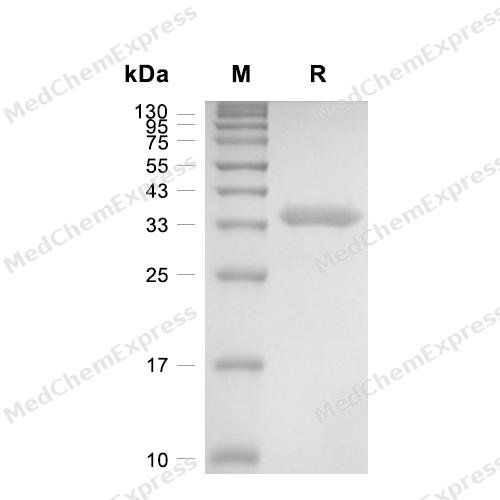
Purity - SDS-PAGE


Publications (1)
-
Journal Impact Factor
-
Most Recent


Technical Parameters
-
Species E.coli
-
Source E. coli
-
Tag N-SUMO;N-6*His
-
Accession
P0A911 (W164-A346)
-
Gene ID917123 [NCBI]
-
Molecular Construction
-
N-term
-
6*His-SUMO
-
OmpA (W164-A346)
Accession # P0A911 -
C-term
-
-
Protein Length
Partial
-
Synonyms
ompA; Z1307; ECs1041; Outer membrane protein A; Outer membrane porin A
-
AA Sequence
WTNNIGDAHTIGTRPDNGMLSLGVSYRFGQGEAAPVVAPAPAPAPEVQTKHFTLKSDVLFNFNKATLKPEGQAALDQLYSQLSNLDPKDGSVVVLGYTDRIGSDAYNQGLSERRAQSVVDYLISKGIPADKISARGMGESNPVTGNTCDNVKQRAALIDCLAPDRRVEIEVKGIKDVVTQPQA
-
Molecular Weight
Approximately 36 kDa, based on SDS-PAGE under reducing conditions.
-
Purity
≥ 90%, as determined by reducing SDS-PAGE.


Product Properties
Lyophilized powder
Lyophilized from a 0.22 μm sterile filtered 20 mM Tris-HCl, 0.5 M NaCl, 6%
Trehalose, pH 8.0.
Note: For SPR assay, please replace the buffer. Primary amine components (e.g., Tris, imidazole) can affect protein-coupled chips.
<1 EU/μg, determined by LAL method.
It is not recommended to reconstitute to a concentration less than 100 μg/mL in ddH2O.
Stored at -20°C for 2 years from date of receipt. After reconstitution, it is stable at 4°C for 1 week or -20°C for longer (with carrier protein). It is recommended to freeze aliquots at -20°C or -80°C for extended storage.
Room temperature in continental US; may vary elsewhere.


Documentation
-
Data Sheet (236 KB)
-
SDS (251 KB)
- English - EN (251 KB)
- Français - FR (251 KB)
- Deutsch - DE (251 KB)
- Norwegian - NO (251 KB)
- Español - ES (251 KB)
- Swedish - SV (251 KB)
- Italian - IT (251 KB)
- Korean - KR (251 KB)
- Portuguese - PT (251 KB)
-
Handling Instructions (2659 KB)

Calculators
Concentration (start) × Volume (start) = Concentration (final) × Volume (final)


 Powered by Bioz

