



PLGF Protein, Rhesus macaque (HEK293, His)
Based on 1 Customer Validation
PLGF protein is an important growth factor in angiogenesis and endothelial cell growth, stimulating cell proliferation and migration by binding to the FLT1/VEGFR-1 receptor. PLGF plays a crucial role in angiogenesis and also contributes to tumor growth, highlighting its involvement in pathological angiogenesis. PLGF Protein, Rhesus macaque (HEK293, His) is the recombinant Rhesus Macaque-derived PLGF protein, expressed by HEK293 , with C-6*His labeled tag.
- Species: Rhesus Macaque
- Source: HEK293
-
Storage:Stored at -20°C for 2 years from date of receipt. After reconstitution, it is stable at 4°C for 1 week or -20°C for longer (with carrier protein). It is recommended to freeze aliquots at -20°C or -80°C for extended storage.


To place orders, for customer services and technical support, please contact: MedChemExpress USA
Tel: 609-228-6898 E-mail: [email protected] [email protected]


-
 Biological Activity
-
Technical Parameters
-
Product Properties
- Documentation
- Help & FAQs




Biological Activity
Description
PLGF protein is an important growth factor in angiogenesis and endothelial cell growth, stimulating cell proliferation and migration by binding to the FLT1/VEGFR-1 receptor. PLGF plays a crucial role in angiogenesis and also contributes to tumor growth, highlighting its involvement in pathological angiogenesis. PLGF Protein, Rhesus macaque (HEK293, His) is the recombinant Rhesus Macaque-derived PLGF protein, expressed by HEK293 , with C-6*His labeled tag.
Background
The PLGF Protein, a growth factor integral to angiogenesis and endothelial cell growth, exhibits stimulatory effects on both proliferation and migration of these cells. Functioning through its binding to the FLT1/VEGFR-1 receptor, PLGF plays a crucial role in orchestrating angiogenic processes. Additionally, it contributes to tumor growth, emphasizing its involvement in pathological angiogenesis. Structurally, PLGF exists as an antiparallel homodimer, connected by disulfide linkages. Furthermore, it can form heterodimers with VEGFA/VEGF, suggesting a dynamic role in the regulation of vascular growth and function. The multifaceted actions and structural arrangements of PLGF underscore its significance in modulating vascular processes and tumor development.
Verified Bioactivity
Measured in a cell proliferation assay using MDA-MB-231 Human Breast Cancer Cells. The ED50 for this effect is 1.493 μg/mL, corresponding to a specific activity is 669.792 units/mg.
MCE Validation Data
-
Bioactivity - Cell-Based Assay
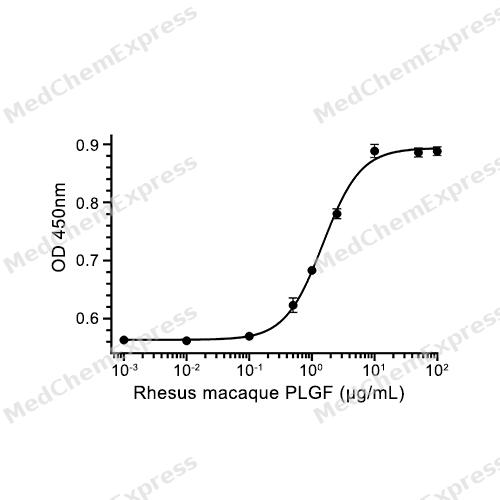
Bioactivity - Cell-Based Assay


Technical Parameters
-
Species Rhesus Macaque
-
Source HEK293
-
Tag C-6*His
-
Accession
F7HB10 (L19-R170)
-
Molecular Construction
-
N-term
-
PLGF (L19-R170)
Accession # F7HB10 -
6*His
-
C-term
-
-
Protein Length
Partial
-
Synonyms
PGF; PlGF-2; Prev. PGFL; Placental Growth Factor, Vascular Endothelial Growth Factor-Related Protein; PLGF; Placental Growth Factor, Vascular Endothelial Growth Factor-Related Protein, Isoform CRA_a; Placenta Growth Factor; Placental Growth Factor-Like; S
-
AA Sequence
LPAVPPQQWALSPGNGSSEVEVVPFQEVWGRSYCRALERLVDIVSEYPSEVEHMFSPSCVSLLRCTGCCGDENLHCVPVETVNVTMQLLKIRSGDRPSYVELTFSQHVRCECRPLREKMKPERRRPKGRGKRRREKQRPTDCHLCGDAVPRR
-
Predicted Molecular Mass
19.3 kDa
-
Molecular Weight
Approximately 28-34 kDa, based on SDS-PAGE under reducing conditions.
-
Purity
≥ 95%, as determined by reducing SDS-PAGE.


Product Properties
Lyophilized powder.
Lyophilized from a 0.22 μm filtered solution of 20 mM PB, 150 mM NaCl, pH 7.4.
<1 EU/μg, determined by LAL method.
It is not recommended to reconstitute to a concentration less than 100 μg/mL in ddH2O. For long term storage it is recommended to add a carrier protein (0.1% BSA, 5% HSA, 10% FBS or 5% Trehalose).
Stored at -20°C for 2 years from date of receipt. After reconstitution, it is stable at 4°C for 1 week or -20°C for longer (with carrier protein). It is recommended to freeze aliquots at -20°C or -80°C for extended storage.
Room temperature in continental US; may vary elsewhere.


Documentation
-
Data Sheet (236 KB)
-
SDS (251 KB)
- English - EN (251 KB)
- Français - FR (251 KB)
- Deutsch - DE (251 KB)
- Norwegian - NO (251 KB)
- Español - ES (251 KB)
- Swedish - SV (251 KB)
- Italian - IT (251 KB)
- Korean - KR (251 KB)
- Portuguese - PT (251 KB)
-
Handling Instructions (2659 KB)

Calculators
Concentration (start) × Volume (start) = Concentration (final) × Volume (final)


 Powered by Bioz

