



PPT1 Protein, Human (HEK293, His)
Based on 1 publication(s) in Google Scholar
PPT1 (palmitoyl protein thioesterase 1) crucially promotes lysosomal degradation by specifically removing thioester-linked fatty acyl groups, especially palmitate, from modified cysteine residues in proteins. Its enzymatic activity is particularly suited to acyl chain lengths of 14 to 18 carbons, facilitating the breakdown of target proteins during lysosomal degradation. PPT1 Protein, Human (HEK293, His) is the recombinant human-derived PPT1 protein, expressed by HEK293 , with C-6*His labeled tag.
- Species: Human
- Source: HEK293
-
Storage:Stored at -80°C for 1 year from date of receipt. It is stable at -20°C for 3 months after opening. It is recommended to freeze aliquots at -80°C for extended storage. Avoid repeated freeze-thaw cycles.


To place orders, for customer services and technical support, please contact: MedChemExpress USA
Tel: 609-228-6898 E-mail: [email protected] [email protected]


-
 Biological Activity
-
Technical Parameters
-
Product Properties
- Documentation
- Help & FAQs




Biological Activity
Description
PPT1 (palmitoyl protein thioesterase 1) crucially promotes lysosomal degradation by specifically removing thioester-linked fatty acyl groups, especially palmitate, from modified cysteine residues in proteins. Its enzymatic activity is particularly suited to acyl chain lengths of 14 to 18 carbons, facilitating the breakdown of target proteins during lysosomal degradation. PPT1 Protein, Human (HEK293, His) is the recombinant human-derived PPT1 protein, expressed by HEK293 , with C-6*His labeled tag.
Background
PPT1, or palmitoyl-protein thioesterase 1, plays a crucial role in lysosomal degradation by efficiently removing thioester-linked fatty acyl groups, particularly palmitate, from modified cysteine residues in proteins or peptides. This enzymatic activity is highly specific, exhibiting a preference for acyl chain lengths ranging from 14 to 18 carbons. The targeted removal of these acyl groups contributes to the breakdown of proteins during lysosomal degradation, emphasizing PPT1's significance in cellular processes related to lipid metabolism and protein turnover.
Verified Bioactivity
The enzyme activity of this recombinant protein is testing in progress, we cannot offer a guarantee yet.
MCE Validation Data
-
Purity - SDS-PAGE
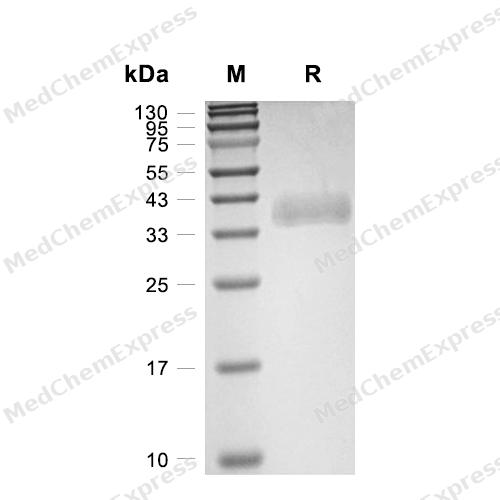
Purity - SDS-PAGE


Publications (1)
-
Journal Impact Factor
-
Most Recent
-
Cell Signal
2026 Jul:143:112502. PMID: 41865945


Technical Parameters
-
Species Human
-
Source HEK293
-
Tag C-6*His
-
Accession
P50897-1 (D28-G306)
-
Molecular Construction
-
N-term
-
PPT1 (D28-G306)
Accession # P50897-1 -
6*His
-
C-term
-
-
Protein Length
Full Length of Isoform-1
-
Synonyms
PPT1; INCL; Prev. PPT; Ceroid-Lipofuscinosis, Neuronal 1, Infantile; CLN1; PPT-1; Palmitoyl-Protein Hydrolase 1; Palmitoyl-Protein Thioesterase 1; Ceroid-Palmitoyl-Palmitoyl-Protein Thioesterase 1
-
AA Sequence
DPPAPLPLVIWHGMGDSCCNPLSMGAIKKMVEKKIPGIYVLSLEIGKTLMEDVENSFFLNVNSQVTTVCQALAKDPKLQQGYNAMGFSQGGQFLRAVAQRCPSPPMINLISVGGQHQGVFGLPRCPGESSHICDFIRKTLNAGAYSKVVQERLVQAEYWHDPIKEDVYRNHSIFLADINQERGINESYKKNLMALKKFVMVKFLNDSIVDPVDSEWFGFYRSGQAKETIPLQETSLYTQDRLGLKEMDNAGQLVFLATEGDHLQLSEEWFYAHIIPFLG
-
Predicted Molecular Mass
32.3 kDa
-
Molecular Weight
Approximately 34-41 kDa, based on SDS-PAGE under reducing conditions.
-
Glycosylation
Yes
-
Purity
≥ 95%, as determined by reducing SDS-PAGE.


Product Properties
Solution
Supplied as a 0.22 μm filtered solution of 20 mM Tris-HCl, 150 mM NaCl, 10% glycerol, pH 7.5.
Note: For SPR assay, please replace the buffer. Primary amine components (e.g., Tris, imidazole) can affect protein-coupled chips.
<1 EU/μg, determined by LAL method.
Stored at -80°C for 1 year from date of receipt. It is stable at -20°C for 3 months after opening. It is recommended to freeze aliquots at -80°C for extended storage. Avoid repeated freeze-thaw cycles.
Shipping with dry ice.


Documentation
-
Data Sheet (237 KB)
-
SDS (251 KB)
- English - EN (251 KB)
- Français - FR (251 KB)
- Deutsch - DE (251 KB)
- Norwegian - NO (251 KB)
- Español - ES (251 KB)
- Swedish - SV (251 KB)
- Italian - IT (251 KB)
- Korean - KR (251 KB)
- Portuguese - PT (251 KB)
-
Handling Instructions (2659 KB)

Calculators
Concentration (start) × Volume (start) = Concentration (final) × Volume (final)


 Powered by Bioz

