



Profilin-2 Protein, Human (His)

Based on 1 Customer Validation
Profilin-2 protein is a key player in protein folding. It specifically binds to cytosolic chaperone protein (c-CPN) and promotes the transfer of target proteins. It also interacts with nascent polypeptide chains, helping unnatural proteins fold correctly in various competing pathways. Profilin-2 Protein, Human (His) is the recombinant human-derived Profilin-2 protein, expressed by E. coli , with N-6*His labeled tag.
- Species: Human
- Source: E. coli
-
Storage:Stored at -20°C for 2 years from date of receipt. After reconstitution, it is stable at 4°C for 1 week or -20°C for longer (with carrier protein). It is recommended to freeze aliquots at -20°C or -80°C for extended storage.


To place orders, for customer services and technical support, please contact: MedChemExpress USA
Tel: 609-228-6898 E-mail: [email protected] [email protected]


-
 Biological Activity
-
Technical Parameters
-
Product Properties
- Documentation
- Help & FAQs




Biological Activity
Description
Profilin-2 protein is a key player in protein folding. It specifically binds to cytosolic chaperone protein (c-CPN) and promotes the transfer of target proteins. It also interacts with nascent polypeptide chains, helping unnatural proteins fold correctly in various competing pathways. Profilin-2 Protein, Human (His) is the recombinant human-derived Profilin-2 protein, expressed by E. coli , with N-6*His labeled tag.
Background
PFDN2, a key player in protein folding, exhibits a specific binding affinity for cytosolic chaperonin (c-CPN), facilitating the transfer of target proteins to this complex. Additionally, PFDN2 interacts with nascent polypeptide chains, promoting their proper folding in an environment where various competing pathways for nonnative proteins exist. The heterohexameric structure of PFDN2 comprises two PFD-alpha type and four PFD-beta type subunits. Moreover, PFDN2 is an integral component of the PAQosome complex, collaborating with other members such as RUVBL1, RUVBL2, RPAP3, PIH1D1, PFDN6, PDRG1, UXT, URI1, ASDURF, POLR2E, and DNAAF10/WDR92 in the biogenesis of diverse protein complexes. Notably, the interaction between PFDN2 and URI1 is phosphorylation-dependent and exhibits a growth-dependent pattern, highlighting the intricate regulatory mechanisms involved in cellular processes.
MCE Validation Data
-
Purity - SDS-PAGE
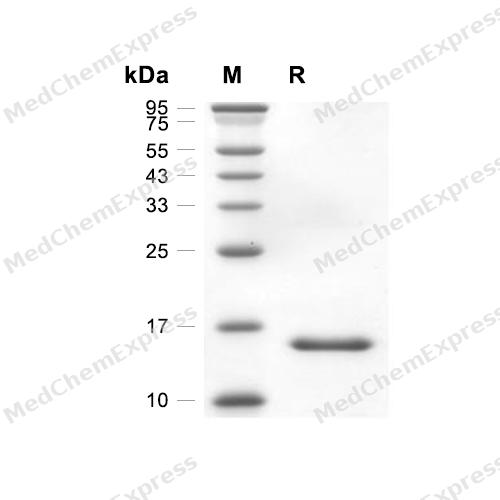
Purity - SDS-PAGE


Technical Parameters
-
Species Human
-
Source E. coli
-
Tag N-6*His
-
Accession
AAH18049.1 (M1-F140)
-
Molecular Construction
-
N-term
-
6*His
-
Profilin-2 (M1-F140)
Accession # AAH18049.1 -
C-term
-
-
Protein Length
Full Length
-
Synonyms
PFN2; D3S1319E; Profilin 2; Profilin; Profilin II; PFL; Profilin-2
-
AA Sequence
MAGWQSYVDNLMCDGCCQEAAIVGYCDAKYVWAATAGGVFQSITPIEIDMIVGKDREGFFTNGLALGAKKCSVIRDSLYVDGDCTMDIRTKSQGGEPTYNVAVGRAGRVLVFVMGKEGVHGGGLNKKAYSMAKYLRDSGF
-
Molecular Weight
Approximately 16 kDa, based on SDS-PAGE under reducing conditions.
-
Purity
≥ 95%, as determined by reducing SDS-PAGE.


Product Properties
Lyophilized powder.
Lyophilized from a 0.22 μm filtered solution of PBS, 300 mM NaCl, 500 mM arginine, pH 7.4.
<1 EU/μg, determined by LAL method.
It is not recommended to reconstitute to a concentration less than 100 μg/mL in ddH2O. For long term storage it is recommended to add a carrier protein (0.1% BSA, 5% HSA, 10% FBS or 5% Trehalose).
Stored at -20°C for 2 years from date of receipt. After reconstitution, it is stable at 4°C for 1 week or -20°C for longer (with carrier protein). It is recommended to freeze aliquots at -20°C or -80°C for extended storage.
Room temperature in continental US; may vary elsewhere.


Documentation
-
Data Sheet (235 KB)
-
SDS (251 KB)
- English - EN (251 KB)
- Français - FR (251 KB)
- Deutsch - DE (251 KB)
- Norwegian - NO (251 KB)
- Español - ES (251 KB)
- Swedish - SV (251 KB)
- Italian - IT (251 KB)
- Korean - KR (251 KB)
- Portuguese - PT (251 KB)
-
Handling Instructions (2659 KB)

Calculators
Concentration (start) × Volume (start) = Concentration (final) × Volume (final)


 Powered by Bioz

