



Prolactin Protein, Sheep (HEK293, His)

Based on 1 Customer Validation
Prolactin Protein, Sheep, (HEK293, His) is a recombinant protein produced by HEK293 cells. Prolactin (PRL) is a 199-amino acid polypeptide hormone mainly synthesized by lactotrope cells in the anterior pituitary. In rodents, PRL has been detected in the preoptic area, hypothalamus, amygdala, and brainstem.
- Species: Sheep
- Source: HEK293
-
Storage:Stored at -20°C for 2 years from date of receipt. After reconstitution, it is stable at 4°C for 1 week or -20°C for longer (with carrier protein). It is recommended to freeze aliquots at -20°C or -80°C for extended storage.


To place orders, for customer services and technical support, please contact: MedChemExpress USA
Tel: 609-228-6898 E-mail: [email protected] [email protected]


-
 Biological Activity
-
Technical Parameters
-
Product Properties
- Documentation
- References
- Help & FAQs




Biological Activity
Description
Prolactin Protein, Sheep, (HEK293, His) is a recombinant protein produced by HEK293 cells. Prolactin (PRL) is a 199-amino acid polypeptide hormone mainly synthesized by lactotrope cells in the anterior pituitary. In rodents, PRL has been detected in the preoptic area, hypothalamus, amygdala, and brainstem[1].
Background
PRL actions are mediated by PRL receptors, which belong to the cytokine class 1 receptor superfamily and exist as short and long isoforms. Both long and short forms of the PRL receptor are expressed in the preoptic area, hypothalamus, and amygdala, among other brain regions of rodents. A great variety of biological effects of PRL have been described in adult animals many of which relate to reproduction. PRL increases the synthesis and turnover of dopamine in the basal hypothalamus, in an arrangement that allows it to feedback to inhibit PRL release[1].
Verified Bioactivity
Measured in a cell proliferation assay using Nb2-11 rat lymphoma cells. The ED50 for this effect is 0.09207-0.2578 ng/mL.
MCE Validation Data
-
Purity - SDS-PAGE
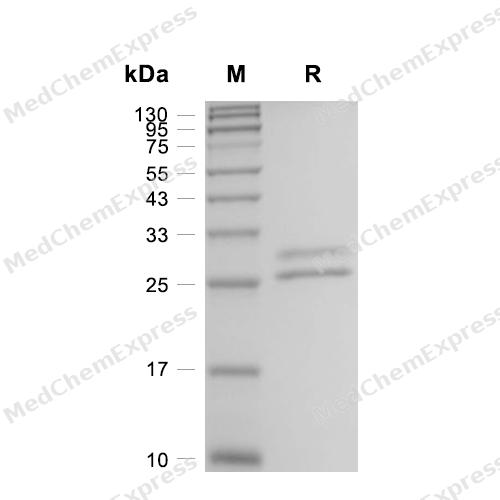
Purity - SDS-PAGE
-
Bioactivity - Cell-Based Assay
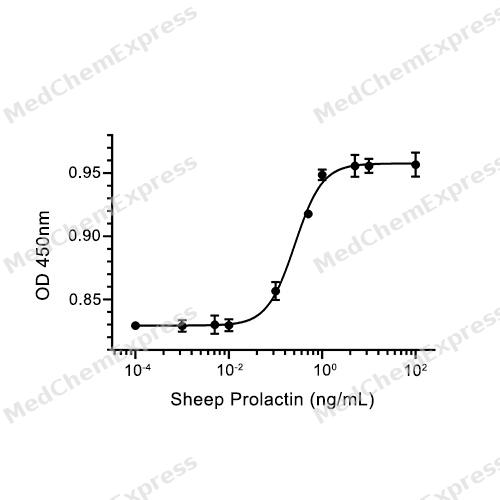
Bioactivity - Cell-Based Assay


Technical Parameters
-
Species Sheep
-
Source HEK293
-
Tag C-6*His
-
Accession
P01240 (T31-C229)
-
Gene ID443317 [NCBI]
-
Molecular Construction
-
N-term
-
Prolactin (T31-C229)
Accession # P01240 -
6*His
-
C-term
-
-
Protein Length
Full Length of Mature Protein
-
Synonyms
PRL; PPRL; Prolactin; GHA1; Luteotropic Hormone; Decidual Prolactin; Prolactin Peptide; Growth Hormone A1; Luteotropin
-
AA Sequence
TPVCPNGPGNCQVSLRDLFDRAVMVSHYIHNLSSEMFNEFDKRYAQGKGFITMALNSCHTSSLPTPEDKEQAQQTHHEVLMSLILGLLRSWNDPLYHLVTEVRGMKGVPDAILSRAIEIEEENKRLLEGMEMIFGQVIPGAKETEPYPVWSGLPSLQTKDEDARHSAFYNLLHCLRRDSSKIDTYLKLLNCRIIYNNNC
-
Molecular Weight
Approximately 25-30 kDa, based on SDS-PAGE under reducing conditions.
-
Glycosylation
Yes
-
Purity
≥ 95%, as determined by reducing SDS-PAGE.


Product Properties
Lyophilized powder
1.Lyophilized from a 0.22 μm filtered solution of 20 mM Tris-HCl, 150 mM NaCl, pH 8.0.
2.Lyophilized from a 0.22 μm filtered solution of PBS, pH 7.4, 8% trehalose.
Note: For SPR assay, please replace the buffer. Primary amine components (e.g., Tris, imidazole) can affect protein-coupled chips.
<1 EU/μg, determined by LAL method.
It is not recommended to reconstitute to a concentration less than 100 μg/mL in ddH2O. For long term storage it is recommended to add a carrier protein (0.1% BSA, 5% HSA, 10% FBS or 5% Trehalose).
Stored at -20°C for 2 years from date of receipt. After reconstitution, it is stable at 4°C for 1 week or -20°C for longer (with carrier protein). It is recommended to freeze aliquots at -20°C or -80°C for extended storage.
Room temperature in continental US; may vary elsewhere.


Documentation
-
Data Sheet (262 KB)
-
SDS (251 KB)
- English - EN (251 KB)
- Français - FR (251 KB)
- Deutsch - DE (251 KB)
- Norwegian - NO (251 KB)
- Español - ES (251 KB)
- Swedish - SV (251 KB)
- Italian - IT (251 KB)
- Korean - KR (251 KB)
- Portuguese - PT (251 KB)
-
Handling Instructions (2659 KB)


References

Calculators
Concentration (start) × Volume (start) = Concentration (final) × Volume (final)


 Powered by Bioz

