



Protein E6, HPV16 (His)

Based on 1 Customer Validation
HPV16 E6 is a viral phosphoprotein with oncogenic activity, belonging to the human papillomavirus early protein family. HPV16 E6 activates the cell cycle by releasing E2F through proteasome degradation of pRB. HPV16 E6 can cooperate with E6 to immortalize cells and neutralize the toxicity of E5, while activating the AP-1/NF-κB pathway and downregulating E-cadherin to enhance migration and invasion, making it a core target for cervical cancer. Protein E6, HPV16 (His) is a recombinant HPV E6 protein expressed from E. coli with an N-6*His tag.
- Species: Virus
- Source: E. coli
-
Storage:Stored at -20°C for 2 years from date of receipt. After reconstitution, it is stable at 4°C for 1 week or -20°C for longer (with carrier protein). It is recommended to freeze aliquots at -20°C or -80°C for extended storage.


To place orders, for customer services and technical support, please contact: MedChemExpress USA
Tel: 609-228-6898 E-mail: [email protected] [email protected]


-
 Biological Activity
-
Technical Parameters
-
Product Properties
- Documentation
- References
- Help & FAQs




Biological Activity
Description
HPV16 E6 is a viral phosphoprotein with oncogenic activity, belonging to the human papillomavirus early protein family. HPV16 E6 activates the cell cycle by releasing E2F through proteasome degradation of pRB. HPV16 E6 can cooperate with E6 to immortalize cells and neutralize the toxicity of E5, while activating the AP-1/NF-κB pathway and downregulating E-cadherin to enhance migration and invasion, making it a core target for cervical cancer. Protein E6, HPV16 (His) is a recombinant HPV E6 protein expressed from E. coli with an N-6*His tag.
Background
HPV16 E6 is a multifunctional nuclear phosphoprotein and a key oncoprotein in HPV16 carcinogenesis. HPV16 E6 belongs to the human papillomavirus early protein family. The C-terminal region of HPV16 E6 contains a conserved Cys-X-X-Cys motif, which can reversibly bind to Zn2+ and stabilize the protein structure. The N-terminus of HPV16 E6 has functional similarities with adenovirus E1A protein, facilitating interaction with cellular tumor suppressors[1][2].
HPV16 E6 binds to the tumor suppressor protein p53 through E6-associated protein (E6AP), promotes its ubiquitination and proteasomal degradation, releases transcription factor E2F, activates the cell cycle and inhibits apoptosis. In addition, HPV16 E6 synergizes with E7 to immortalize primary human keratinocytes and neutralize E5-induced cytotoxicity. HPV16 E6 can also activate AP-1 and NF-κB signaling pathways, downregulate E-cadherin expression, enhance cell migration and invasion by destroying intercellular junctions, and interfere with cytoskeleton rearrangement to promote epithelial-mesenchymal transition. The upstream regulatory factors of HPV16 E6 include viral promoters (such as LCR); downstream targets include p53, E2F, p16 and E-cadherin, which are involved in cell cycle control and adhesion regulation.
HPV16 E6 can be used for the mechanism of action of cervical cancer development. The full-length E7 protein or E7 display vector (such as Lactobacillus casei) induces specific anti-tumor immunity in animal models such as TC-1 mice, inhibits tumor growth and improves survival rate. HPV16 E6 is the main target of HPV-related cancer therapeutic vaccines.
In Vitro
Protein E6, HPV16 (3 μg plasmid; 48 h or 24 h) promotes cell growth, neutralized E5-induced cytotoxicity, reduces cell adhesion to tissue culture plastic and endometrial cells, enhances cell migration and invasion, downregulated E-cadherin expression, and activates AP-1 and NF-κB pathways when co-expressed with E7 in trophoblast and cervical cell lines[2].
Verified Bioactivity
Measured in a cell proliferation assay using A549 cells. The ED50 for this effect is <6.8 ng/mL, corresponding to a specific activity is >1.47×10⁵ units/mg.
MCE Validation Data
-
Purity - SDS-PAGE
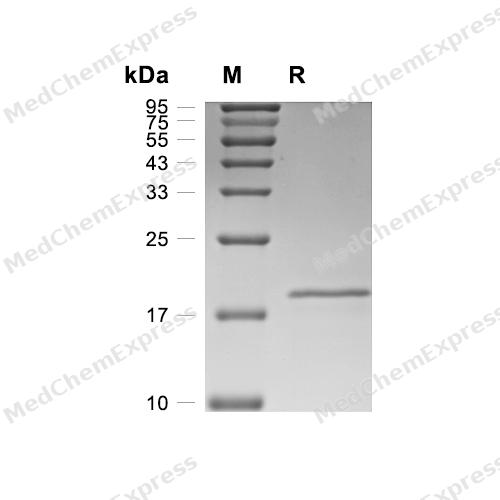
Purity - SDS-PAGE
-
Bioactivity - Cell-Based Assay
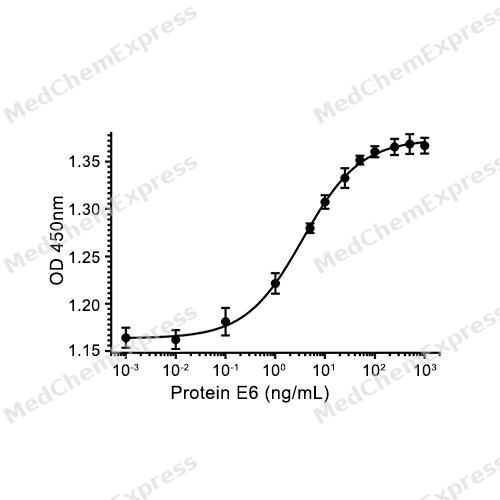
Bioactivity - Cell-Based Assay


Technical Parameters
-
Species Virus
-
Source E. coli
-
Tag N-6*His
-
Accession
P03126 (M1-L158)
-
Gene ID1489078 [NCBI]
-
Molecular Construction
-
N-term
-
6*His
-
Protein E6 (M1-L158)
Accession # P03126 -
C-term
-
-
Protein Length
Full Length
-
Synonyms
Protein E6; E6
-
AA Sequence
MHQKRTAMFQDPQERPRKLPQLCTELQTTIHDIILECVYCKQQLLRREVYDFAFRDLCIVYRDGNPYAVCDKCLKFYSKISEYRHYCYSLYGTTLEQQYNKPLCDLLIRCINCQKPLCPEEKQRHLDKKQRFHNIRGRWTGRCMSCCRSSRTRRETQL
-
Molecular Weight
Approximately 21 kDa, based on SDS-PAGE under reducing conditions.
-
Purity
≥ 90%, as determined by reducing SDS-PAGE.


Product Properties
Lyophilized powder
1.Lyophilized from a 0.22 μm filtered solution of 10 mM Tris-HCl, 1 mM EDTA, 6% trehalose.
2.Lyophilized from a 0.22 μm filtered solution of 50 mM Tris-HCl, 300 mM NaCl, 200 mM arginine, pH 8.0.
3.Lyophilized from a 0.22 μm filtered solution of 50 mM Tris-HCl, 300 mM NaCl, 500 mM arginine, pH 8.0.
4.Lyophilized from a 0.22 μm filtered solution of 50 mM Tris-HCl, 200 mM NaCl, 500 mM arginine, pH 8.0.
Please refer to the lot-specific COA for specific buffer information.
Note: For SPR assay, please replace the buffer. Primary amine components (e.g., Tris, imidazole) can affect protein-coupled chips.
<1 EU/μg, determined by LAL method.
It is not recommended to reconstitute to a concentration less than 100 μg/mL in ddH2O. For long term storage it is recommended to add a carrier protein (0.1% BSA, 5% HSA, 10% FBS or 5% Trehalose).
Stored at -20°C for 2 years from date of receipt. After reconstitution, it is stable at 4°C for 1 week or -20°C for longer (with carrier protein). It is recommended to freeze aliquots at -20°C or -80°C for extended storage.
Room temperature in continental US; may vary elsewhere.


Documentation
-
Data Sheet (264 KB)
-
SDS (252 KB)
- English - EN (252 KB)
- Français - FR (252 KB)
- Deutsch - DE (252 KB)
- Norwegian - NO (252 KB)
- Español - ES (252 KB)
- Swedish - SV (252 KB)
- Italian - IT (252 KB)
- Korean - KR (252 KB)
- Portuguese - PT (252 KB)
-
Handling Instructions (2659 KB)


References
[1]. Androphy EJ, et al. Identification of the HPV-16 E6 protein from transformed mouse cells and human cervical carcinoma cell lines. EMBO J. 1987 Apr;6(4):989-92. [Content Brief]
[2]. Boulenouar S, et al. Effects of HPV-16 E5, E6 and E7 proteins on survival, adhesion, migration and invasion of trophoblastic cells. Carcinogenesis. 2010 Mar;31(3):473-80. [Content Brief]
[3]. Duerksen-Hughes PJ, et al. HPV 16 E6 blocks TNF-mediated apoptosis in mouse fibroblast LM cells. Virology. 1999 Nov 10;264(1):55-65. [Content Brief]
[4]. Hu D, et al. HPV-16 E6/E7 promotes cell migration and invasion in cervical cancer via regulating cadherin switch in vitro and in vivo. Arch Gynecol Obstet. 2015 Dec;292(6):1345-54. [Content Brief]

Calculators
Concentration (start) × Volume (start) = Concentration (final) × Volume (final)


 Powered by Bioz

