



RBP4 Protein, Canine (HEK293, His)

Based on 1 Customer Validation
RBP4 Protein is a member of the lipocalin family and the major transport protein of the hydrophobic molecule retinol, also known as vitamin A, in the circulation. RBP4 Protein, Canine (HEK293, His) is the recombinant canine-derived RBP4 protein, expressed by HEK293 , with C-His labeled tag.
- Species: Canine
- Source: HEK293
-
Storage:Stored at -20°C for 2 years from date of receipt. After reconstitution, it is stable at 4°C for 1 week or -20°C for longer (with carrier protein). It is recommended to freeze aliquots at -20°C or -80°C for extended storage.


To place orders, for customer services and technical support, please contact: MedChemExpress USA
Tel: 609-228-6898 E-mail: [email protected] [email protected]


-
 Biological Activity
-
Technical Parameters
-
Product Properties
- Documentation
- References
- Help & FAQs




Biological Activity
Description
RBP4 Protein is a member of the lipocalin family and the major transport protein of the hydrophobic molecule retinol, also known as vitamin A, in the circulation. RBP4 Protein, Canine (HEK293, His) is the recombinant canine-derived RBP4 protein, expressed by HEK293 , with C-His labeled tag.
Background
RBP4 Protein is a member of the lipocalin family and the major transport protein of the hydrophobic molecule retinol, also known as vitamin A, in the circulation. RBP4 enables retinol binding and retinol transmembrane transporter activity. RBP4 is involved in retinol transport and located in extracellular space[1][2][3].
Verified Bioactivity
Measured by its ability to bind all-trans retinoic acid. The binding of retinoic acid results in the quenching of Trp fluorescence in RBP4. The 50% binding concentration (ED50) is 2.771 μM, as measured under the described conditions.
MCE Validation Data
-
Purity - SDS-PAGE
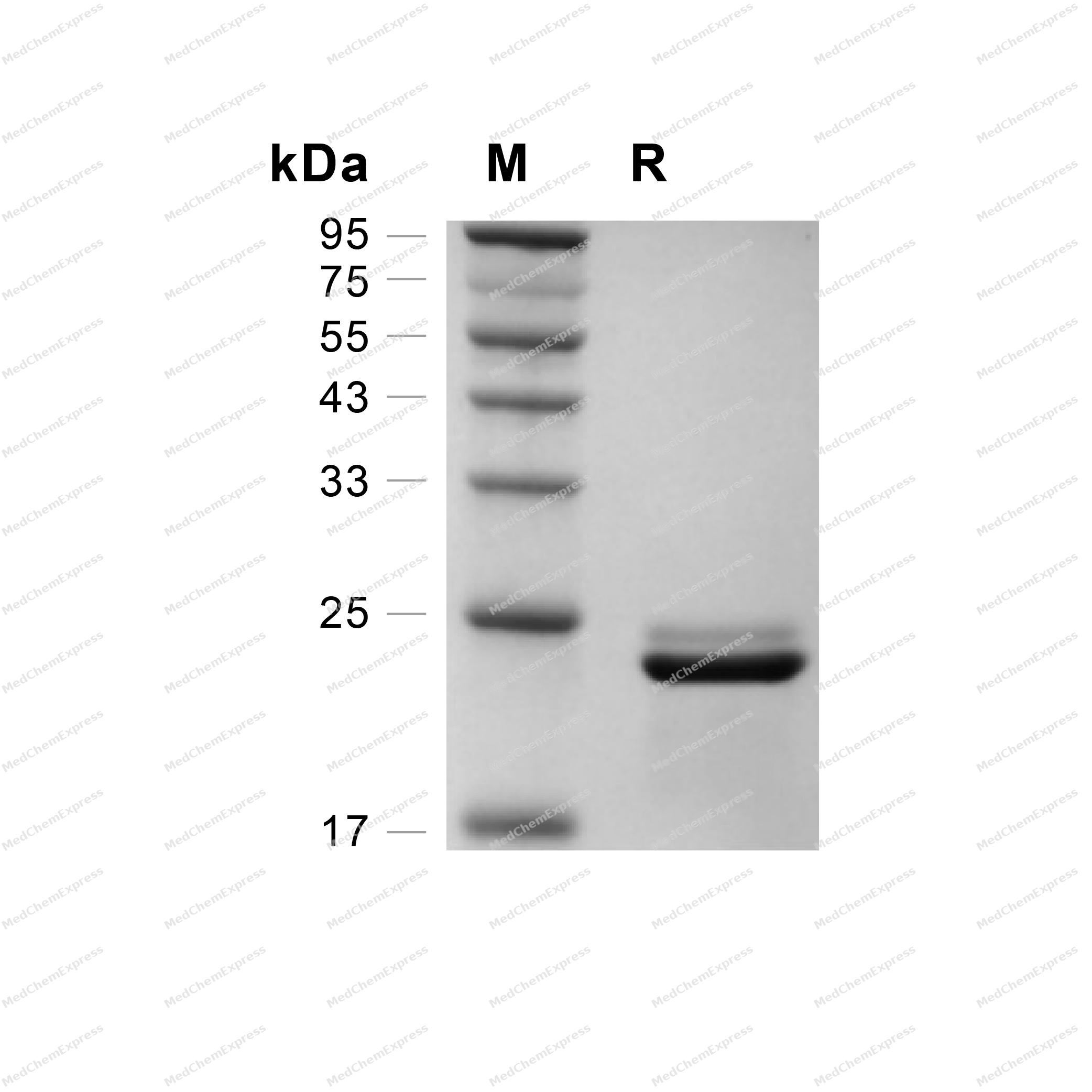
Purity - SDS-PAGE


Technical Parameters
-
Species Canine
-
Source HEK293
-
Tag C-His
-
Accession
XP_038295882 (E19-L201)
-
Molecular Construction
-
N-term
-
RBP4 (E19-L201)
Accession # XP_038295882 -
His
-
C-term
-
-
Protein Length
Partial
-
Synonyms
RBP4; Retinol-Binding Protein 4, Interstitial; Retinol Binding Protein 4; Retinol-Binding Protein 4, Plasma; Plasma Retinol-Binding Protein; Retinol Binding Protein 4, Plasma; Retinol-Binding Protein 4; Retinol-Binding Protein; PRBP; MCOPCB10; RBP; RDCCAS
-
AA Sequence
ESDCRVSNFQVKKNFDKARFAGTWYAMAKKDPEGLFLQDNIVAEFSVDENGRMSATAKGRVRLLNNWDVCADMVGTFTDTEDPAKFKMKYWGVASFLQKGNDDHWIIDTDYDTYAVQYSCRLLNLDGTCADSYSFVFSRDPNGLPLEAQKIVRQRQEELCLARQYRLIVHNGYCDGRSEPNTL
-
Molecular Weight
Approximately 23 kDa, based on SDS-PAGE under reducing conditions, due to the glycosylation.
-
Purity
≥ 90%, as determined by reducing SDS-PAGE.


Product Properties
Lyophilized powder.
Lyophilized from a 0.22 μm filtered solution of PBS, pH 7.4.
<1 EU/μg, determined by LAL method.
It is not recommended to reconstitute to a concentration less than 100 μg/mL in ddH2O. For long term storage it is recommended to add a carrier protein (0.1% BSA, 5% HSA, 10% FBS or 5% Trehalose).
Stored at -20°C for 2 years from date of receipt. After reconstitution, it is stable at 4°C for 1 week or -20°C for longer (with carrier protein). It is recommended to freeze aliquots at -20°C or -80°C for extended storage.
Room temperature in continental US; may vary elsewhere.


Documentation
-
Data Sheet (262 KB)
-
SDS (251 KB)
- English - EN (251 KB)
- Français - FR (251 KB)
- Deutsch - DE (251 KB)
- Norwegian - NO (251 KB)
- Español - ES (251 KB)
- Swedish - SV (251 KB)
- Italian - IT (251 KB)
- Korean - KR (251 KB)
- Portuguese - PT (251 KB)
-
Handling Instructions (2659 KB)


References
[1]. Steinhoff JS,et al. Biological Functions of RBP4 and Its Relevance for Human Diseases. Front Physiol. 2021 Mar 11;12:659977. [Content Brief]
[2]. Tang H, et al. TreeGrafter: phylogenetic tree-based annotation of proteins with Gene Ontology terms and other annotations. Bioinformatics. 2019 Feb 1;35(3):518-520. [Content Brief]
[3]. Burge S, et al. Manual GO annotation of predictive protein signatures: the InterPro approach to GO curation. Database (Oxford). 2012 Feb 1;2012:bar068. [Content Brief]

Calculators
Concentration (start) × Volume (start) = Concentration (final) × Volume (final)


 Powered by Bioz

