



S100A2 Protein, Human (HEK293, hFc)

Based on 1 Customer Validation
Protein S100-A2 (S100A2) is a member of the S100 family. S100A2 is localized in the cytoplasm and/or nucleus of a wide range of cells, and involved in the regulation of a number of cellular processes. S100A2 may function as calcium sensor and modulator, contributing to cellular calcium signaling or function by interacting with other proteins and indirectly play a role in many physiological processes. S100A2 may also play a role in suppressing tumor cell growth. S100A2 Protein, Human (HEK293, hFc) is the recombinant human-derived S100A2 protein, expressed by HEK293 , with N-hFc labeled tag.
- Species: Human
- Source: HEK293
-
Storage:Stored at -20°C for 2 years from date of receipt. After reconstitution, it is stable at 4°C for 1 week or -20°C for longer (with carrier protein). It is recommended to freeze aliquots at -20°C or -80°C for extended storage.


To place orders, for customer services and technical support, please contact: MedChemExpress USA
Tel: 609-228-6898 E-mail: [email protected] [email protected]


-
 Biological Activity
-
Technical Parameters
-
Product Properties
- Documentation
- Help & FAQs




Biological Activity
Description
Protein S100-A2 (S100A2) is a member of the S100 family. S100A2 is localized in the cytoplasm and/or nucleus of a wide range of cells, and involved in the regulation of a number of cellular processes. S100A2 may function as calcium sensor and modulator, contributing to cellular calcium signaling or function by interacting with other proteins and indirectly play a role in many physiological processes. S100A2 may also play a role in suppressing tumor cell growth. S100A2 Protein, Human (HEK293, hFc) is the recombinant human-derived S100A2 protein, expressed by HEK293 , with N-hFc labeled tag.
Background
Protein S100-A2 (S100A2) is a member of the S100 family of proteins containing 2 EF-hand calcium-binding motifs. S100A2 is localized in the cytoplasm and/or nucleus of a wide range of cells, and involved in the regulation of a number of cellular processes such as cell cycle progression and differentiation. S100A2 may function as calcium sensor and modulator, contributing to cellular calcium signaling or function by interacting with other proteins, such as TPR-containing proteins, and indirectly play a role in many physiological processes. S100A2 may also play a role in suppressing tumor cell growth, chromosomal rearrangements and altered expression of S100A2 have been implicated in breast cancer[1][2].
Verified Bioactivity
Measured by its ability to chemoattract A549 Human non-small cell lung cancer cells. The ED50 for this effect is 14.62 ng/mL, corresponding to a specific activity is 6.83×10^4 U/mg.
MCE Validation Data
-
Purity - SDS-PAGE
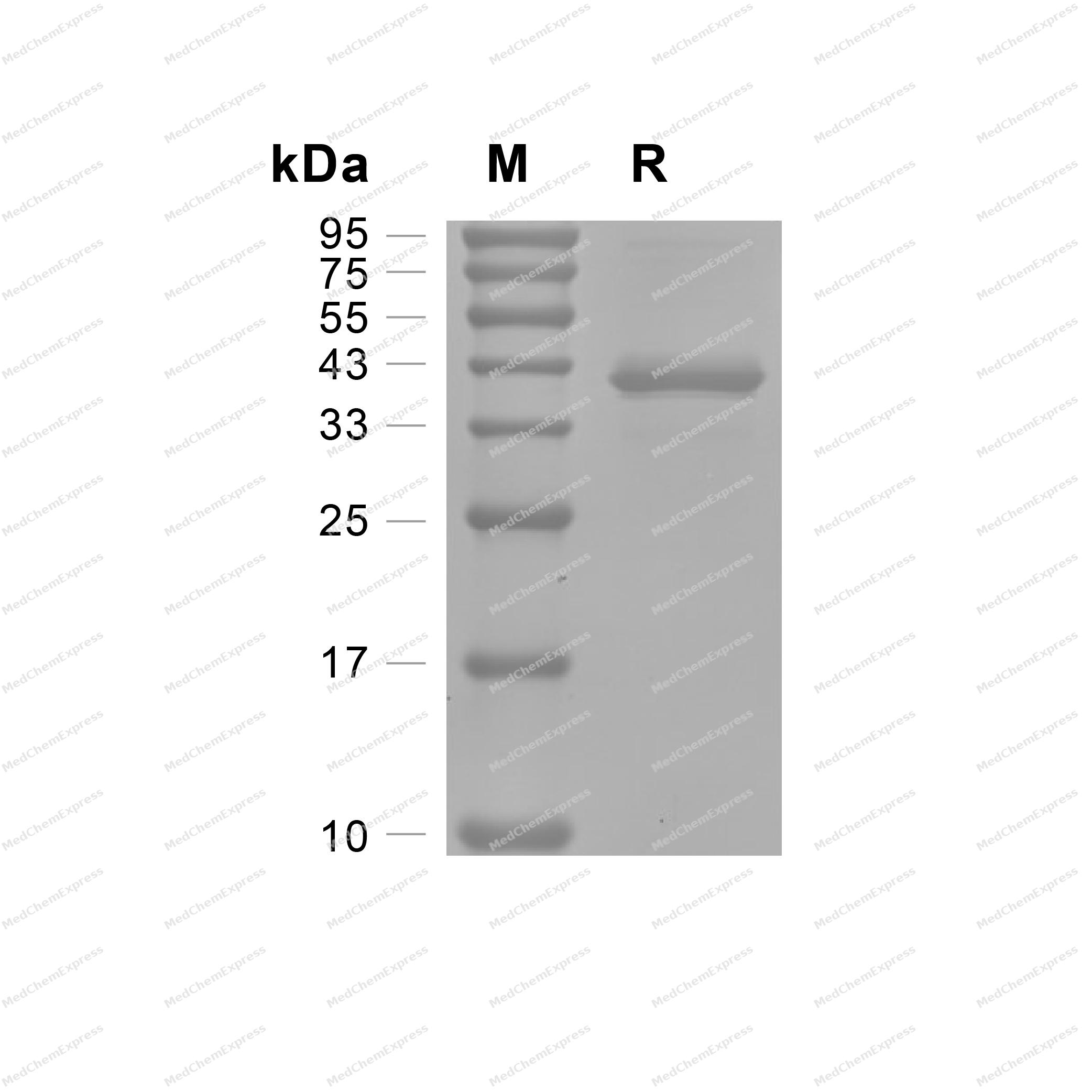
Purity - SDS-PAGE
-
Bioactivity - Cell-Based Assay
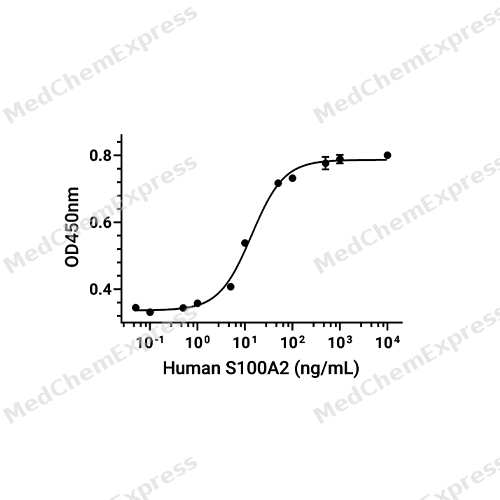
Bioactivity - Cell-Based Assay


Technical Parameters
-
Species Human
-
Source HEK293
-
Tag N-hFc
-
Accession
NP_005969.2 (M2-P98)
-
Molecular Construction
-
N-term
-
hFc
-
S100A2 (M2-P98)
Accession # NP_005969.2 -
C-term
-
-
Protein Length
Full Length of Protein S100-A2 Chain
-
Synonyms
S100A2; S100 Calcium-Binding Protein A2; Prev. S100L; Protein S-100L; CAN19; S100 Calcium Binding Protein A2; Protein S100-A2
-
AA Sequence
MCSSLEQALAVLVTTFHKYSCQEGDKFKLSKGEMKELLHKELPSFVGEKVDEEGLKKLMGSLDENSDQQVDFQEYAVFLALITVMCNDFFQGCPDRP
-
Molecular Weight
Approximately 40 kDa, based on SDS-PAGE under reducing conditions, due to the glycosylation.
-
Purity
≥ 95%, as determined by reducing SDS-PAGE.


Product Properties
Lyophilized powder
1.Lyophilized from a 0.22 μm filtered solution of 50 mM Tris, 10 mM NaCl, 100 Glyane, pH 7.5.
Note: For SPR assay, please replace the buffer. Primary amine components (e.g., Tris, imidazole) can affect protein-coupled chips.
<1 EU/μg, determined by LAL method.
It is not recommended to reconstitute to a concentration less than 100 μg/mL in ddH2O. For long term storage it is recommended to add a carrier protein (0.1% BSA, 5% HSA, 10% FBS or 5% Trehalose).
Stored at -20°C for 2 years from date of receipt. After reconstitution, it is stable at 4°C for 1 week or -20°C for longer (with carrier protein). It is recommended to freeze aliquots at -20°C or -80°C for extended storage.
Room temperature in continental US; may vary elsewhere.


Documentation
-
Data Sheet (260 KB)
-
SDS (251 KB)
- English - EN (251 KB)
- Français - FR (251 KB)
- Deutsch - DE (251 KB)
- Norwegian - NO (251 KB)
- Español - ES (251 KB)
- Swedish - SV (251 KB)
- Italian - IT (251 KB)
- Korean - KR (251 KB)
- Portuguese - PT (251 KB)
-
Handling Instructions (2659 KB)

Calculators
Concentration (start) × Volume (start) = Concentration (final) × Volume (final)


 Powered by Bioz

