



SAA1/Serum Amyloid A-1 Protein, Mouse (His)
Based on 2 publication(s) in Google Scholar
Serum Amyloid A-1 Protein, a vital acute phase protein, primarily exists as a homohexamer composed of dimers of trimers.Although it can form amyloid fibrils after partial proteolysis, the native, undenatured form does not exhibit amyloid fibril formation in vitro.Serving as an apolipoprotein within the HDL complex, Serum Amyloid A-1 also shows affinity for heparin binding, highlighting its multifaceted role in biological processes.SAA1/Serum Amyloid A-1 Protein, Mouse (His) is the recombinant mouse-derived SAA1 protein, expressed by E.coli , with N-6*His labeled tag.
- Species: Mouse
- Source: E. coli
-
Storage:Stored at -20°C for 2 years from date of receipt. After reconstitution, it is stable at 4°C for 1 week or -20°C for longer (with carrier protein). It is recommended to freeze aliquots at -20°C or -80°C for extended storage.


To place orders, for customer services and technical support, please contact: MedChemExpress USA
Tel: 609-228-6898 E-mail: [email protected] [email protected]


-
 Biological Activity
-
Technical Parameters
-
Product Properties
- Documentation
- Help & FAQs




Biological Activity
Description
Serum Amyloid A-1 Protein, a vital acute phase protein, primarily exists as a homohexamer composed of dimers of trimers.Although it can form amyloid fibrils after partial proteolysis, the native, undenatured form does not exhibit amyloid fibril formation in vitro.Serving as an apolipoprotein within the HDL complex, Serum Amyloid A-1 also shows affinity for heparin binding, highlighting its multifaceted role in biological processes.SAA1/Serum Amyloid A-1 Protein, Mouse (His) is the recombinant mouse-derived SAA1 protein, expressed by E.coli , with N-6*His labeled tag.
Background
Serum Amyloid A-1 Protein emerges as a significant acute phase protein, existing primarily as a homohexamer composed of dimers of trimers. While it has the potential to form amyloid fibrils after partial proteolysis, it's noteworthy that the native, undenatured form of the protein does not exhibit amyloid fibril formation in vitro. Additionally, Serum Amyloid A-1 serves a crucial role as an apolipoprotein within the HDL complex and demonstrates affinity for heparin binding, underscoring its multifaceted nature in biological processes.
Verified Bioactivity
Measured by its ability to induce TNF-alpha secretion by J774A.1 mouse reticulum cell sarcoma macrophage cells. The ED 50 for this effect is 4.689 μg/mL.
MCE Validation Data
-
Purity - SDS-PAGE
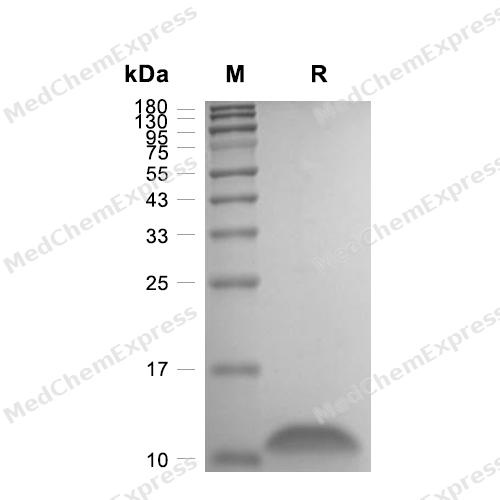
Purity - SDS-PAGE
-
Bioactivity - Cell-Based Assay
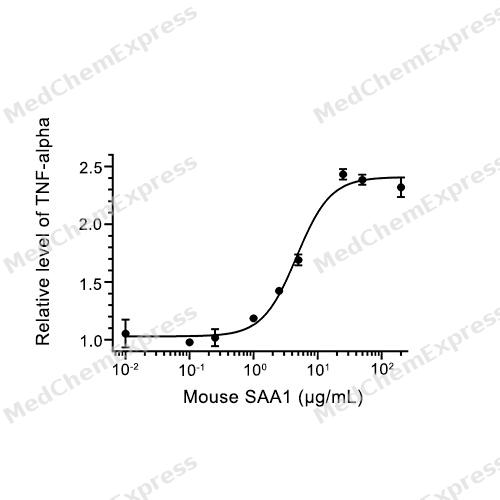
Bioactivity - Cell-Based Assay


Publications (2)
-
Journal Impact Factor
-
Most Recent
-
J Exp Clin Cancer Res
Tumor cells promote immunosuppression in ovarian cancer via a positive feedback loop with MDSCs through the SAA1-IL-1β axis. [Abstract]2025 Sep 30;44(1):277. PMID: 41029721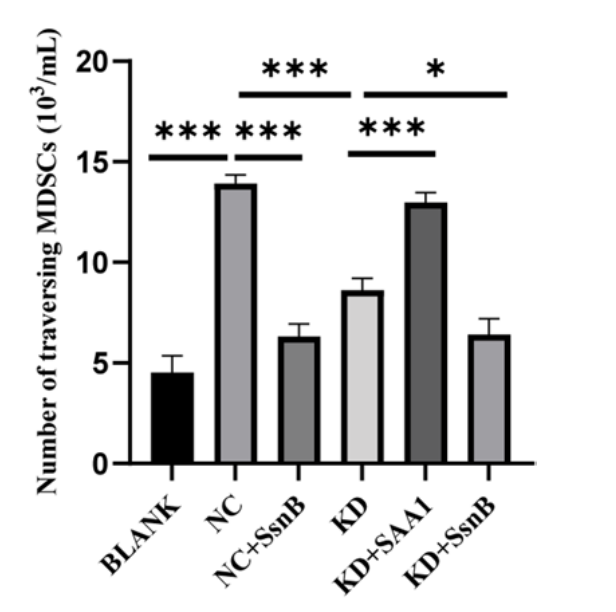
SAA1/Serum Amyloid A-1 Protein, Mouse (His) purchased from MedChemExpress. Usage Cited in: J Exp Clin Cancer Res. 2025 Sep 30;44(1):277. [Abstract]
Rescue experiments assessing the effect of recombinant SAA1 protein (HY-P700309; 200 ng/ml; ; 20–24 h) or SsnB (Sparstolonin B; HY-116213; 20 µM; 20–24 h) on the ability of ID8 cell supernatants to recruit MDSCs. Data are presented as mean ± SEM from three independent experiments; one-way ANOVA followed by Tukey’s multiple comparisons test.
-
Inflammation
SAA1 Promotes Ulcerative Colitis and Activating Colonic TLR4/NF-κB/NLRP3 Signaling Pathway. [Abstract]2025 Jun 17. PMID: 40526227


Technical Parameters
-
Species Mouse
-
Source E. coli
-
Tag N-6*His
-
Accession
P05366 (G20-Y122)
-
Molecular Construction
-
N-term
-
6*His
-
SAA1 (G20-Y122)
Accession # P05366 -
C-term
-
-
Protein Length
Full Length of Mature Protein
-
Synonyms
SAA1; PIG4; Prev. SAA; Serum Amyloid A Protein; TP53I4; Tumor Protein P53 Inducible Protein 4; Serum Amyloid A1; Serum Amyloid A-1 Protein
-
AA Sequence
GFFSFVHEAFQGAGDMWRAYTDMKEANWKNSDKYFHARGNYDAAQRGPGGVWAAEKISDGREAFQEFFGRGHEDTIADQEANRHGRSGKDPNYYRPPGLPDKY
-
Molecular Weight
Approximately 13-17 kDa, based on SDS-PAGE under reducing conditions.
-
Purity
≥ 85%, as determined by reducing SDS-PAGE.


Product Properties
Lyophilized powder
1.Lyophilized from a 0.22 μm filtered solution of 10 mM Tris-HCl, 1 mM EDTA, 6% trehalose.
2.Lyophilized from a 0.22 μm filtered solution of PBS, pH 7.4, 8% trehalose.
Please refer to the lot-specific COA for specific buffer information.
Note: For SPR assay, please replace the buffer. Primary amine components (e.g., Tris, imidazole) can affect protein-coupled chips.
<1 Eu/ug, determined by LAL method.
It is not recommended to reconstitute to a concentration less than 100 μg/mL in ddH2O.
Stored at -20°C for 2 years from date of receipt. After reconstitution, it is stable at 4°C for 1 week or -20°C for longer (with carrier protein). It is recommended to freeze aliquots at -20°C or -80°C for extended storage.
Room temperature in continental US; may vary elsewhere.


Documentation
-
Data Sheet (235 KB)
-
SDS (251 KB)
- English - EN (251 KB)
- Français - FR (251 KB)
- Deutsch - DE (251 KB)
- Norwegian - NO (251 KB)
- Español - ES (251 KB)
- Swedish - SV (251 KB)
- Italian - IT (251 KB)
- Korean - KR (251 KB)
- Portuguese - PT (251 KB)
-
Handling Instructions (2659 KB)

Calculators
Concentration (start) × Volume (start) = Concentration (final) × Volume (final)


 Powered by Bioz

