



SIAE Protein, Human (HEK293, His)

Based on 1 Customer Validation
SIAE proteins play a key role in cellular processes by catalyzing the removal of the O-acetyl ester group specifically from the 9-position of the parent sialic acid N-acetylneuraminic acid. Through this enzymatic activity, SIAE helps regulate sialic acid modifications, affecting various biological functions associated with cell surface glycoconjugates. SIAE Protein, Human (HEK293, His) is the recombinant human-derived SIAE protein, expressed by HEK293 , with C-6*His labeled tag.
- Species: Human
- Source: HEK293
-
Storage:Stored at -80°C for 1 year from date of receipt. It is stable at -20°C for 3 months after opening. It is recommended to freeze aliquots at -80°C for extended storage. Avoid repeated freeze-thaw cycles.


To place orders, for customer services and technical support, please contact: MedChemExpress USA
Tel: 609-228-6898 E-mail: [email protected] [email protected]


-
 Biological Activity
-
Technical Parameters
-
Product Properties
- Documentation
- Help & FAQs




Biological Activity
Description
SIAE proteins play a key role in cellular processes by catalyzing the removal of the O-acetyl ester group specifically from the 9-position of the parent sialic acid N-acetylneuraminic acid. Through this enzymatic activity, SIAE helps regulate sialic acid modifications, affecting various biological functions associated with cell surface glycoconjugates. SIAE Protein, Human (HEK293, His) is the recombinant human-derived SIAE protein, expressed by HEK293 , with C-6*His labeled tag.
Background
The SIAE (Sialic Acid Acetylesterase) protein is an enzyme that plays a crucial role in sialic acid metabolism by catalyzing the removal of O-acetyl ester groups from position 9 of the parent sialic acid, N-acetylneuraminic acid. This enzymatic activity is important for regulating the structural modifications of sialic acids, which are essential components of glycoproteins and glycolipids. SIAE-mediated deacetylation at position 9 influences the overall charge and structure of sialic acids, impacting cellular interactions, immune responses, and signal transduction. Understanding the functions of SIAE provides insights into the dynamic regulation of sialic acid modifications and their implications for various physiological processes.
MCE Validation Data
-
Purity - SDS-PAGE
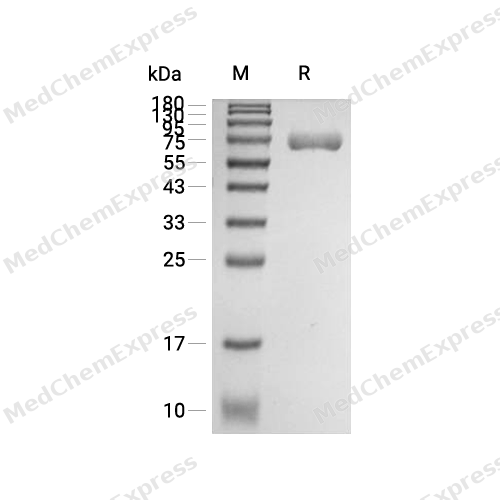
Purity - SDS-PAGE


Technical Parameters
-
Species Human
-
Source HEK293
-
Tag C-6*His
-
Accession
Q9HAT2-1 (I24-K523)
-
Molecular Construction
-
N-term
-
SIAE (I24-K523)
Accession # Q9HAT2-1 -
6*His
-
C-term
-
-
Protein Length
Full Length of Isoform-1
-
Synonyms
SIAE; MGC87009; Prev. YSG2; Cytosolic Sialic Acid 9-O-Acetylesterase Homolog; CSE-C; Sialic Acid-Specific 9-O-Acetylesterase; LSE; Ysg2 Homolog (Mouse); Sialic Acid-Specific Acetylesterase II; AIS6; Sialate O-Acetylesterase; CSEC; Sialic Acid Acetylestera
-
AA Sequence
IGFRFASYINNDMVLQKEPAGAVIWGFGTPGATVTVTLRQGQETIMKKVTSVKAHSDTWMVVLDPMKPGGPFEVMAQQTLEKINFTLRVHDVLFGDVWLCSGQSNMQMTVLQIFNATRELSNTAAYQSVRILSVSPIQAEQELEDLVAVDLQWSKPTSENLGHGYFKYMSAVCWLFGRHLYDTLQYPIGLIASSWGGTPIEAWSSGRSLKACGVPKQGSIPYDSVTGPSKHSVLWNAMIHPLCNMTLKGVVWYQGESNINYNTDLYNCTFPALIEDWRETFHRGSQGQTERFFPFGLVQLSSDLSKKSSDDGFPQIRWHQTADFGYVPNPKMPNTFMAVAMDLCDRDSPFGSIHPRDKQTVAYRLHLGARALAYGEKNLTFEGPLPEKIELLAHKGLLNLTYYQQIQVQKKDNKIFEISCCSDHRCKWLPASMNTVSTQSLTLAIDSCHGTVVALRYAWTTWPCEYKQCPLYHPSSALPAPPFIAFITDQGPGHQSNVAK
-
Predicted Molecular Mass
57 kDa
-
Molecular Weight
Approximately 55-80 kDa, based on SDS-PAGE under reducing conditions.
-
Glycosylation
Yes
-
Purity
≥ 95%, as determined by reducing SDS-PAGE.


Product Properties
Solution
Supplied as a 0.22 μm filtered solution of 20 mM Tris-HCl, 150 mM NaCl, 10% glycerol, pH 7.5.
Note: For SPR assay, please replace the buffer. Primary amine components (e.g., Tris, imidazole) can affect protein-coupled chips.
<1 EU/μg, determined by LAL method.
Stored at -80°C for 1 year from date of receipt. It is stable at -20°C for 3 months after opening. It is recommended to freeze aliquots at -80°C for extended storage. Avoid repeated freeze-thaw cycles.
Shipping with dry ice.


Documentation
-
Data Sheet (238 KB)
-
SDS (252 KB)
- English - EN (252 KB)
- Français - FR (252 KB)
- Deutsch - DE (252 KB)
- Norwegian - NO (252 KB)
- Español - ES (252 KB)
- Swedish - SV (252 KB)
- Italian - IT (252 KB)
- Korean - KR (252 KB)
- Portuguese - PT (252 KB)
-
Handling Instructions (2659 KB)

Calculators
Concentration (start) × Volume (start) = Concentration (final) × Volume (final)


 Powered by Bioz

