



SORD Protein, Human (HEK293, His)

Based on 1 Customer Validation
SORD Protein is an enzyme that in humans is encoded by the SORD gene. SPRD is a polyol dehydrogenase that catalyzes the reversible NAD+-dependent oxidation of various sugar alcohols. SPRD is a key enzyme in the polyol pathway that interconverts glucose and fructose via sorbitol, which constitutes an important alternate route for glucose metabolism. SORD Protein, Human (HEK293, His) is the recombinant human-derived SORD protein, expressed by HEK293 , with C-6*His labeled tag.
- Species: Human
- Source: HEK293
-
Storage:Stored at -80°C for 1 year from date of receipt. It is stable at -20°C for 3 months after opening. It is recommended to freeze aliquots at -80°C for extended storage. Avoid repeated freeze-thaw cycles.


To place orders, for customer services and technical support, please contact: MedChemExpress USA
Tel: 609-228-6898 E-mail: [email protected] [email protected]


-
 Biological Activity
-
Technical Parameters
-
Product Properties
- Documentation
- Help & FAQs




Biological Activity
Description
SORD Protein is an enzyme that in humans is encoded by the SORD gene. SPRD is a polyol dehydrogenase that catalyzes the reversible NAD+-dependent oxidation of various sugar alcohols. SPRD is a key enzyme in the polyol pathway that interconverts glucose and fructose via sorbitol, which constitutes an important alternate route for glucose metabolism. SORD Protein, Human (HEK293, His) is the recombinant human-derived SORD protein, expressed by HEK293 , with C-6*His labeled tag.
Background
Sorbitol dehydrogenase (SPRD) is an enzyme that in humans is encoded by the SORD gene. SPRD is a polyol dehydrogenase that catalyzes the reversible NAD+-dependent oxidation of various sugar alcohols, which is mostly active with D-sorbitol (D-glucitol), L-threitol, xylitol and ribitol as substrates, leading to the C2-oxidized products D-fructose, L-erythrulose, D-xylulose, and D-ribulose, respectively. SPRD is a key enzyme in the polyol pathway that interconverts glucose and fructose via sorbitol, which constitutes an important alternate route for glucose metabolism. The polyol pathway is believed to be involved in the etiology of diabetic complications, such as diabetic neuropathy and retinopathy, induced by hyperglycemia. SPRD may play a role in sperm motility by using sorbitol as an alternative energy source for sperm motility. SPRD may have a more general function in the metabolism of secondary alcohols since it also catalyzes the stereospecific oxidation of (2R,3R)-2,3-butanediol[1][2][3][4].
MCE Validation Data
-
Purity - SDS-PAGE
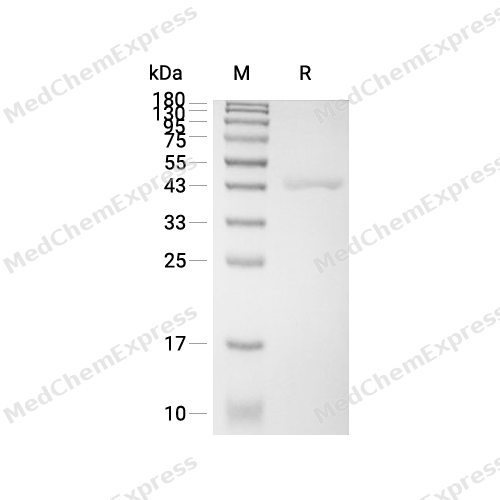
Purity - SDS-PAGE


Technical Parameters
-
Species Human
-
Source HEK293
-
Tag C-6*His
-
Accession
AAH21085.1 (A2-P357)
-
Molecular Construction
-
N-term
-
SORD (A2-P357)
Accession # AAH21085.1 -
6*His
-
C-term
-
-
Protein Length
Full Length
-
Synonyms
SORD; Ribitol Dehydrogenase; Sorbitol Dehydrogenase; RDH; L-Iditol 2-Dehydrogenase; Epididymis Secretory Sperm Binding Protein Li 95n; Xylitol Dehydrogenase; HEL-S-95n; SDH; HMNR8; XDH; SORD1; Polyol Dehydrogenase; SORDD; (R,R)-Butanediol Dehydrogenase
-
AA Sequence
AAAAKPNNLSLVVHGPGDLRLENYPIPEPGPNEVLLRMHSVGICGSDVHYWEYGRIGNFIVKKPMVLGHEASGTVEKVGSSVKHLKPGDRVAIEPGAPRENDEFCKMGRYNLSPSIFFCATPPDDGNLCRFYKHNAAFCYKLPDNVTFEEGALIEPLSVGIHACRRGGVTLGHKVLVCGAGPIGMVTLLVAKAMGAAQVVVTDLSATRLSKAKEIGADLVLQISKESPQEIARKVEGQLGCKPEVTIECTGAEASIQAGIYATRSGGTLVLVGLGSEMTTVPLLHAAIREVDIKGVFRYCNTWPVAISMLASKSVNVKPLVTHRFPLEKALEAFETFKKGLGLKIMLKCDPSDQNP
-
Predicted Molecular Mass
39.3 kDa
-
Molecular Weight
Approximately 43 kDa, based on SDS-PAGE under reducing conditions.
-
Purity
≥ 95%, as determined by reducing SDS-PAGE.


Product Properties
Solution
Supplied as a 0.22 μm filtered solution of 20 mM Tris-HCl, 0.2 M NaCl, 5 mM DTT, 20% glycerol, pH 8.0.
Note: For SPR assay, please replace the buffer. Primary amine components (e.g., Tris, imidazole) can affect protein-coupled chips.
<1 EU/μg, determined by LAL method.
Stored at -80°C for 1 year from date of receipt. It is stable at -20°C for 3 months after opening. It is recommended to freeze aliquots at -80°C for extended storage. Avoid repeated freeze-thaw cycles.
Shipping with dry ice.


Documentation
-
Data Sheet (238 KB)
-
SDS (252 KB)
- English - EN (252 KB)
- Français - FR (252 KB)
- Deutsch - DE (252 KB)
- Norwegian - NO (252 KB)
- Español - ES (252 KB)
- Swedish - SV (252 KB)
- Italian - IT (252 KB)
- Korean - KR (252 KB)
- Portuguese - PT (252 KB)
-
Handling Instructions (2659 KB)

Calculators
Concentration (start) × Volume (start) = Concentration (final) × Volume (final)


 Powered by Bioz

