



Tryptophan Synthase Protein, E.coli (His)

Based on 1 Customer Validation
The TrpA protein, especially its α subunit, plays a crucial role in catalyzing the aldol cleavage of indole glycerol phosphate to produce indole and glyceraldehyde 3-phosphate. This enzymatic activity highlights the importance of TrpA in the tryptophan biosynthetic pathway, providing an essential component of cellular processes. Tryptophan Synthase Protein, E.coli (His) is a recombinant protein dimer complex containing E. coli-derived Tryptophan Synthase protein, expressed by E. coli , with N-6*His labeled tag. Tryptophan Synthase Protein, E.coli (His), has molecular weight of 28 & 40-50 kDa, respectively.
- Species: E.coli
- Source: E. coli
-
Storage:Stored at -80°C for 1 year from date of receipt. It is stable at -20°C for 3 months after opening. It is recommended to freeze aliquots at -80°C for extended storage. Avoid repeated freeze-thaw cycles.


To place orders, for customer services and technical support, please contact: MedChemExpress USA
Tel: 609-228-6898 E-mail: [email protected] [email protected]


-
 Biological Activity
-
Technical Parameters
-
Product Properties
- Documentation
- Help & FAQs




Biological Activity
Description
The TrpA protein, especially its α subunit, plays a crucial role in catalyzing the aldol cleavage of indole glycerol phosphate to produce indole and glyceraldehyde 3-phosphate. This enzymatic activity highlights the importance of TrpA in the tryptophan biosynthetic pathway, providing an essential component of cellular processes. Tryptophan Synthase Protein, E.coli (His) is a recombinant protein dimer complex containing E. coli-derived Tryptophan Synthase protein, expressed by E. coli , with N-6*His labeled tag. Tryptophan Synthase Protein, E.coli (His), has molecular weight of 28 & 40-50 kDa, respectively.
Background
The TrpA protein, with its alpha subunit, takes on the crucial role of catalyzing the aldol cleavage of indoleglycerol phosphate, yielding indole and glyceraldehyde 3-phosphate. This enzymatic activity highlights the functional significance of TrpA in the tryptophan biosynthesis pathway, contributing to the generation of essential components for cellular processes. The alpha subunit's specific involvement in this cleavage reaction underscores its role as a key catalyst in the intricate biochemical machinery governing the synthesis of tryptophan in various biological contexts.
MCE Validation Data
-
Purity - SDS-PAGE
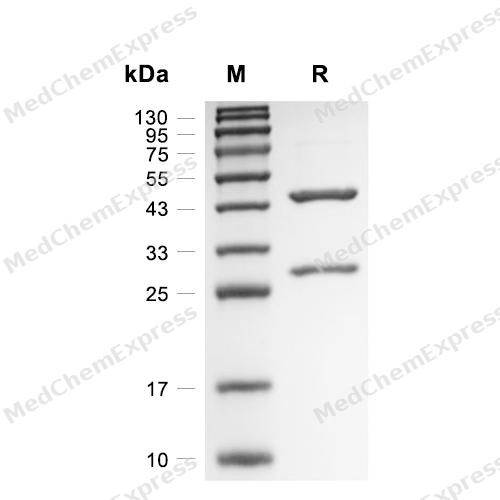
Purity - SDS-PAGE


Technical Parameters
-
Species E.coli
-
Source E. coli
-
Tag N-6*His
-
Molecular Construction
-
N-term
-
6*His
-
trpA (M1-S268)
Accession # P0A877 -
C-term
-
N-term
-
trpB (T2-I397)
Accession # P0A879 -
C-term
-
-
Synonyms
trpA; b1260; JW1252; Tryptophan synthase alpha chain; EC 4.2.1.20; trpB; b1261; JW1253; Tryptophan synthase beta chain; EC 4.2.1.20
-
AA Sequence
MERYESLFAQLKERKEGAFVPFVTLGDPGIEQSLKIIDTLIEAGADALELGIPFSDPLADGPTIQNATLRAFAAGVTPAQCFEMLALIRQKHPTIPIGLLMYANLVFNKGIDEFYAQCEKVGVDSVLVADVPVEESAPFRQAALRHNVAPIFICPPNADDDLLRQIASYGRGYTYLLSRAGVTGAENRAALPLNHLVAKLKEYNAAPPLQGFGISAPDQVKAAIDAGAAGAISGSAIVKIIEQHINEPEKMLAALKVFVQPMKAATRS&TTLLNPYFGEFGGMYVPQILMPALRQLEEAFVSAQKDPEFQAQFNDLLKNYAGRPTALTKCQNITAGTNTTLYLKREDLLHGGAHKTNQVLGQALLAKRMGKTEIIAETGAGQHGVASALASALLGLKCRIYMGAKDVERQSPNVFRMRLMGAEVIPVHSGSATLKDACNEALRDWSGSYETAHYMLGTAAGPHPYPTIVREFQRMIGEETKAQILEREGRLPDAVIACVGGGSNAIGMFADFINETNVGLIGVEPGGHGIETGEHGAPLKHGRVGIYFGMKAPMMQTEDGQIEESYSISAGLDFPSVGPQHAYLNSTGRADYVSITDDEALEAFKTLCLHEGIIPALESSHALAHALKMMRENPDKEQLLVVNLSGRGDKDIFTVHDILKARGEI
-
Predicted Molecular Mass
28.7 kDa & 43.8 kDa
-
Molecular Weight
Approximately 28 kDa & 40-50 kDa, based on SDS-PAGE under reducing conditions.
-
Purity
≥ 95%, as determined by reducing SDS-PAGE.


Product Properties
Solution
Supplied as a 0.2 μm filtered solution of PBS, pH 7.4.
<1 EU/μg, determined by LAL method.
Stored at -80°C for 1 year from date of receipt. It is stable at -20°C for 3 months after opening. It is recommended to freeze aliquots at -80°C for extended storage. Avoid repeated freeze-thaw cycles.
Shipping with dry ice.


Documentation
-
Data Sheet (238 KB)
-
SDS (252 KB)
- English - EN (252 KB)
- Français - FR (252 KB)
- Deutsch - DE (252 KB)
- Norwegian - NO (252 KB)
- Español - ES (252 KB)
- Swedish - SV (252 KB)
- Italian - IT (252 KB)
- Korean - KR (252 KB)
- Portuguese - PT (252 KB)
-
Handling Instructions (2659 KB)

Calculators
Concentration (start) × Volume (start) = Concentration (final) × Volume (final)


 Powered by Bioz

