



Vitronectin Protein, Human (HEK293, His)
Based on 2 publication(s) in Google Scholar
Vitronectin is a multifunctional cell adhesion factor in serum and tissues that interacts with glycosaminoglycans and proteoglycans. It acts as an adhesion molecule between cells and the matrix, binding to specific integrins. Vitronectin Protein, Human (HEK293, His) is the recombinant human-derived Vitronectin protein, expressed by HEK293 , with C-6*His labeled tag.
- Species: Human
- Source: HEK293
-
Storage:Stored at -20°C for 2 years from date of receipt. After reconstitution, it is stable at 4°C for 1 week or -20°C for longer (with carrier protein). It is recommended to freeze aliquots at -20°C or -80°C for extended storage.


To place orders, for customer services and technical support, please contact: MedChemExpress USA
Tel: 609-228-6898 E-mail: [email protected] [email protected]


-
 Biological Activity
-
Technical Parameters
-
Product Properties
- Documentation
- Help & FAQs


-

HY-P70593
Fibronectin Protein, Human
-
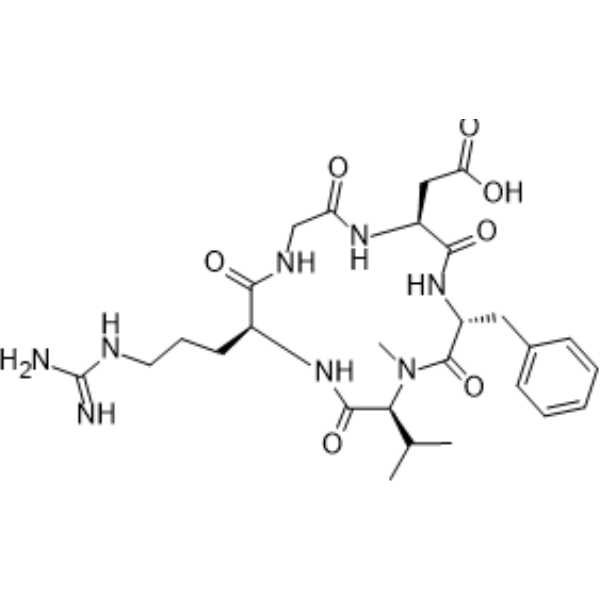
HY-16141
Cilengitide
-
HY-P700765
Integrin alpha V beta 3 Protein, Human (Biotinylated, HEK293, His-Avi)
-
HY-P7025
IFN-gamma Protein, Human
-
HY-P7028
IL-1 beta Protein, Human
-
HY-P7110A
VEGF165 Protein, Human (HEK293)
-

HY-NP010
Type I Collagen, from rat tail
-
HY-P73193
IL-23 Protein, Human (HEK293, His)
-
HY-P701311
Laminin 521 Protein, Human (HEK293)
-
HY-P7004
FGF basic/bFGF Protein, Human (146a.a)
-
HY-P7864
Complement C5a Protein, Human
-
HY-P73063
Fibronectin Protein, Human (HEK293, His)


Biological Activity
Vitronectin is a multifunctional cell adhesion factor in serum and tissues that interacts with glycosaminoglycans and proteoglycans. It acts as an adhesion molecule between cells and the matrix, binding to specific integrins. Vitronectin Protein, Human (HEK293, His) is the recombinant human-derived Vitronectin protein, expressed by HEK293 , with C-6*His labeled tag.
Vitronectin Protein is a multifunctional cell adhesion and spreading factor present in serum and tissues. It interacts with glycosaminoglycans and proteoglycans and acts as a cell-to-substrate adhesion molecule, binding to specific integrins. Additionally, Vitronectin Protein functions as an inhibitor of the terminal cytolytic complement pathway, protecting cell membranes from damage. It also possesses protease-inhibiting activity and is involved in regulating growth hormone-dependent processes, specifically somatomedin-B.
1.Immobilized Human Vitronectin, His Tag at 5 μg/mL (100 μl/well) on the plate. Dose response curve for Biotinylated Mouse ITGAV&ITGB3, His Tag with the EC50 of ≤1.72 μg/mL determined by ELISA.
2.Measured by the ability of the immobilized protein to support the adhesion of B16-F1 mouse melanoma cells. When 5x10⁴ cells/well are added to Vitronectin coated plates (5 µg/mL with 100 µL/well), approximately >70% will adhere after 30 minutes at 37°C.
3.Measured by its ability to support iPS cell attachment and spreading when used as a substratum for cell culture with the ED50 of 232 ng/mL.


Publications (2)
-
Journal Impact Factor
-
Most Recent
-
Adv Sci (Weinh)
The Role of CAF-derived Vitronectin in Promoting Colorectal Cancer Progression and Immunosuppression. [Abstract]2025 Sep;12(33):e05769. PMID: 40538300 -
Mediators Inflamm
Vitronectin Destroyed Intestinal Epithelial Cell Differentiation through Activation of PDE4-Mediated Ferroptosis in Inflammatory Bowel Disease. [Abstract]2023 Jul 19:2023:6623329. PMID: 37501933


Technical Parameters
-
Species Human
-
Source HEK293
-
Tag C-6*His
-
Accession
P04004/AAH05046.1 (D20-L478)
-
Molecular Construction
-
N-term
-
Vitronectin (D20-L478)
Accession # P04004 -
6*His
-
C-term
-
-
Protein Length
Full Length of Mature Protein
-
Synonyms
VTN; Vitronectin; VN; Serum Spreading Factor; Serum‑Spreading Factor; Complement S‑Protein; Somatomedin B; S‑Protein; V75; Vitronectin (Serum Spreading Factor, Somatomedin B, Complement S‑Protein); Epibolin; VNT
-
AA Sequence
DQESCKGRCTEGFNVDKKCQCDELCSYYQSCCTDYTAECKPQVTRGDVFTMPEDEYTVYDDGEEKNNATVHEQVGGPSLTSDLQAQSKGNPEQTPVLKPEEEAPAPEVGASKPEGIDSRPETLHPGRPQPPAEEELCSGKPFDAFTDLKNGSLFAFRGQYCYELDEKAVRPGYPKLIRDVWGIEGPIDAAFTRINCQGKTYLFKGSQYWRFEDGVLDPDYPRNISDGFDGIPDNVDAALALPAHSYSGRERVYFFKGKQYWEYQFQHQPSQEECEGSSLSAVFEHFAMMQRDSWEDIFELLFWGRTSAGTRQPQFISRDWHGVPGQVDAAMAGRIYISGMAPRPSLAKKQRFRHRNRKGYRSQRGHSRGRNQNSRRPSRATWLSLFSSEESNLGANNYDDYRMDWLVPATCEPIQSVFFFSGDKYYRVNLRTRRVDTVDPPYPRSIAQYWLGCPAPGHL
-
Predicted Molecular Mass
53.4 kDa
-
Molecular Weight
Approximately 60-80 kDa, based on SDS-PAGE under reducing conditions.
-
Glycosylation
Yes
-
Purity
≥ 95%, as determined by reducing SDS-PAGE or Bis-Tris PAGE.


Product Properties
Lyophilized powder
1.Lyophilized from a 0.22 μm filtered solution of 20 mM Tris-HCl, 150 mM NaCl, pH 8.0.
2.Lyophilized from a 0.22 μm filtered solution of PBS.
3.Lyophilized from a 0.22 μm filtered solution of PBS, pH 7.4.
4.Lyophilized from a 0.22 μm filtered solution of PBS, pH 7.4, 8% trehalose.
Please refer to the lot-specific COA for specific buffer information.
Note: For SPR assay, please replace the buffer. Primary amine components (e.g., Tris, imidazole) can affect protein-coupled chips.
<1 EU/μg, determined by LAL method.
It is not recommended to reconstitute to a concentration less than 100 μg/mL in ddH2O. For long term storage it is recommended to add a carrier protein (0.1% BSA, 5% HSA, 10% FBS or 5% Trehalose).
Stored at -20°C for 2 years from date of receipt. After reconstitution, it is stable at 4°C for 1 week or -20°C for longer (with carrier protein). It is recommended to freeze aliquots at -20°C or -80°C for extended storage.
Room temperature in continental US; may vary elsewhere.


Documentation
-
Data Sheet (239 KB)
-
SDS (252 KB)
- English - EN (252 KB)
- Français - FR (252 KB)
- Deutsch - DE (252 KB)
- Norwegian - NO (252 KB)
- Español - ES (252 KB)
- Swedish - SV (252 KB)
- Italian - IT (252 KB)
- Korean - KR (252 KB)
- Portuguese - PT (252 KB)
-
Handling Instructions (2659 KB)

Calculators
Concentration (start) × Volume (start) = Concentration (final) × Volume (final)


 Powered by Bioz

