7 Results for "

subcutaneous administration

" in MedChemExpress (MCE) Product Catalog:
Products (7)

7 Results for "subcutaneous administration" in MCE Product Catalog:

Cat. No.: HY-P991212
CAS No.: 2636716-20-4
Synonyms: ALT-B4

Target:  

Glycosidase

Research Areas:  

Cancer

Berahyaluronidase alfa (ALT-B4) is a recombinant hyaluronidase engineered from human hyaluronidase PH20. Berahyaluronidase alfa features favorable structural stability and enzymatic activity, and can be used to enhance drug absorption and dispersion in subcutaneous or intradermal administration .
loading...
    loading...
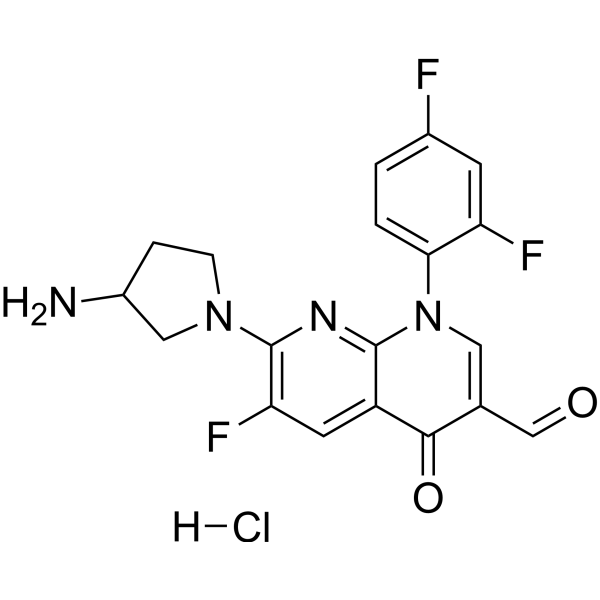
Cat. No.: HY-122309
CAS No.: 134762-03-1
Target:  

Antibiotic

Research Areas:  

Infection

A-71497 is the 3-formyl derivative of the antibiotic Tosufloxacin (HY-B1802). A-71497 can produce high plasma levels of tosufloxacin upon both oral and subcutaneous administration to mice .
loading...
    loading...
Cat. No.: HY-P0037
CAS No.: 136208-71-4
Synonyms: Org 30850ANT
Target:  

GnRH Receptor

Research Areas:  

Endocrinology

Org-30850 is a potent LHRH antagonist designed for treating hormone-dependent disorders. In animal studies, a single subcutaneous dose effectively inhibited ovulation in rats and significantly reduced testosterone levels in male rats for up to 48 hours post-administration. Daily doses of Org-30850 in female rats suppressed estrous cycles, decreased uterine and ovarian weights, and lowered estradiol and FSH serum levels. In male rats, prolonged treatment resulted in reversible reductions in gonadal function and testosterone levels, with almost complete recovery observed after cessation of treatment. Unlike comparable LHRH antagonists, Org-30850 exhibited minimal injection site irritation and no edematous reactions, suggesting a more favorable therapeutic profile .
loading...
    loading...
Cat. No.: HY-P992453
Synonyms: MTBT1466A; RG-6315
RO-7303509 (MTBT1466A; RG-6315) is a human monoclonal antibody and TGFβ3 neutralizer. RO-7303509 targets the profibrotic mediator TGFβ3 to alleviate fibrosis. RO-7303509 can be administered via subcutaneous or intravenous routes and is used in research on systemic sclerosis . Recommended isotype control: Human IgG1 kappa, Isotype Control (HY-P99001).
loading...
    loading...
Cat. No.: HY-159796A
CAS No.: 117211-03-7
Synonyms: GR69153
Research Areas:  

Infection Metabolic Disease

Ceftezole (GR69153) is a broad-spectrum cephalosporin antibiotic and an α-glucosidase inhibitor. Ceftezole inhibits bacterial cell lysis by inhibiting cell wall synthesis and binding to penicillin-binding proteins (PBPs). Ceftezole exhibits in vivo anti-diabetic activity in diabetic mice. Ceftezole can be used in antibacterial and anti-diabetic research .
loading...
    loading...
Cat. No.: HY-P992108
CAS No.: 3061442-66-5
Synonyms: RELAX10

Research Areas:  

Cardiovascular Disease

Efadirelaxin alfa (RELAX10) is a highly selective agonist of relaxin/insulin-like family peptide receptor RXFP1. After subcutaneous administration in animal experiments, Efadirelaxin alfa exhibits a significantly prolonged terminal half-life (7 days in mice, 3.75 days in rats), and shows no activity against related receptors such as RXFP2 and RXFP3. Efadirelaxin alfa has significant anti-cardiac hypertrophy and anti-fibrotic effects. Efadirelaxin alfa effectively attenuates and reverses cardiac hypertrophy and collagen deposition by regulating the TGF-β1/Smad2 and AKT/eNOS signaling pathways. Efadirelaxin alfa improves cardiac systolic function without causing fluctuations in blood pressure or heart rate, demonstrating favorable safety. Efadirelaxin alfa is currently mainly used in studies related to heart failure .
loading...
    loading...
Cat. No.: HY-184389
Research Areas:  

Inflammation/Immunology

PROTAC HDAC6 degrader 10 is a highly efficient, safe and selective HDAC6 PROTAC degrader with a pIC50 of 8.75 and a pDC50 of 9.2 in BEAS-2B cells. PROTAC HDAC6 degrader 10 recruits cereblon to form a ternary complex with HDAC6, thereby achieving the degradation of HDAC6. PROTAC HDAC6 degrader 10 significantly induces hyperacetylation of α-tubulin without affecting the acetylation of H3, and achieves sustained HDAC6 knockdown in mouse lung tissues. PROTAC HDAC6 degrader 10 exhibits high bioavailability after subcutaneous administration in mice. PROTAC HDAC6 degrader 10 enables the study of HDAC6 pharmacology via chemical knockdown of HDAC6 in vitro and in vivo, and can be used for research on pulmonary diseases .
loading...
    loading...

