1. Others

Others

There are a number of inhibitors, agonists, and antagonists which we cannot make precise classification because the research area is still unknown.

Others Related Products (73761):

Cat. No. Product Name CAS No. Purity Chemical Structure
  • HY-W053507
    m-Tolylacetic acid 621-36-3
    m-Tolylacetic acid (3-Methylbenzeneacetic acid) is a hydroaromatic dicarboxylic acids excreted in the urine as metabolite of tolueneacetic acid. m-Tolylacetic acid can be used for drug intermediate for synthesising more complex molecules.
    m-Tolylacetic acid
  • HY-W071686
    6-Methyltetrahydropterin dihydrochloride 69113-63-9 99.64%
    6-Methyltetrahydropterin (dihydrochloride) is a biochemical detection reagent that can be used in tyrosine hydroxylase activity assay.
    6-Methyltetrahydropterin dihydrochloride
  • HY-W075435
    5,5'-(1,3,6,8-Tetraoxo-1,3,6,8-tetrahydrobenzo[lmn][3,8]phenanthroline-2,7-diyl)diisophthalic acid 350024-36-1 98%
    5,5'-(1,3,6,8-Tetraoxo-1,3,6,8-tetrahydrobenzo[lmn][3,8]phenanthroline-2,7-diyl)diisophthalic acid is a metal-organic framework (MOF).
    5,5'-(1,3,6,8-Tetraoxo-1,3,6,8-tetrahydrobenzo[lmn][3,8]phenanthroline-2,7-diyl)diisophthalic acid
  • HY-W093183
    Palmitic anhydride 623-65-4
    Palmitic anhydride, a saturated fatty acid found in many natural sources such as animal fats and vegetable oils, is commonly used as a reagent in organic synthesis to introduce palmitoyl(hexadecanoyl) functional groups into other organic molecules, moreover, Palmitic anhydride has been Used in the production of surfactants, lubricants and plasticizers, as well as in the preparation of cosmetics and pharmaceuticals.
    Palmitic anhydride
  • HY-W095198
    N-(2-Hydroxyethyl)acrylamide 7646-67-5 ≥98.0%
    N-(2-Hydroxyethyl)acrylamide is an amphiphilic polymer that can be used to prepare hydrogels.
    N-(2-Hydroxyethyl)acrylamide
  • HY-W127502
    1-Hexadecyl lysophosphatidic acid 52603-03-9 99.89%
    1-Hexadecyl lysophosphatidic acid is an ether analog of lysophosphatidic acid (LPA) containing a hexadecyl group in the sn-1 position. LPA binds to five different G protein-coupled receptors and mediates a variety of biological responses, including cell proliferation, smooth muscle contraction, platelet aggregation, neurite contraction, and cell motility.
    1-Hexadecyl lysophosphatidic acid
  • HY-W127640
    Phosphocholine chloride disodium 16904-96-4 98.0%
    Phosphocholine Chloride Sodium Salt is an organic compound containing phosphate, choline and chloride ions. It is commonly used to prepare cell membranes and liposomes for drug delivery systems. Phosphocholine Chloride Sodium Salt has various applications in the pharmaceutical industry, especially as a stabilizer and surfactant. In addition, it is used as an emulsifier and conditioning agent in the manufacture of cosmetic and personal care products.
    Phosphocholine chloride disodium
  • HY-W127785
    N,N-Dimethyldodecylamine N-oxide 1643-20-5
    N,N-Dimethyldodecylamine N-oxide is an amine oxide surfactant commonly used as a detergent, emulsifier and wetting agent in various industrial processes, especially in personal care products and household cleaning in the production of agents. N,N-Dimethyldodecylamine N-oxide has unique chemical properties that make it an effective ingredient in many product formulations to help reduce surface tension and enhance cleaning power.
    N,N-Dimethyldodecylamine N-oxide
  • HY-W129633
    2,6-Dichlorophenolindophenol sodium hydrate 1266615-56-8
    2,6-Dichlorophenolindophenol (DCIP; DPIP) sodium hydrate is a redox chromogenic indicator with a redox potential of +217 mV relative to SHE, and it acts as a substrate for reduction reactions. During the metabolic process of nutrient consumption by Saccharomyces cerevisiae, 2,6-Dichlorophenolindophenol sodium hydrate is reduced from dark blue to colorless, resulting in a decrease in absorbance. 2,6-Dichlorophenolindophenol sodium hydrate is widely used in spectrophotometric biochemical oxygen demand determination and preclinical colorimetric toxicity analysis for heavy metal ion detection based on Saccharomyces cerevisiae.
    2,6-Dichlorophenolindophenol sodium hydrate
  • HY-W142015
    Hexa-L-Tyrosine 6934-38-9 99.88%
    Hexa-L-Tyrosine is a tyrosine derivative.
    Hexa-L-Tyrosine
  • HY-W145626
    β-D-Glucopyranose 1-phosphate disodium salt 83833-15-2 99.34%
    β-D-Glucopyranose 1-Phosphate Disodium Salt is a biochemical reagent that can be used as a biological material or organic compound for life science related research.
    β-D-Glucopyranose 1-phosphate disodium salt
  • HY-W250309
    Pentaerythritol tetra3-mercaptopropionate 7575-23-7
    Pentaerythritol tetra(3-mercaptopropionate)It is a class of organic compounds containing both pentaerythritol and mercaptopropionate groups. It is commonly used as a stabilizer and crosslinking agent in various chemical and industrial applications. Pentaerythritol tetra(3-mercaptopropionate)Has a variety of properties that make it suitable for these applications, including the ability to increase the mechanical strength, thermal stability and weatherability of polymers and coatings. Additionally, it can be used as a feedstock for the production of other specialty chemicals and materials.
    Pentaerythritol tetra3-mercaptopropionate
  • HY-W250795
    Maltodextrin, dextrose equivalent 16.5-19.5 9050-36-6
    Maltodextrin, dextrose equivalent 16.5-19.5 can be used as an excipient. Pharmaceutical excipients, or pharmaceutical auxiliaries, refer to other chemical substances used in the pharmaceutical process other than pharmaceutical ingredients. Pharmaceutical excipients generally refer to inactive ingredients in pharmaceutical preparations, which can improve the stability, solubility and processability of pharmaceutical preparations. Pharmaceutical excipients also affect the absorption, distribution, metabolism, and elimination (ADME) processes of co-administered drugs.
    Maltodextrin, dextrose equivalent 16.5-19.5
  • HY-W317414
    Indole-3-acetylglycine 13113-08-1
    Indole-3-acetylglycine is a biochemical assay reagent.
    Indole-3-acetylglycine
  • HY-W440821
    m-PEG-DMG (MW 2000) 1019000-64-6 ≥98.0%
    m-PEG-DMG (MW 2000) is a PEG lipid for the preparation of liposomes and can be used in drug delivery studies.
    m-PEG-DMG (MW 2000)
  • HY-W698390
    3′-Sialyl-N-acetyllactosamine 81693-22-3 99.85%
    3′-Sialyl-N-acetyllactosamine is a class of biochemical reagents used in glycobiology research. Glycobiology studies the structure, synthesis, biology, and evolution of sugars. It involves carbohydrate chemistry, enzymology of glycan formation and degradation, protein-glycan recognition, and the role of glycans in biological systems. This field is closely related to basic research, biomedicine, and biotechnology.
    3′-Sialyl-N-acetyllactosamine
  • HY-W713926
    1-Pyrenedecanoic acid 64701-47-9 99.34%
    1-Pyrenedecanoic acid is a biochemical reagent, and can be used for membrane fluidity assessment.
    1-Pyrenedecanoic acid
  • HY-W718145
    D-Mannose,6-dihydrogen phosphate sodium 70442-25-0 99.93%
    D-Mannose,6-(dihydrogen phosphate) (sodium) is a class of biochemical reagents used in glycobiology research. Glycobiology studies the structure, synthesis, biology, and evolution of sugars. It involves carbohydrate chemistry, enzymology of glycan formation and degradation, protein-glycan recognition, and the role of glycans in biological systems. This field is closely related to basic research, biomedicine, and biotechnology.
    D-Mannose,6-dihydrogen phosphate sodium
  • HY-W009592A
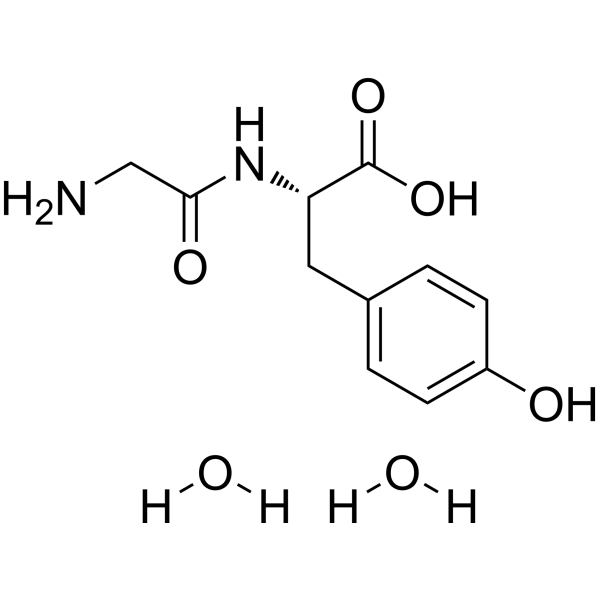
    Glycyl-L-tyrosine dihydrate 39630-46-1 ≥99.0%
    Glycyl-L-tyrosine dihydrate is a synthetic dipeptide that can be used as a food additive for tyrosine supplementation.
    Glycyl-L-tyrosine dihydrate
  • HY-W115727B
    Polyacrylamide,Anion,Mw 18 million 9003-05-8 ≥98.0%
    Polyacrylamide,Anion,Mw 18 million (PAM,Anion,Mw 18 million) is a multifunctional high molecular weight anionic polyacrylamide copolymer. The anionic properties of Polyacrylamide,Anion,Mw 18 million enable it to be used as a flocculant to achieve charge neutralization and aggregation, while its high molecular weight properties provide viscoelastic properties for fluid applications. Polyacrylamide series materials can maintain enzyme activity in enzyme immobilization, act as drug carriers to achieve controlled release, serve as smart materials responding to temperature/pH stimuli, and be used for in vitro toxin adsorption and soft tissue filling through mechanisms such as physical entrapment, covalent binding or chemical crosslinking. Polyacrylamide finds applications in biomedical engineering, environmental management and industrial applications.
    Polyacrylamide,Anion,Mw 18 million