



Maltodextrin, dextrose equivalent 16.5-19.5

Based on 1 Customer Validation
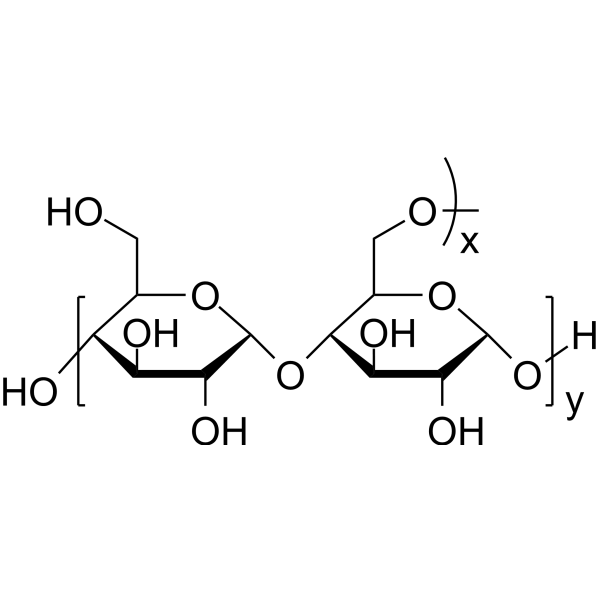
Maltodextrin, dextrose equivalent 16.5-19.5 can be used as an excipient. Pharmaceutical excipients, or pharmaceutical auxiliaries, refer to other chemical substances used in the pharmaceutical process other than pharmaceutical ingredients. Pharmaceutical excipients generally refer to inactive ingredients in pharmaceutical preparations, which can improve the stability, solubility and processability of pharmaceutical preparations. Pharmaceutical excipients also affect the absorption, distribution, metabolism, and elimination (ADME) processes of co-administered drugs.
For research use only. We do not sell to patients.
- CAS No.: 9050-36-6
- Formula: (C6H10O5)n·xH2O
-
Storage:Powder -20°C, 3 years , 4°C, 2 years ; In solvent -80°C, 6 months , -20°C, 1 month

To place orders, for customer services and technical support, please contact: MedChemExpress USA
Tel: 609-228-6898 E-mail: [email protected] [email protected]


-
 Biological Activity
-
Chemical Information
-
Solvent & Solubility
- Purity & Documentation
- References
-
 Help & FAQs


-

HY-W250795B
Maltodextrin, dextrose equivalent 5.0-8.0 -

HY-W250795A
Maltodextrin, dextrose equivalent 13.0-17.0 -
HY-W250111
Carboxymethyl chitosan -

HY-Y1365
Gelatins -
HY-B2144A
Chitosan (MW 150000) (≥85% deacetylated) -

HY-Y1365D
Bovine Gelatin,suitable for cell culture -

HY-Y1365L
Porcine skin Gelatin,suitable for cell culture(high gel strength) -

HY-W134423
Agar, microbiology tested, for cell culture (powder) -
HY-B2144B
Chitosan (MW 30000) (≥85% deacetylated) -

HY-B2144K
Chitosan (≥85% deacetylated, viscosity>90 mPa.s, MW 15000) -
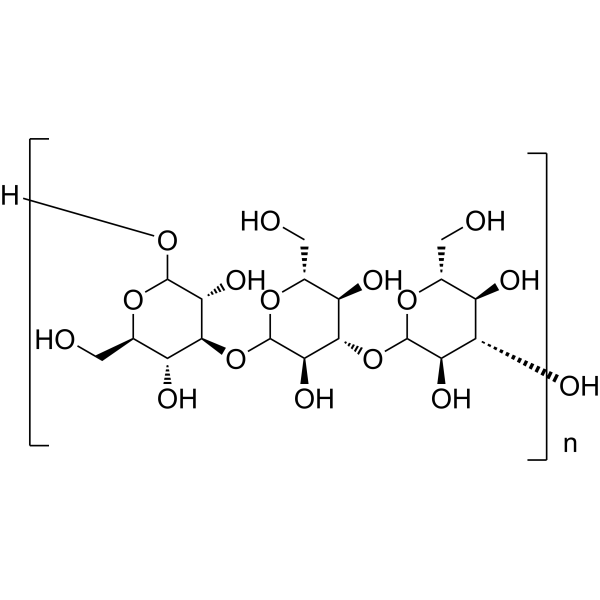
HY-119109
Laminaran -
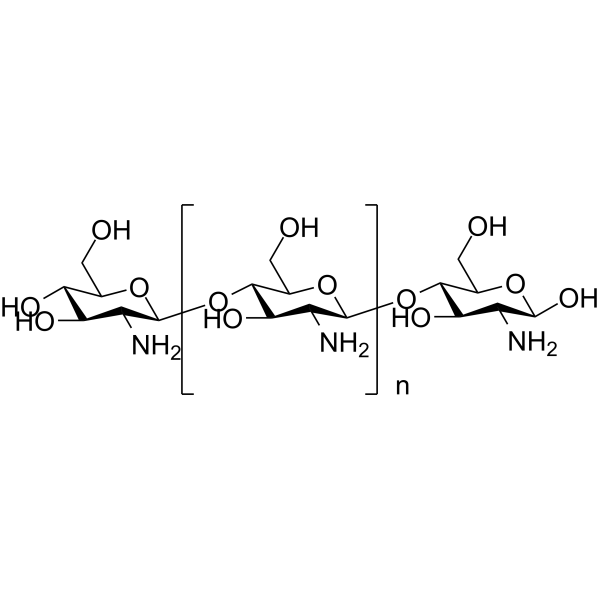
HY-B2144E
Chitosan (≥90% deacetylated, Low viscosity,<200mPa.s)


Biological Activity
Description
IC50 & Target
|
Human Endogenous Metabolite |
In Vitro
Maltodextrin, dextrose equivalent 16.5-19.5 is a polysaccharide with good biocompatibility and drug encapsulation ability, that encapsulates BSA as a model protein with an efficiency of about 70% and a loading rate of up to 20%. Maltodextrin, dextrose equivalent 16.5-19.5 exhibits non-toxic to cells at a concentrations of 5 mg/mL, and can be used in drug delivery system. The glucose equivalent (DE) value reflects the degree of hydrolysis of maltodextrin. The higher the DE value, the higher the degree of hydrolysis is. Maltodextrin, dextrose equivalent 16.5-19.5 forms stable nanoparticles with particle sizes ranging from 170 nm to 450 nm and a narrow particle size distribution[2].
MedChemExpress (MCE) has not independently confirmed the accuracy of these methods. They are for reference only.
Clinical Trial
| NCT Number | Sponsor | Condition | Start Date |
Phase

|
|---|---|---|---|---|
| NCT01329991 | Plexxikon| | 2011-05 | PHASE1 |


Chemical Information
-
CAS No. 9050-36-6
-
Appearance Solid
-
Formula (C6H10O5)n·xH2O
-
Color White to off-white
-
SMILES
OC[C@@H]1[C@@H](O)[C@H](O)[C@@H](O)[C@@H](O[C@@H]2[C@@H](COC)O[C@H](O[H])[C@H](O)[C@H]2O)O1.[y].[x]
-
Synonyms
Maltodextrin; Dextrin maize starch
-
Structure Classification
-
Initial Source
-
Shipping
Room temperature in continental US; may vary elsewhere.
-
Storage
Powder -20°C 3 years 4°C 2 years In solvent -80°C 6 months -20°C 1 month


Solvent & Solubility
In Vitro:
DMSO : 100 mg/mL (Need ultrasonic; Hygroscopic DMSO has a significant impact on the solubility of product, please use newly opened DMSO)
In Vivo:
Select the appropriate dissolution method based on your experimental animal and administration route.
- For the following dissolution methods, please ensure to first prepare a clear stock solution using an In Vitro approach and then sequentially add co-solvents:
- To ensure reliable experimental results, the clarified stock solution can be appropriately stored based on storage conditions. As for the working solution for In Vivo experiments, it is recommended to prepare freshly and use it on the same day.
- The percentages shown for the solvents indicate their volumetric ratio in the final prepared solution. If precipitation or phase separation occurs during preparation, heat and/or sonication can be used to aid dissolution.
Add each solvent one by one: 10% DMSO 40% PEG300 5% Tween-80 45% Saline
Solubility: ≥ 5 mg/mL; Clear solution
This protocol yields a clear solution of ≥ 5 mg/mL (saturation unknown).
Taking 1 mL working solution as an example, add 100 μL DMSO stock solution (50.0 mg/mL) to 400 μL PEG300, and mix evenly; then add 50 μL Tween-80 and mix evenly; then add 450 μL Saline to adjust the volume to 1 mL.
Preparation of Saline: Dissolve 0.9 g sodium chloride in ddH₂O and dilute to 100 mL to obtain a clear Saline solution.
In Vivo Dissolution Calculator
Please enter the basic information of animal experiments:
-
-
-
-
Recommended: Prepare an additional quantity of animals to account for potential losses during experiments.
Please enter your animal formula composition:
-
%DMSO +
Recommended: Keep the proportion of DMSO in working solution below 2% if your animal is weak.
-
%+
-
+%Tween-80 + +
-
%Saline +
The co-solvents required include: DMSO, . All of co-solvents are available by MedChemExpress (MCE). , Tween 80. All of co-solvents are available by MedChemExpress (MCE).
Working solution concentration: 0.22 mg/mL
Method for preparing stock solution: mg drug dissolved in μL DMSO. Stock solution concentration: mg/mL.
1. Take μL DMSO stock solution;
2. Add μL .
μL , mix evenly;
3. Then add μL Tween 80, mix evenly;
4. Then add μL
Please ensure that the stock solution in the first step is dissolved to a clear state, and add co-solvents in sequence. You can use ultrasonic heating (ultrasonic cleaner, recommended frequency 20-40 kHz), vortexing, etc. to assist dissolution.


Purity & Documentation
-
Data Sheet (274 KB)
-
SDS (393 KB)
- English - EN (393 KB)
- Français - FR (393 KB)
- Deutsch - DE (393 KB)
- Norwegian - NO (393 KB)
- Español - ES (393 KB)
- Swedish - SV (393 KB)
- Italian - IT (393 KB)
- Korean - KR (393 KB)
- Portuguese - PT (393 KB)
-
Handling Instructions (2659 KB)
References
[1]. Elder DP, et al. Pharmaceutical excipients - quality, regulatory and biopharmaceutical considerations. Eur J Pharm Sci. 2016 May 25;87:88-99. [Content Brief]
[2]. Barthold S, et al., Preparation of maltodextrin nanoparticles and encapsulation of bovine serum albumin - Influence of formulation parameters. Eur J Pharm Biopharm. 2019 Sep;142:405-410. [Content Brief]

Calculators
Concentration (start) × Volume (start) = Concentration (final) × Volume (final)


Maltodextrin, dextrose equivalent 16.5-19.5 Related Classifications
HY-W250795 Related Classifications
 Powered by Bioz
Keywords
- Maltodextrin, dextrose equivalent 16.5-19.5
- 9050-36-6
- Maltodextrin
- Dextrin maize starch
- Environmental Pollutants
- Biochemical Assay Reagents
- pharmaceutical excipient
- pharmaceutical auxiliarie
- pharmaceutical ingredients
- inactive ingredients
- stability
- solubility
- processability
- absorption
- distribution
- metabolism
- and elimination (ADME)
- Inhibitor
- inhibitor
- inhibit