



Fluorescent Dye
Fluorescence is a phenomenon of photoluminescence in luminescence. When an atom is irradiated by light, some electrons around the nucleus jump from their original orbitals to higher energy orbitals under the influence of light energy, i.e., from the ground state to the first or second excited single-line state, etc. Due to the instability of the first or second excited singlet state, the electron returns from the excited singlet state to the ground state accompanied by released energy, resulting in fluorescence.
Fluorescent dyes can be covalently bound or physically adsorbed in the structure of the substance. The fluorescence properties allow for the characterization, localization and quantitative analysis of the labeled object. Fluorescent dyes have shown great potential for the detection of proteins, nucleic acids, cells, and immunoassays, attributed to the advantages in non-radioactive contamination, simple experimental operation and easy observation.
Fluorescent dyes have penetrated many fields such as pharmacology, physiology, environmental science, and information science, as well as functional studies of proteins and drug screening.
All Product Categories
-
Fluorescent Dye Related Products (4914)
Related Products (4914)

-
Antibodies (4)
-
FAM Phosphoramidite, 6-isomer hydroxyprolinol
 0 ImagesCat. No.: HY-W1061294CAS No.: 959470-55-4FAM Phosphoramidite, 6-isomer hydroxyprolinol is a derivative of 6-carboxyfluorescein (6-FAM) featuring a phosphoramidite moiety for use in oligonucleotide synthesis. It is primarily used for the synthesis of fluorescent oligonucleotide probes (Ex/Em = 495/519 nm).
-
Rhodamine B-Dextran chloride (MW 5000)
 0 ImagesCat. No.: HY-D3047ARhodamine B-Dextran (MW 5000) is a Rhodamine B (HY-Y0016)-labeled dextran with a molecular weight of 5000. Rhodamine B-Chitosan (MW 5000) plays an important role in fluorescent labeling, cell imaging, vascular imaging, and drug delivery research (Ex/Em = 546/610 nm).

-
BacGO
 0 ImagesCat. No.: HY-D2987BacGO is a highly selective, wash free fluorescent probe for Gram positive bacteria. BacGO binds to the carbohydrate structure in peptidoglycan through boric acid and exhibits depolymerization induced luminescence (DIE) properties. BacGO can be used for imaging complex environmental samples (such as activated sludge) and flat plate bacteria without affecting bacterial activity.
-
H-D-Val-Leu-Lys-AFC TFA
 0 ImagesCat. No.: HY-P5356APurity: 98.79%Synonyms: Plasmin substrate TFAH-D-Val-Leu-Lys-AFC TFA (Plasmin substrate TFA) is a plasmin-specific fluorescent substrate. H-D-Val-Leu-Lys-AFC TFA can be cleaved to generate a fluorescent signal, which is used to determine plasmin activity. Abs/Em=380/500 nm.
-
ONOO-LysopH
 0 ImagesCat. No.: HY-D2998CAS No.: 2567068-39-5ONOO-LysopH is a new Rhodamine-based near-infrared fluorescent probe. ONOO-LysopH is acid-sensitive, exhibiting rapid near-infrared fluorescence enhancement around 686 nm under acidic pH conditions. ONOO-LysopH also displays a rapid NIR turn-on fluorescence around 678 nm for ONOO− at physiological pH. ONOO-LysopH can target lysosomes to track lysosomal pH changes and image endogenous/exogenous ONOO− in live cells. ONOO-LysopH is applicable for cell imaging ONOO− and tracking lysosomal pH changes.


-
FAM labled Archexin sodium
 0 ImagesCat. No.: HY-177616CFAM labled Archexin sodiumis a FAM labled Archexin sodium.
-
YH-APN
 0 ImagesCat. No.: HY-D2973YH-APN is a high-performance APN activated near-infrared fluorescent probe. YH-APN has high sensitivity, high selectivity, fast response, and can achieve extremely high tumor/normal tissue signal-to-noise ratio through in situ spraying. YH-APN can specifically distinguish cancer cells with high expression of APN from normal cells and monitor the migration of cancer cells.
-
7-Amino-4-methylcoumarin hydrogensulfate
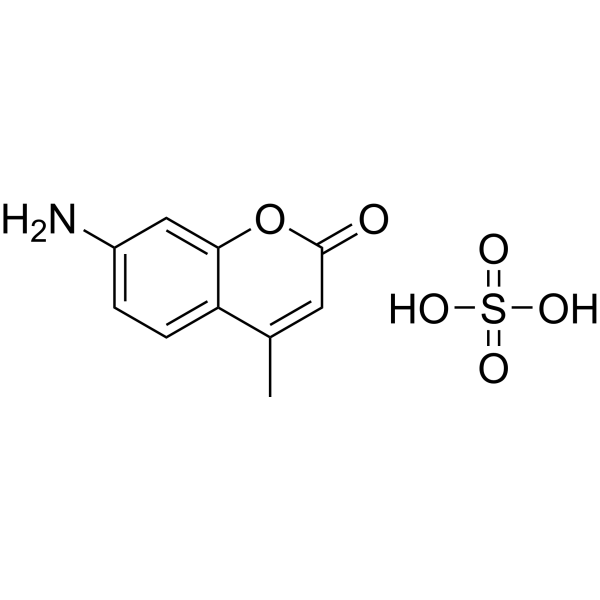 0 ImagesCat. No.: HY-D0002CAS No.: 207673-94-7Synonyms: Coumarin 120 hydrogensulfate; AMC hydrogensulfate7-Amino-4-methylcoumarin hydrogensulfate (Coumarin 120 hydrogensulfate; AMC hydrogensulfate) is a multifunctional dye. Dyes are important tools in biological experiments. They can help researchers observe and analyze cell structures, track biomolecules, evaluate cell functions, distinguish cell types, detect biomolecules, study tissue pathology and monitor microorganisms. Their applications range from basic scientific research to clinical A wide range of diagnostics. Dyes are also widely used in traditional fields such as textile dyeing, as well as in emerging fields such as functional textile processing, food pigments and dye-sensitized solar cells.
-
RB-PEG600-NH2
 0 ImagesCat. No.: HY-D2895ASynonyms: Rhodamine B-PEG600-NH2RB-PEG600-NH2 (Rhodamine B-PEG600-NH2) is a fluorescent dye composed of Rhodamine B (HY-Y0016), PEG and an amino group. The reactive primary amine or NH2 groups can react rapidly with activated carboxylic acids such as NHS esters to form stable amide bonds (Ex/Em=546/610 nm).
-
7-Acetoxy-4-bromomethylcoumarin
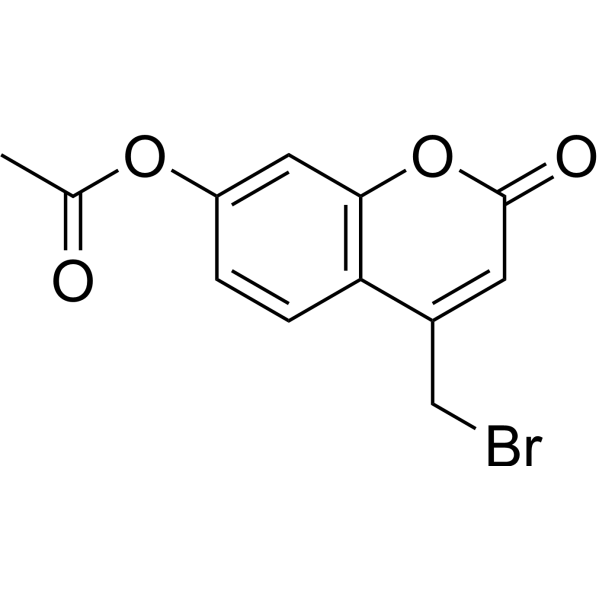 0 ImagesCat. No.: HY-W297715CAS No.: 2747-04-87-Acetoxy-4-bromomethylcoumarin acts as a fluorescence label for fatty acids.
-
Cy5.5-PEG5000-SH
 0 ImagesCat. No.: HY-D2558Cy5.5-PEG5000-SH is a fluorescent labeling reagent that combines Cy5.5 (HY-D0924) fluorescent dye, polyethylene glycol (PEG) and sulfhydryl (SH) derivatives, and is suitable for molecular coupling. SH is highly reactive and can react with a variety of functional groups (such as maleimide) to form stable thioether bonds.
-
ATTO 514 alkyne
 0 ImagesCat. No.: HY-D2035ATTO 514 alkyne is a new fluorescent marker based on the Rhodamine structure. It has strong absorption, high fluorescence quantum yield, high thermal stability and photochemical stability, and is suitable for single molecule detection and high-resolution microscopy. ATTO 514 alkyne is an alkyne derivative of ATTO 514 and can be used to label proteins or antibodies.

-
Fluo-3FF AM
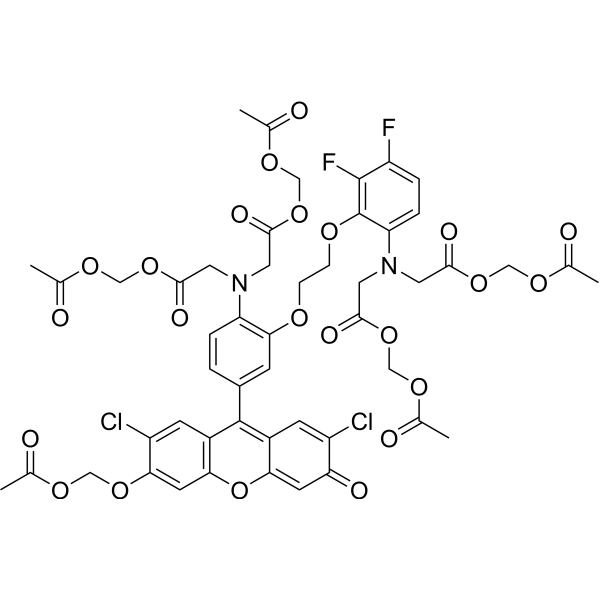 0 ImagesCat. No.: HY-D1755CAS No.: 348079-13-0Fluo-3FF AM is a low affinity (Kd = 42 μM) fluorescent Ca2+ sensitive indicator (Abs/Em = 462 nm/526 nm). Fluo-3FF AM is Mg2+ insensitive and relatively photostable. Fluo-3FF AM is an analog of Fluo-3FF AM. Fluo-3FF AM is essentially non-fluorescent, but exhibits a strong fluorescence enhancement upon entry into cells and binding to calcium.
-
BODIPY FL hydrazide hydrochloride
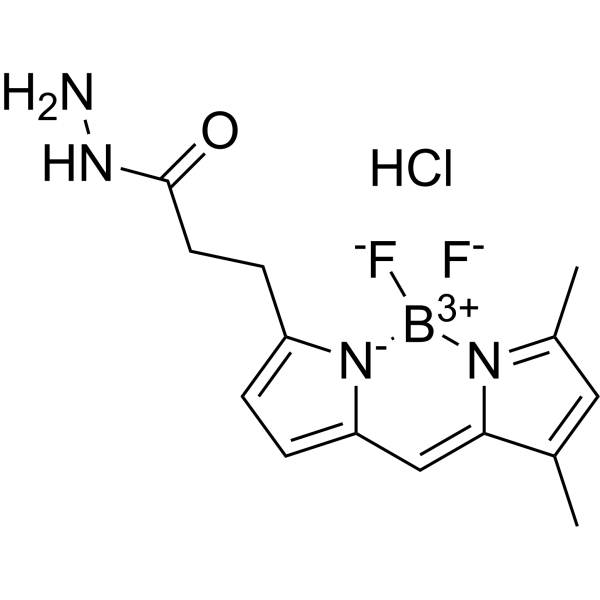 0 ImagesCat. No.: HY-D1332CAS No.: 2183473-45-0BODIPY FL hydrazide hydrochloride is a BODIPY-containing hydrazide fluorescent dye. BODIPY FL hydrazide hydrochloride is used to label carbonyl groups on oxidatively damaged proteins, 3-ketosteroids, and heparin/heparan sulfate carbohydrates. BODIPY FL hydrazide hydrochloride specifically binds to protein carbonyls, steroid keto groups, or reducing-end carbonyls of carbohydrates through derivatization or reductive amination via its hydrazide group to form stable conjugates; after the reaction is complete, the labeled molecules emit strong fluorescence (Ex/Em = 488-495/516-520 nm).
-
CY5.5-Alginate
 0 ImagesCat. No.: HY-D3020CY5.5-Alginate is a CY5.5 (HY-D0924)-labeled alginate. CY5.5-Alginate combines the polysaccharide properties of alginate with the fluorescence properties of CY5.5, playing an important role in fields such as fluorescent labeling, cell imaging, and drug delivery research (Ex/Em = 680/710 nm).




