



Fluorescent Dye
Fluorescence is a phenomenon of photoluminescence in luminescence. When an atom is irradiated by light, some electrons around the nucleus jump from their original orbitals to higher energy orbitals under the influence of light energy, i.e., from the ground state to the first or second excited single-line state, etc. Due to the instability of the first or second excited singlet state, the electron returns from the excited singlet state to the ground state accompanied by released energy, resulting in fluorescence.
Fluorescent dyes can be covalently bound or physically adsorbed in the structure of the substance. The fluorescence properties allow for the characterization, localization and quantitative analysis of the labeled object. Fluorescent dyes have shown great potential for the detection of proteins, nucleic acids, cells, and immunoassays, attributed to the advantages in non-radioactive contamination, simple experimental operation and easy observation.
Fluorescent dyes have penetrated many fields such as pharmacology, physiology, environmental science, and information science, as well as functional studies of proteins and drug screening.
All Product Categories
-
Fluorescent Dye Related Products (4888)
Related Products (4888)

-
Antibodies (4)
-
Green Fluorescent PLGA nanoparticles, 100nm
 0 ImagesCat. No.: HY-168947Green Fluorescent PLGA nanoparticles, 100nm is a PLGA nanoparticle labeled with a green fluorescent dye and is commonly used in imaging and diagnostic applications.
-
Cy7.5 hydrazide
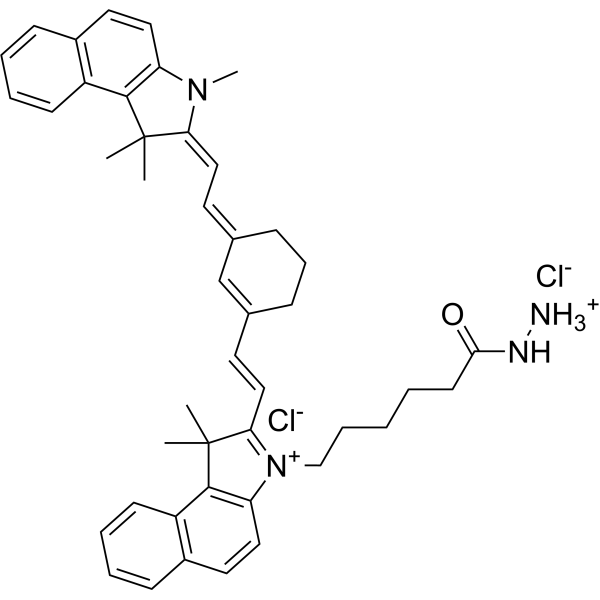 0 ImagesCat. No.: HY-D1564Cy7.5 hydrazide is a fluorophore Cy7.5-labeled hydrazide fluorescent dye.
-
sCy5DA
 0 ImagesCat. No.: HY-D3390sCy5DA is a is a fluorescent D-amino acid. sCy5DA incorporates into bacterial peptidoglycan layers and cross-links via transpeptidase action, replacing peptidoglycan stem peptide D-amino acids. sCy5DA labels live bacterial cell walls, nascent peptidoglycan biosynthesis sites, and diverse bacterial species including Gram-negative, Gram-positive, and mycobacteria (Ex/Em = 646/665 nm).
-
Cy5.5-PEG5000-FA
 0 ImagesCat. No.: HY-D2574Cy5.5-PEG5000-FA is a fluorescently labeled biomolecule consisting of Cy5.5 (HY-D0924) fluorescent dye, polyethylene glycol (PEG), and Folic acid (FA) (HY-16637). Cy5.5 is commonly used in applications such as immunolabeling and nucleic acid labeling. The maximum emission wavelength of Cy5.5 is approximately 710 nm.

-
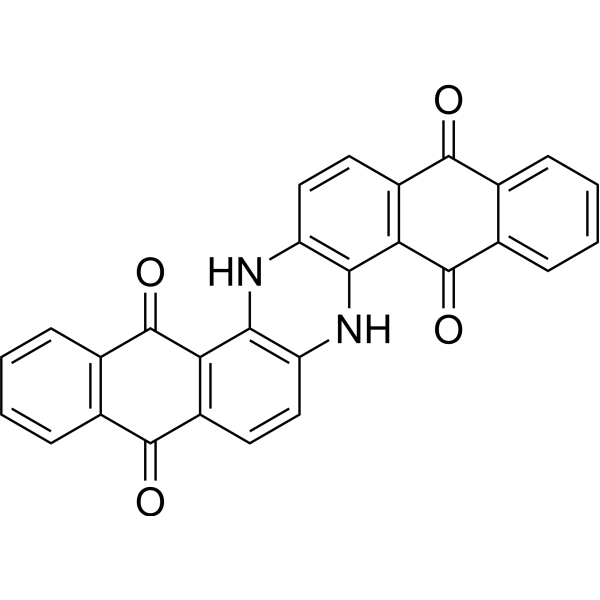
Isoviolanthrone
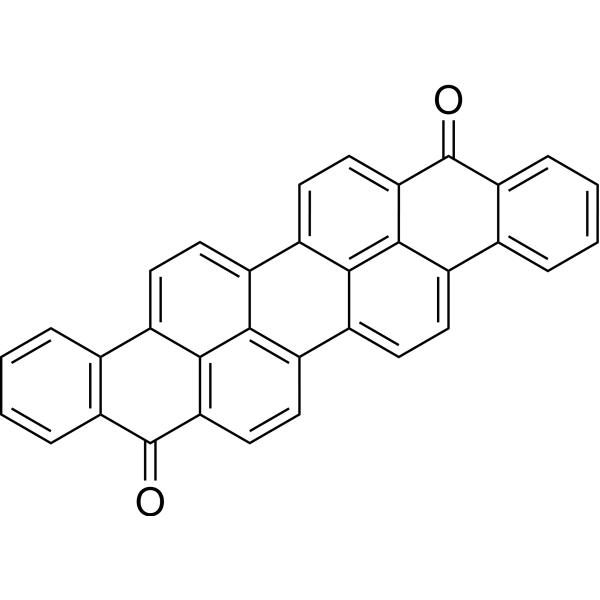 0 ImagesIsoviolanthrone is a multifunctional dye. Dyes are important tools in biological experiments. They can help researchers observe and analyze cell structures, track biomolecules, evaluate cell functions, distinguish cell types, detect biomolecules, study tissue pathology and monitor microorganisms. Their applications range from basic scientific research to clinical A wide range of diagnostics. Dyes are also widely used in traditional fields such as textile dyeing, as well as in emerging fields such as functional textile processing, food pigments and dye-sensitized solar cells.
-
RB-PEG3400-NH2
 0 ImagesCat. No.: HY-D2895DSynonyms: Rhodamine B-PEG3400-NH2RB-PEG3400-NH2 (Rhodamine B-PEG3400-NH2) is a fluorescent dye composed of Rhodamine B (HY-Y0016), PEG and an amino group. The reactive primary amine or NH2 groups can react rapidly with activated carboxylic acids such as NHS esters to form stable amide bonds (Ex/Em=546/610 nm).
-
ATTO 590
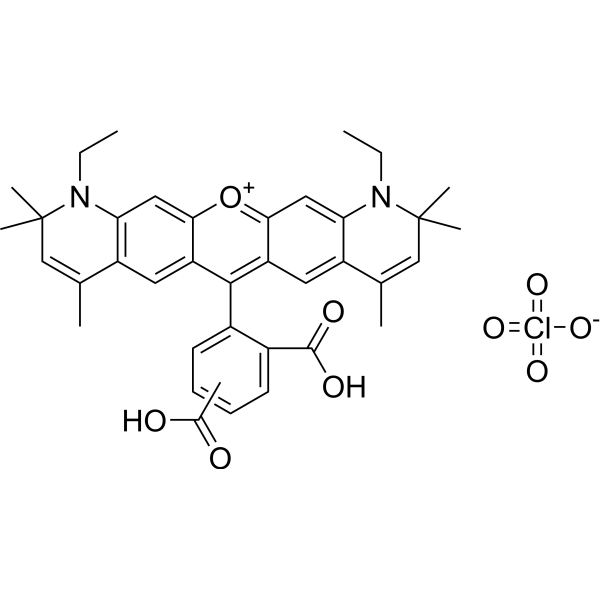 0 ImagesCat. No.: HY-D1931CAS No.: 639065-13-7ATTO 590 is a new type of fluorescent dye with high fluorescence yield, which can be used for most labeling applications, maximum excitation/emission wavelength: 594/622 nm.
-
ATTO 425
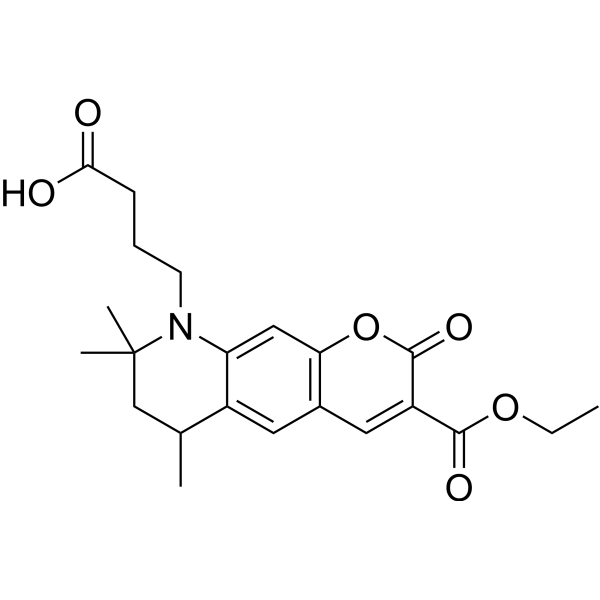 0 ImagesCat. No.: HY-W726893CAS No.: 652966-03-5ATTO 425 is an uncharged fluorescent dye.
-
Cy3-PEG5000-FA
 0 ImagesCat. No.: HY-D2524Cy3-PEG5000-FA is a fluorescently labeled biomolecule consisting of Cy3 (HY-D0822) fluorescent dye, polyethylene glycol (PEG), and Folic acid (FA) (HY-16637). Cy3 is commonly used in applications such as immunolabeling and nucleic acid labeling. The maximum emission wavelength of Cy3 is approximately 562-570 nm.
-
1,3-Di-(2-pyrenyl)propane
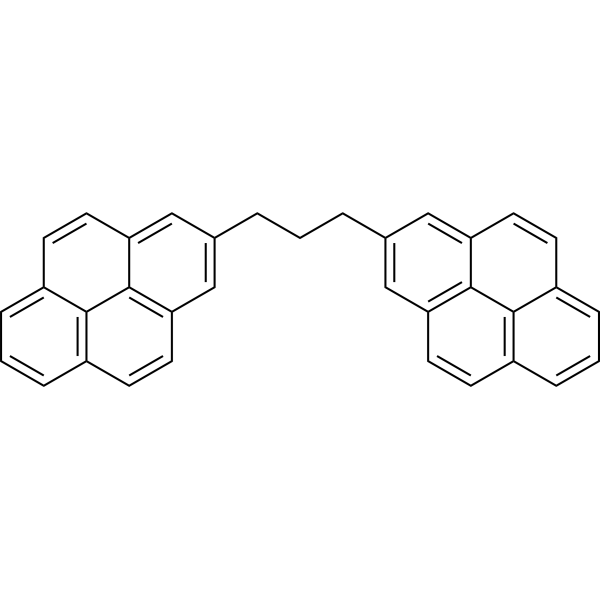 0 ImagesCat. No.: HY-147181CAS No.: 97325-55-8
-
Fluorescein-PEG6-amine
 0 ImagesCat. No.: HY-D3500Fluorescein-PEG6-amine is a derivative of Fluorescein. Fluorescein-PEG6-amine features free amine group for further conjugation. Fluorescein-PEG6-amine is commonly used in fluorescence microscopy, flow cytometry, immunoassays, and nucleic acid detection (Ex/Em = 495/519 nm) .

-
Rhodamine-PEG350
 0 ImagesCat. No.: HY-D2892Rhodamine-PEG350 a fluorescent PEG derivative composed of Rhodamine B (HY-Y0016) and PEG. Rhodamine-PEG350 can be used for fluorescent labeling and imaging (Ex/Em=546/610 nm).
-
4-Carboxy-pennsylvania green
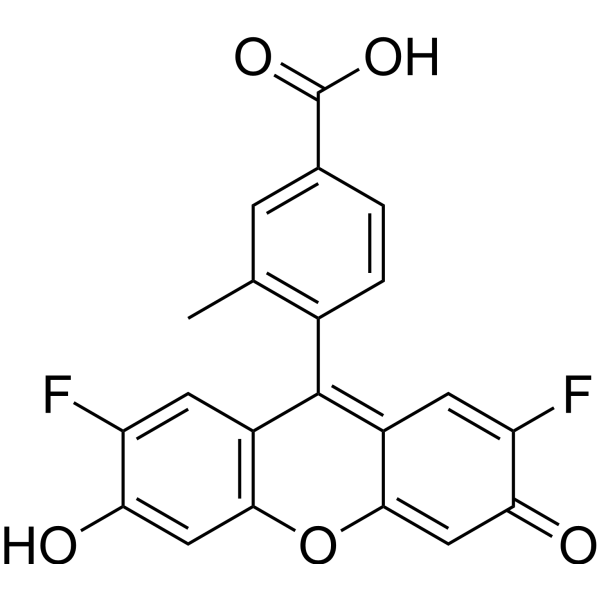 0 ImagesCat. No.: HY-D1205CAS No.: 879288-14-94-Carboxy-pennsylvania green is a multifunctional dye. Dyes are important tools in biological experiments. They can help researchers observe and analyze cell structures, track biomolecules, evaluate cell functions, distinguish cell types, detect biomolecules, study tissue pathology and monitor microorganisms. Their applications range from basic scientific research to clinical A wide range of diagnostics. Dyes are also widely used in traditional fields such as textile dyeing, as well as in emerging fields such as functional textile processing, food pigments and dye-sensitized solar cells.
-
Cy3 labled Olezarsen sodium
 0 ImagesCat. No.: HY-153491DCy3 labled Olezarsen sodium is a Cy3 labled Olezarsen sodium.
-
AF750 PEG12 DBCO
 0 ImagesCat. No.: HY-D3569AF750 PEG12 DBCO is a derivative of Alexa Fluor 750 featuring a DBCO (dibenzocyclooctyne) group for copper-free click chemistry (SPAAC). It incorporates a PEG12 linker to enhance hydrophilicity and provide increased spacer length. AF750 PEG12 DBCO is primarily used for copper-free click chemistry (SPAAC) bioconjugation (Ex/Em = 749/775 nm).




