



Isotope-Labeled Compounds
Isotope-labeled compounds are chemical substances in which some atoms in their molecules are replaced by isotope atoms. The range of stable isotope products can cover from gases to complex molecules. Isotope-labeled compounds could provide a site-specific investigation of structures, making molecules easily detectable by mass spectrometry and NMR, and maintaining the physico-chemical properties of the target molecule at the same time.
MCE isotope-labeled compounds are all stable isotope-labeled compounds and are non-radioactive labeled substances. MCE isotope-labeled compounds are unique tools for identifying and understanding biological and chemical processes. Stable isotope-labeled products are now getting more and more popular among scientists. The scope of application is gradually penetrating into various scientific fields, such as life sciences, food and medicine, agriculture, environment, geology, etc. Stable isotope-labeled compounds have a wide range of applications in the Life Science areas, such as Metabolomics, Proteomics, Clinical studies, Deuterium drugs, etc.
All Product Categories
-
Isotope-Labeled Compounds Related Products (11051)
Related Products (11051)

-
cis-4-Hepten-1-ol-d2
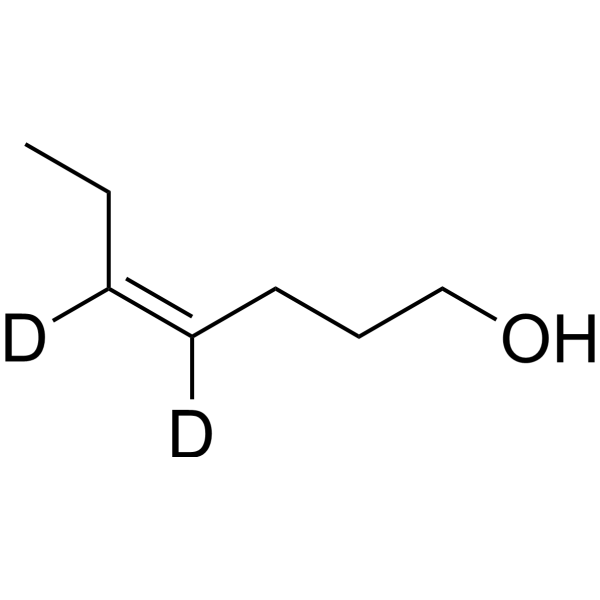 0 ImagesCat. No.: HY-W127532Scis-4-Hepten-1-ol-d2 is deuterated labeled cis-4-Hepten-1-ol (HY-W127532). cis-4-Hepten-1-ol is a biochemical reagent that can be used as a biological material or organic compound for life science related research.
-
Methyl behenate-d4
 0 ImagesCat. No.: HY-W009082SCAS No.: 2692624-14-7Synonyms: Methyl docosanoate-d4Methyl behenate-d4 (Methyl docosanoate-d4) is an isotope-labeled Methyl behenate. Methyl behenate is a fatty acid methyl ester, can be found in the plant Aspidopterys obcordata Lemsl. Methyl behenate can be used as a phase change material.
-
Selegiline-d5 hydrochloride
 0 ImagesCat. No.: HY-14199SCAS No.: 1217705-21-9Synonyms: Deprenyl-d5 hydrochloride; (-)-Selegiline-d5 hydrochloride; (-)-Deprenyl-d5 hydrochlorideSelegiline-d5 (hydrochloride) (Deprenyl-d5 (hydrochloride)) is deuterium labeled Selegiline (hydrochloride). Selegiline (Deprenyl) hydrochloride is a potent, selective and irreversible inhibitor of MAO-B, with an IC50 of 51 nM. Selegiline hydrochloride exhibits 450-flod selectivity for MAO-B over MAO-A (IC50=23 μM). Selegiline hydrochloride can be used for the research of Parkinson's disease, Alzheimer's disease and major depressive disorder.
-
Imatinib-13C,d3
 0 ImagesCat. No.: HY-15463S3Synonyms: STI571-13C,d3; CGP-57148B-13C,d3Imatinib-13C,d3 (STI571-13C,d3) is 13C labeled Imatinib. Imatinib (STI571) is an orally bioavailable tyrosine kinases inhibitor that selectively inhibits BCR/ABL, v-Abl, PDGFR and c-kit kinase activity. Imatinib (STI571) works by binding close to the ATP binding site, locking it in a closed or self-inhibited conformation, therefore inhibiting the enzyme activity of the protein semicompetitively. Imatinib also is an inhibitor of SARS-CoV and MERS-CoV.
-
Ubrogepant-d5
 0 ImagesCat. No.: HY-12366SSynonyms: MK-1602-d5Ubrogepant-d5 (MK-1602-d5) is deuterium labeled Ubrogepant. Ubrogepant (MK-1602) is an orally active and selective antagonist of calcitonin gene-related peptide receptor (CGRP). Ubrogepant has high affinity for CGRP receptors in human and rhesus monkeys, and can effectively block the cAMP response stimulated by α-CGRP. Ubrogepant can be used in the study of acute migraine.
-
1,2,3,4,5-Pentabromo-6-(2,3-dibromophenoxy)benzene-13C12
 0 ImagesCat. No.: HY-W716411S1,2,3,4,5-Pentabromo-6-(2,3-dibromophenoxy)benzene-13C12 is 13C labeled 1,2,3,4,5-Pentabromo-6-(2,3-dibromophenoxy)benzene.
-
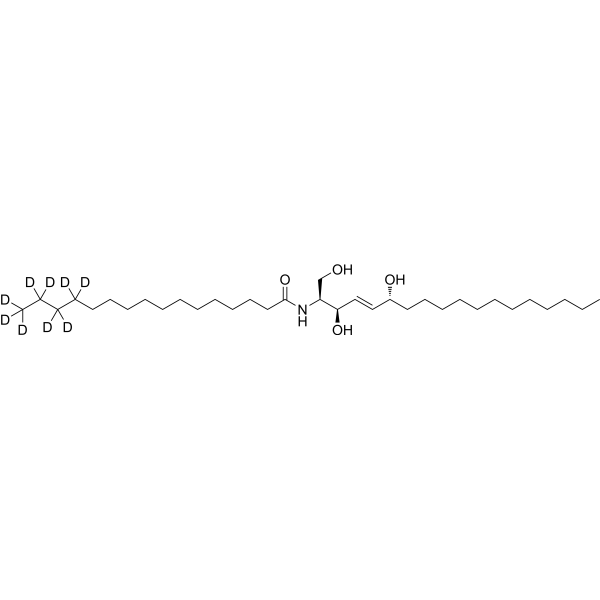
CER9 (t18:0/26:0/18:1)-d9
 0 ImagesCER9 (t18:0/26:0/18:1)-d9 is deuterium labeled CER9 (t18:0/26:0/18:1).
-
17:0-20:3 PI-d5
 0 ImagesSynonyms: 1-heptadecanoyl-2-eicosatrienoyl-sn-glycero(d5)-3-phosphoinositol ammonium17:0-20:3 PI-d5 (1-heptadecanoyl-2-eicosatrienoyl-sn-glycero(d5)-3-phosphoinositol (ammonium)) is deuterium labeled 17:0-20:3 PI.
-
Revefenacin-d9
 0 ImagesCat. No.: HY-15851S1Synonyms: TD-4208-d9; GSK1160724-d9Revefenacin-d9 (TD-4208-d9) is deuterium labeled Revefenacin. Revefenacin (TD-4208; GSK1160724) is a potent mAChR antagonist; has a high affinity on M3 receptor with a Ki of 0.18 nM.
-
Linagliptin-d6
 0 ImagesCat. No.: HY-10284S5Synonyms: BI 1356-d6Linagliptin-d6 (BI 1356-d6) is deuterium labeled Linagliptin. Linagliptin is a highly potent, selective DPP-4 inhibitor with IC50 of 1 nM.
-
Methanone, 1,1′-[1,4-butanediylbis[oxy(2-hydroxy-4,1-phenylene)]]bis[phenyl-d10
![Methanone, 1,1′-[1,4-butanediylbis[oxy(2-hydroxy-4,1-phenylene)]]bis[phenyl-d10](https://file.medchemexpress.com/product_pic/hy-165699s.gif "Click to View Methanone, 1,1′-[1,4-butanediylbis[oxy(2-hydroxy-4,1-phenylene)]]bis[phenyl-d10 Product Detail") 0 ImagesCat. No.: HY-165699SMethanone, 1,1′-[1,4-butanediylbis[oxy(2-hydroxy-4,1-phenylene)]]bis[phenyl-d10 is deuterium labeled Methanone, 1,1′-[1,4-butanediylbis[oxy(2-hydroxy-4,1-phenylene)]]bis[phenyl.
0 ImagesCat. No.: HY-165699SMethanone, 1,1′-[1,4-butanediylbis[oxy(2-hydroxy-4,1-phenylene)]]bis[phenyl-d10 is deuterium labeled Methanone, 1,1′-[1,4-butanediylbis[oxy(2-hydroxy-4,1-phenylene)]]bis[phenyl.
-
(Rac)-Etomidate acid-d5
 0 ImagesCat. No.: HY-116666S(Rac)-Etomidate acid-d5 is the deuterium labeled (Rac)-Etomidate acid.
-
2-(2-Furanyl)-6-methylpyrazine-d3
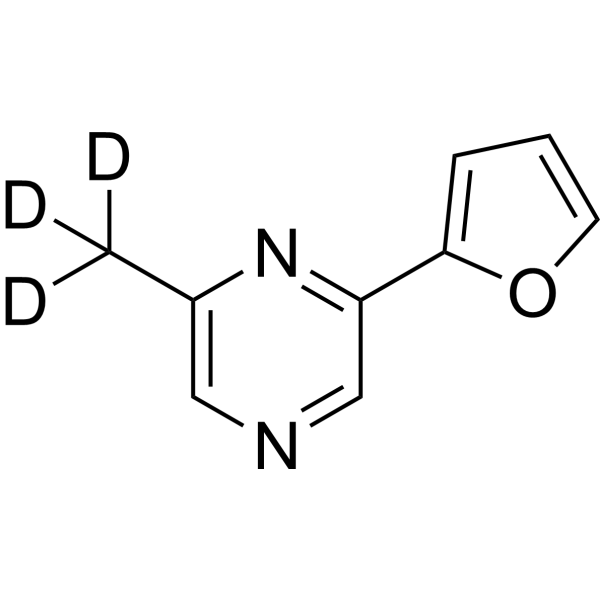 0 ImagesCat. No.: HY-156269SCAS No.: 1335402-08-82-(2-Furanyl)-6-methylpyrazine-d3 is deuterated labeled 2-(2-Furanyl)-6-methylpyrazine.
-
DPCPX-d4
 0 ImagesCat. No.: HY-100937SSynonyms: PD 116948-d4
-
Prochlorperazine sulfoxide-d8
 0 ImagesCat. No.: HY-157069SCAS No.: 1215350-60-9Prochlorperazine sulfoxide-d8 is deuterium-labeled Prochlorperazine sulfoxide.
-
21-Deacetoxy deflazacort-d3
 0 ImagesCat. No.: HY-W742103
-
γ-Nonanolactone-d4
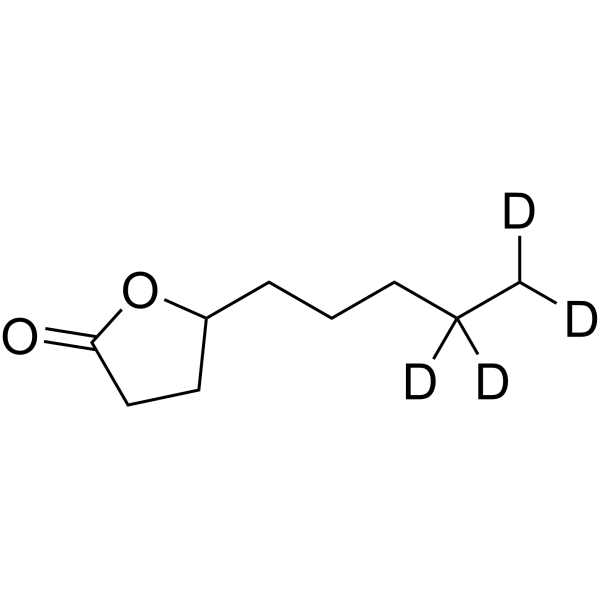 0 ImagesCat. No.: HY-W017281SCAS No.: 1394230-27-3γ-Nonanolactone-d4 is deuterated labeled γ-Nonanolactone.
-
6-ECDCA-d4
 0 ImagesCat. No.: HY-157938SCAS No.: 2025364-15-0Synonyms: 6α-ethyl Cheodeoxycholic Acid-d4, Obeticholic Acid-d46-ECDCA-d4 (6α-ethyl Cheodeoxycholic Acid-d4, Obeticholic Acid-d4) is deuterium labeled 6-ECDCA.
-
Pirlindole-d4
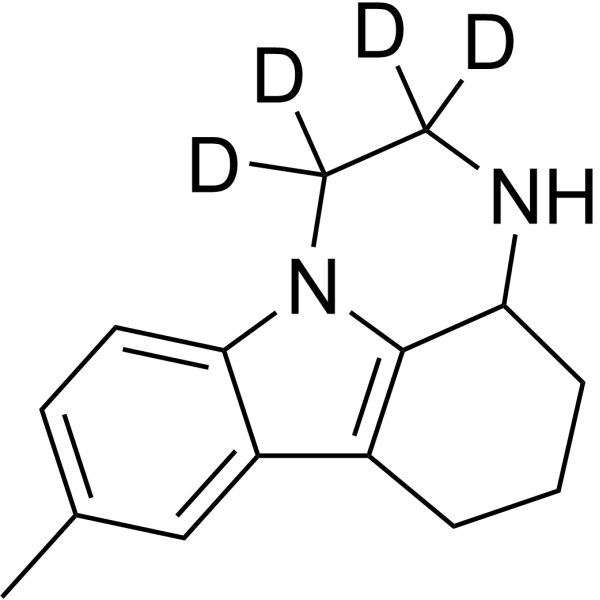 0 ImagesCat. No.: HY-100679SCAS No.: 1801646-26-3Pirlindole-d4 is the d4-labeled Pirlindole (HY-100679). Pirlindole is an orally active, selective and reversible MAO-A inhibitor with an IC50 value of 250 nM. Pirlindole inhibits genomic replication of Enterovirus species B and D, and exhibits moderate activity against enterovirus species A. Pirlindole inhibits MAO-A-mediated monoamine metabolism, promotes adult hippocampal neurogenesis, rescues stress-induced dendritic atrophy of hippocampal granule neurons, reverses behavioral effects associated with chronic mild stress, and also possesses anticonvulsant, analgesic, local anesthetic, hypotensive, antiplatelet aggregation and antispasmodic activities. Pirlindole shows no detectable mutagenic, clastogenic or carcinogenic properties. Pirlindole can be used in research related to depression and enterovirus infections.



