



NLRP3 Antibody(YA6868)
(Synonyms: C1orf7, CIAS1, NALP3, PYPAF1, NLRP3, Angiotensin/vasopressin receptor AII/AVP-like, Caterpiller protein 1.1, Cold-induced autoinflammatory syndrome 1 protein, Cryopyrin, PYRIN-containing APAF1-like protein 1, CLR1.1)NLRP3 Antibody(YA6868) is a Rabbit-derived and non-conjugated IgG monoclonal antibody, targeting to NLRP3.
-
Host:
Rabbit
-
Isotype:
IgG
-
Application:
WB, IHC-P, ICC/IF
-
Reactivity :
Human, Mouse, Rat
-
Formulation:
Supplied in 10mM PBS, pH 7.4, 150mM sodium chloride, 0.05% BSA, 0.02% sodium azide and 50% glycerol.
-
Conjugation:
Non-conjugated


To place orders, for customer services and technical support, please contact: MedChemExpress USA
Tel: 609-228-6898 E-mail: [email protected] [email protected]





Applications
| Application |
WB

WB: Western Blot
|
IHC-P
IHC-P: Immunohistochemistry-Paraffin
|
ICC/IF
ICC/IF: Immunocytochemistry/
Immunofluorescence |
|---|---|---|---|
| Dilution Ratio | 1:500-1:1000 | 1:50-1:100 | 1:50-1:200 |


Product Details
NLRP3 Antibody(YA6868) is a Rabbit-derived and non-conjugated IgG monoclonal antibody, targeting to NLRP3.
-
Host Rabbit

-
Clonality Monoclonal,Recombinant

-
Species ReactivityHuman, Mouse, Rat
-
Observed Molecular WeightObserved band size: 118 kDa
Note: Due to possible protein modifications or aggregation, the molecular weight should be confirmed by actual measurement, and the predicted value is for reference only.

-
Calculated Molecular Weight Predicted band size: 118 kDa

Entrez Gene: 114548 Human ; 216799 Mouse ; 287362 Rat
SwissProt: Q96P20 Human ; Q8R4B8 Mouse ; D4A523 Rat
OMIM: 120100 Human
Synthetic peptide corresponding to Human NALP3 aa1-150.
affinity purified
Non-conjugated
Unmodified
IgG


Product Properties
-
Appearance
Solution
-
Formulation
Supplied in 10mM PBS, pH 7.4, 150mM sodium chloride, 0.05% BSA, 0.02% sodium azide and 50% glycerol.
-
Storage & Stability
Stored at -20°C for 1 year. Avoid repeated freeze / thaw cycles.
-
Shipping
Shipping with blue ice.


Verification Images
-
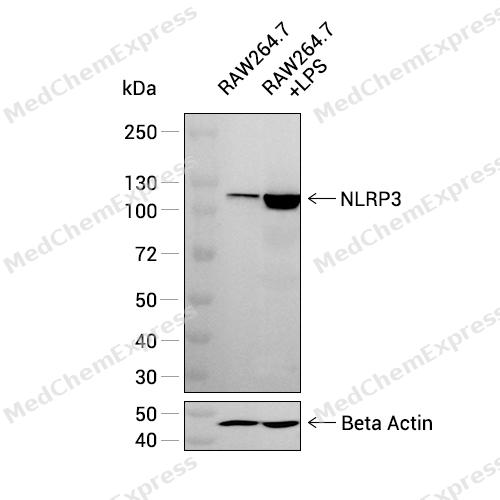 Western blot analysis was performed on extracts from RAW264.7 (lane 1, 15 μg), and RAW264.7+LPS (lane 2, 15 μg) using NLRP3 Rabbit mAb.Proteins were transferred to a PVDF membrane and blocked with 5% non-fat milk in TBST at 4°C overnight.The primary antibody (1:1000 dilution) and the loading control antibody (beta-Actin, HY-P83730, 1:20000 dilution) were incubated in 5% non-fat milk in TBST for 1 hour at 37°C.Goat Anti-Rabbit IgG-HRP Secondary Antibody (1:20000 dilution) was then applied for 40 minutes at 37°C.


Background
-
Function
NLRP3 (NLR Family Pyrin Domain Containing 3) is a cytosolic pattern-recognition receptor that functions as the sensor component of the NLRP3 inflammasome, enabling innate immune cells to detect microbial motifs, endogenous danger signals, and environmental irritants[1]. Upon activation, NLRP3 oligomerizes and recruits the adaptor ASC and pro-caspase-1, leading to inflammasome assembly, caspase-1 activation, and subsequent maturation of the pro-inflammatory cytokines IL-1β and IL-18 as well as gasdermin D-mediated pyroptosis[1][2]. Mechanistically, canonical NLRP3 activation requires a priming step that enhances NLRP3 and pro-inflammatory cytokine expression, followed by an activation step triggered by diverse stimuli including extracellular ATP, microbial toxins, silica particles, and monosodium urate crystals[2]. Through these signaling processes, NLRP3 regulates inflammation, host defense, and immune homeostasis, while excessive activation promotes pathological inflammatory responses[1][3]. Dysregulated NLRP3 inflammasome activity has been implicated in autoinflammatory syndromes, gout, cardiovascular disease, neurodegenerative disorders, inflammatory bowel disease, and other inflammation-associated conditions[1][3][4]. Compared with other inflammasome-forming NOD-like receptors such as NLRP1 and NLRC4, NLRP3 is distinguished by its ability to respond to an exceptionally broad spectrum of pathogen-associated and danger-associated signals rather than a limited set of ligands[1][4]. For experimental applications, selective NLRP3 inhibitors such as MCC950 suppress inflammasome assembly by targeting the NACHT domain and are widely used to investigate NLRP3-dependent inflammatory mechanisms in preclinical disease models[4].
-
Subcellular Localization
Cytoplasm, cytosol; Inflammasome; Cytoplasm, cytoskeleton, microtubule organizing center; Golgi apparatus membrane; Endoplasmic reticulum; Mitochondrion; Secreted; Nucleus
-
Expression
Tissue_specificity:It is primarily expressed in macrophages (PubMed:33231615, PubMed:34133077) . It is also expressed in dendritic cells, B cells, and T cells (protein level) (PubMed:11786556, PubMed:17164409) . It is expressed in LPS-treated granulocytes but not in resting cells (protein level) (PubMed:17164409) . Expression in monocytes is very weak (protein level) (PubMed:17164409) . It is expressed in stratified nonkeratinized squamous epithelium, including the mucosa of the oral cavity, esophagus, and external cervical os, as well as Harrier bodies in the thymus. Furthermore, this protein has also been detected in the stratified epithelium (transitional mucosa) covering the bladder and ureters (protein level) (PubMed:17164409) . It is also expressed in lung epithelial cells (protein level) (PubMed:23229815) . It is also expressed in chondrocytes (PubMed:12032915) . It is expressed at low levels in resting osteoblasts (PubMed:17907925) .
Induction:By activators of Toll-like receptors, such as lipoteichoic acid (LTA) (TLR2) , polyinosine-polycytidylic acid (poly (I:C) , a synthetic analog of dsRNA) (TLR3) and bacterial lipopolysaccharides (LPS) (TLR4) , and by TNF (PubMed:14662828) . Up-regulated in osteoblasts after exposure to invasive, but not invasion-defective, strains of Salmonella typhimurium (at protein level) (PubMed:17907925) . In macrophages, up-regulated by endocannabinoid anandamide/AEA (PubMed:23955712) ; (Microbial infection) In COVID-19 derived macrophages, expression is induced by SARS-CoV-2 spike protein, probably via TLR2 (at protein level) -
Isoforms & Post-Translational Modification
Q96P20 has 6 isomers: Q96P20-1: 118173 Da (predicted); Q96P20-2: 105975 Da (predicted); Q96P20-3: 83533 Da (predicted); Q96P20-4: 111884 Da (predicted); Q96P20-5: 112263 Da (predicted); Q96P20-6: 115968 Da (predicted).
Phosphorylation at Ser-198 by MAPK8/JNK1 increases inflammasome activation by promoting deubiquitination by BRCC3 and NLRP3 homooligomerization (PubMed:28943315). Phosphorylation at Ser-806 by CSNK1A1 prevents inflammasome activation by preventing NEK7 recruitment (PubMed:34615873). Phosphorylation at Ser-5 in the pyrin domain inhibits homomultimerization of NLRP3 and activation of the NLRP3 inflammasome: dephosphorylation by protein phosphatase 2A (PP2A) promotes assembly of the NLRP3 inflammasome (PubMed:28465465). Phosphorylation at Ser-295 by PKD/PRKD1 promotes NLRP3 inflammasome assembly (By similarity). Phosphorylation by ERK1/MAPK3 promotes NLRP3 inflammasome assembly (PubMed:24623131). Phosphorylation by BTK (at Tyr-136, Tyr-140, Tyr-143 and Tyr-168) in the region that mediates binding to phosphatidylinositol phosphate, promotes relocalization of NLRP3 and assembly of the NLRP3 inflammasome (PubMed:34554188). Phosphorylation at Tyr-861 inhibits NLRP3 inflammasome assembly: dephosphorylation by PTPN22 promotes inflammasome activation (PubMed:27043286). Phosphorylated by LATS1 and LATS2 at Ser-265 following palmitoylation by ZDHHC1, promoting its relocalization to the microtubule organizing center (MTOC), where NLRP3 is activated by NEK7, leading to inflammasome assembly and activation (PubMed:39173637);Ubiquitinated; undergoes both 'Lys-48'- and 'Lys-63'-linked polyubiquitination (PubMed:22948162, PubMed:27929086). Ubiquitination does not lead to degradation, but inhibits inflammasome activation (By similarity). Deubiquitination is catalyzed by BRCC3 and associated with NLRP3 activation and inflammasome assembly (By similarity). This process can be induced by the activation of Toll-like receptors (by LPS), through a non-transcriptional pathway dependent on the mitochondrial production of reactive oxygen species, and by ATP (By similarity). Ubiquitinated by TRIM31 via 'Lys-48'-linked ubiquitination, leading to its degradation by the proteasome (PubMed:27929086). Ubiquitinated at Lys-689 by the SCF(FBXL2) complex, leading to its degradation by the proteasome (PubMed:26037928). Ubiquitinated by TRIM35 via 'lys-48' and 'Lys-63'-linked ubiquitination leading to inhibition of NLRP3 inflammasome activation (PubMed:34512673). Undergoes 'Lys-27'-linked polyubiquitination by MARCHF5, leading to NLRP3-NEK7 complex formation and NLRP3 oligomerization (PubMed:37575012);Palmitoylation by ZDHHC12 promotes NLRP3 degradation by the chaperone-mediated autophagy pathway (CMA) and therefore limits NLRP3 inflammasome activation (PubMed:36586411, PubMed:39225180). Following palmitoylation, HSPA8/HSC70 recognizes and binds the KFERQ-like motifs on NLRP3 and promotes NLRP3 recruitment to lysosomes, where it is degraded via the chaperone-mediated autophagy pathway in a LAMP2-dependent process (PubMed:36586411). Palmitoylation at Cys-837 and Cys-838 by ZDHHC5 enhances its binding to NEK7 leading to inflammasome assembly and activation (PubMed:38092000). Palmitoylation at Cys-130 and Cys-958 by ZDHHC1 facilitates phosphorylation at Ser-265 by LATS1 and LATS2, promoting its relocalization to the microtubule organizing center (MTOC), where NLRP3 is activated by NEK7, leading to inflammasome assembly and activation (PubMed:39173637). Depalmitoylated by ABHD17A (PubMed:38092000);Degraded via selective autophagy following interaction with IRGM (PubMed:30612879). IRGM promotes NLRP3 recruitment to autophagosome membranes, promoting its SQSTM1/p62-dependent autophagy-dependent degradation (PubMed:30612879);The disulfide bond in the pyrin domain might play a role in reactive oxygen species-mediated activation;(Microbial infection) ADP-ribosylated by M.pneumoniae CARDS toxin in vitro -
Subunit
Sensor component of NLRP3 inflammasomes; inflammasomes are supramolecular complexes that assemble in the cytosol in response to pathogens and other damage-associated signals and play critical roles in innate immunity and inflammation (PubMed:11786556, PubMed:15030775, PubMed:21880711). The core of NLRP3 inflammasomes consists of a signal sensor component (NLRP3), an adapter (PYCARD/ASC), which recruits an effector pro-inflammatory caspase (CASP1 and, possibly, CASP4 and CASP5) (PubMed:11786556, PubMed:15030775, PubMed:21880711). Homodecamer; inactive NLRP3 forms homodecameric double-ring cages that hide pyrin domains within NACHT-LRR rings to avoid premature activation (PubMed:35114687, PubMed:35254907). Interacts (via pyrin domain) with PYCARD/ASC (via pyrin domain); interaction is direct (PubMed:11786556, PubMed:27432880, PubMed:34341353, PubMed:35559676, PubMed:36142182, PubMed:36442502). Interacts (via LRR repeat domain) with NEK7 (via N-terminus); the interaction is required for the formation of the complex NLRP3:PYCARD, oligomerization of PYCARD/ASC and activation of CASP1 (PubMed:31189953, PubMed:36442502, PubMed:38092000, PubMed:39173637, PubMed:37575012). Interacts (via LRR repeat domain) with NR4A1/Nur77 (via N-terminus); the interaction is direct, requires activation of NR4A1 by its ligands NBRE-containing dsDNA and lipopolysaccharide, and stimulates the association of NLRP3 with NEK7 for non-canonical NLRP3 inflammasome activation (By similarity). Interacts with CARD8; leading to inhibit formation of the NLRP3 inflammasome (PubMed:24517500). Interacts with MEFV; this interaction targets NLRP3 to degradation by autophagy, hence preventing excessive IL1B- and IL18-mediated inflammation (PubMed:17431422, PubMed:26347139). Interacts with EIF2AK2/PKR; this interaction requires EIF2AK2 activity, is accompanied by EIF2AK2 autophosphorylation and promotes inflammasome assembly in response to specific stimuli (PubMed:22801494). Interacts with GBP5 (via DAPIN domain); this interaction promotes inflammasome assembly in response to microbial and soluble, but not crystalline, agents (PubMed:22461501). Interacts with PML (isoform PML-1) (via the leucine-rich repeat (LRR) domain); PML-mediated increase in NLRP3 inflammasome activation does not depend upon this interaction (PubMed:23430110). Interacts (via NACHT domain) with DHX33 (via DEAH box); NLRP3 activation in presence of cytosolic dsRNA is mediated by DHX33 (PubMed:23871209). Interacts (via NACHT and LRR domains) with ARRB2; this interaction is direct and inducible by polyunsaturated fatty acids (PUFAs) (PubMed:23809162). Interacts with PYDC5 (PubMed:24531343). Interacts (via NACHT domain) with DDX3X under both LPS-primed and inflammasome-activating conditions (By similarity). Interacts with IRF4 (via the LRR domain); this interaction is direct and is required for optimal IRF4 binding to IL4 promoter and efficient IL4 transactivation during differentiation of Th2 helper T-cells (By similarity). Interacts with MAVS; promoting localization to mitochondria and activation of the NLRP3 inflammasome (PubMed:23582325). Interacts with MARK4; promoting localization of NLRP3 to the microtubule organizing center (MTOC) (PubMed:28656979). Interacts with TRIM50; this interaction also promotes NLRP3 oligomerization and subsequent inflammasome activation (By similarity). Interacts with IRGM; preventing NLRP3 inflammasome assembly and promoting NLRP3 degradation (PubMed:30612879). Interacts (via KFERQ-like motifs) with HSPA8/HSC70; promoting NLRP3 degradation by the chaperone-mediated autophagy pathway (PubMed:36586411). Interacts (via NACHT and LLR domains) with ABHD8; this interaction is enhanced in the presence of NLRP3 inflammasome inducers, such as ATP, nigericin, silica, or alum. Interaction with ABHD8 leads the recruitment of ZDHHC12, hence facilitating NLRP3 palmitoylation and degradation by the chaperone-mediated autophagy pathway (CMA), therefore attenuating NLRP3 inflammasome activation (PubMed:39225180)
-
SwissProt ID
-
Synonyms
C1orf7, CIAS1, NALP3, PYPAF1, NLRP3, Angiotensin/vasopressin receptor AII/AVP-like, Caterpiller protein 1.1, Cold-induced autoinflammatory syndrome 1 protein, Cryopyrin, PYRIN-containing APAF1-like protein 1, CLR1.1
-
Research Field
Immunology


Documentation
References
[1]. Swanson KV, et al. The NLRP3 inflammasome: molecular activation and regulation to therapeutics. Nat Rev Immunol. 2019 Aug;19(8):477-489. [Content Brief]
[2]. Shin HJ, et al. Molecular mechanisms of NLRP3 inflammasome activation. Exp Mol Med. 2026 Mar;58(3):650-663. [Content Brief]
[3]. Chen Y, et al. The NLRP3 inflammasome: contributions to inflammation-related diseases. Cell Mol Biol Lett. 2023 Jun 27;28(1):51. [Content Brief]

 Powered by Bioz
