



Polycystic Kidney Disease
-
Polycystic Kidney Disease (7)

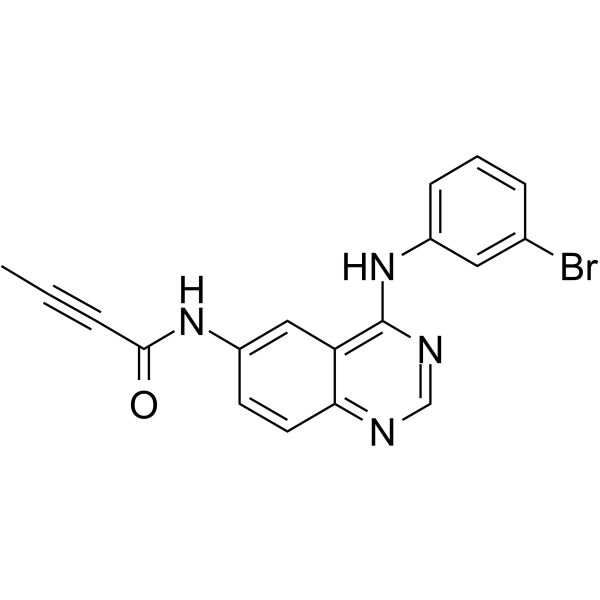
- Formula: C18H13BrN4O
- Molecular Weight: 381.23
CL-387785 (EKI-785; WAY-EKI 785) is an orally active EGFR inhibitor with an IC50 of 370 pM. CL-387785 inhibits EGF-stimulated EGFR autophosphorylation with an IC50 of approximately 5 nM. CL-387,785 exerts selective inhibition on cell lines overexpressing EGFR or c-erbB-2, whereas it shows weak inhibitory effects on cell lines with low expression of these two receptors. CL-387785 effectively induces cell cycle arrest and apoptosis. CL-387785 can be used for the research of non-small cell lung cancer and autosomal recessive polycystic kidney disease.

- Formula: C21H28N4O3
- Molecular Weight: 384.48
Lixazinone (RS-82856) is a selective inhibitor of cGMP-inhibited phosphodiesterase (PDE3) with an IC50 value of 22 nM. Lixazinone exhibits positive inotropic effects, afterload reduction and antithrombotic properties. Lixazinone increases cyclic adenosine monophosphate (cAMP) levels in human platelets, inhibits thrombin-induced aggregation of human platelets, and blocks the photolabeling of PDE3 active sites by [32P]cGMP. Lixazinone can be used in the research of polycystic kidney disease and congestive heart failure.

- Formula: C21H32N4O8S
- Molecular Weight: 500.57
Lixazinone (RS-82856) hydrogensulfate is a selective inhibitor of cGMP-inhibited phosphodiesterase (PDE3) with an IC50 value of 22 nM. Lixazinone hydrogensulfate exhibits positive inotropic effects, afterload reduction and antithrombotic properties. Lixazinone hydrogensulfate increases cyclic adenosine monophosphate (cAMP) levels in human platelets, inhibits thrombin-induced aggregation of human platelets, and blocks the photolabeling of PDE3 active sites by [32P]cGMP. Lixazinone hydrogensulfate can be used in the research of polycystic kidney disease and congestive heart failure.

- Formula: C33H25FN2O4
- Molecular Weight: 532.56
XYDC2050 (Compound 29) is a selective vasopressin V2 receptor (V2R) antagonist with an IC50 of 27 nM and a Ki of 2.8 nM. XYDC2050 shows a Ki of 420.7 nM (SI = 162 fold) for V1R. XYDC2050 can inhibit Vasopressin (HY-B1811)-induced intracellular cyclic adenosine monophosphate (cAMP) accumulation with an IC50 of 12 nM. XYDC2050 can inhibit the growth of renal cysts, reduce the ratio of kidney weight to body weight and decrease the area of cysts and the cystic index. XYDC2050 can be used for the research of autosomal dominant polycystic kidney disease (ADPKD).

- Formula: C33H38F7N5O6
- Molecular Weight: 733.67
SSTR3 agonist-1 TFA is a potent, orally active, and selective SSTR3 agnoist (EC50 =0.14 nM). SSTR3 agonist-1 TFA binds to SSTR3 receptor to inhibit cAMP activity. SSTR3 agonist-1 TFA decreases kidney weight and kidney cystic index (KCI) in a mouse model of autosomal dominant polycystic kidney disease (ADPKD). SSTR3 agonist-1 TFA can be used for ADPKD research.
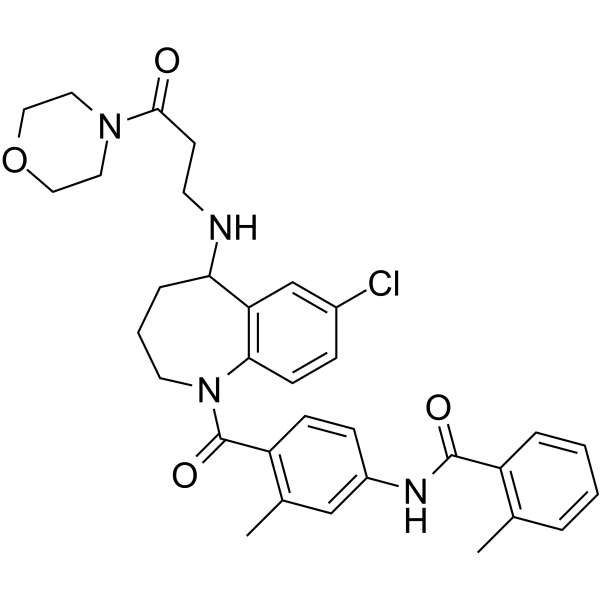
- Formula: C33H37ClN4O4
- Molecular Weight: 589.12
Vasopressin V2 receptor antagonist 1 is a vasopressin V2 receptor (V2R) antagonist with a Ki value of 3.8 nM. Vasopressin V2 receptor antagonist 1 inhibits renal cyst formation in embryonic renal cyst models and mouse models. Vasopressin V2 receptor antagonist 1 can be used in research related to autosomal dominant polycystic kidney disease.

- Formula: C18H13BrN4O
- Molecular Weight: 381.23
CL-387785 (EKI-785; WAY-EKI 785) (Standard) is the analytical standard of CL-387785 (HY-10325). This product is intended for research and analytical applications. CL-387785 is an orally active EGFR inhibitor with an IC50 of 370 pM. CL-387785 inhibits EGF-stimulated EGFR autophosphorylation with an IC50 of approximately 5 nM. CL-387,785 exerts selective inhibition on cell lines overexpressing EGFR or c-erbB-2, whereas it shows weak inhibitory effects on cell lines with low expression of these two receptors. CL-387785 effectively induces cell cycle arrest and apoptosis. CL-387785 can be used for the research of non-small cell lung cancer and autosomal recessive polycystic kidney disease.



