



Guangxitoxin 1E

Based on 1 Customer Validation
Guangxitoxin 1E is a potent and selective blocker of KV2.1 and KV2.2 channels. Guangxitoxin 1E inhibits KV2 with an IC50 of 1-3 nM. KV2 channels underlie delayed-rectifier potassium currents in various neurons.
For research use only. We do not sell to patients.
- Purity : 98.82%
- CAS No.: 1233152-82-3
- Formula: C178H248N44O45S7
- Molecular Weight:3948.61
-
Storage:
Sealed storage, away from moisture.
Powder -80°C, 2 years , -20°C, 1 year* In solvent : -80°C, 6 months; -20°C, 1 month (sealed storage, away from moisture)

To place orders, for customer services and technical support, please contact: MedChemExpress USA
Tel: 609-228-6898 E-mail: [email protected] [email protected]


-
 Biological Activity
-
Chemical Information
-
Solvent & Solubility
- Protocols
- Purity & Documentation
- References
-
 Help & FAQs




Biological Activity
Description
IC50 & Target
IC50: 1-3 nM (KV2 channels); 24-54 nM (KV4.3 channels)[2]
In Vitro
Guangxitoxin 1E inhibits KV2 with an IC50 of 1-3 nM but has no significant effect on KV1.2, KV1.3, KV1.5, KV3.2 and BK potassium channels, nor on calcium and sodium channels CaV1.2, CaV2.2, NaV1.5, NaV1.7, NaV1.8, whereas the IC50 for KV4.3 channels is 24-54 nM[2].
In mouse β-cells, Guangxitoxin 1E inhibits 90% of IDR and, as for KV2.1, shifts the voltage dependence of channel activation to more depolarized potentials, a characteristic of gating-modifier peptides. Guangxitoxin 1E broadens theβ-cell action potential, enhances glucose-stimulated intracellular calcium oscillations, and enhances insulin secretion from mouse pancreatic islets in a glucose-dependent manner[2].
MedChemExpress (MCE) has not independently confirmed the accuracy of these methods. They are for reference only. Further protocols information, click here.


Chemical Information
-
CAS No. 1233152-82-3
-
Appearance Solid
-
Molecular Weight 3948.61
-
Formula C178H248N44O45S7
-
Color White to off-white
-
Sequence
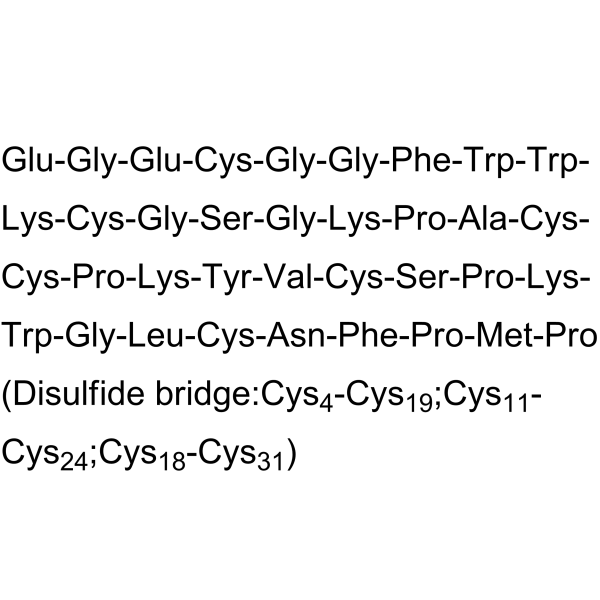
Glu-Gly-Glu-Cys-Gly-Gly-Phe-Trp-Trp-Lys-Cys-Gly-Ser-Gly-Lys-Pro-Ala-Cys-Cys-Pro-Lys-Tyr-Val-Cys-Ser-Pro-Lys-Trp-Gly-Leu-Cys-Asn-Phe-Pro-Met-Pro (Disulfide bridge:Cys4-Cys19;Cys11-Cys24;Cys18-Cys31)
-
Sequence Shortening
EGECGGFWWKCGSGKPACCPKYVCSPKWGLCNFPMP (Disulfide bridge:Cys4-Cys19;Cys11-Cys24;Cys18-Cys31)
-
Shipping
Room temperature in continental US; may vary elsewhere.
-
Storage
Sealed storage, away from moisture
Powder -80°C 2 years -20°C 1 year * In solvent : -80°C, 6 months; -20°C, 1 month (sealed storage, away from moisture)


Solvent & Solubility
In Vitro:
H2O : ≥ 1 mg/mL (0.25 mM)
* "≥" means soluble, but saturation unknown.

Protocols
-
Cell Cytotoxicity Assay
Cytotoxicity assays are usually based on the assessment of cell membrane damage, which can also be indirectly detected by measuring cell viability. Detection methods include MTT assay, CKK-8 assay, LDH assay and ATP assay, etc.


Purity & Documentation
-
Data Sheet (294 KB)
-
SDS (254 KB)
- English - EN (254 KB)
- Français - FR (254 KB)
- Deutsch - DE (254 KB)
- Norwegian - NO (254 KB)
- Español - ES (254 KB)
- Swedish - SV (254 KB)
- Italian - IT (254 KB)
- Korean - KR (254 KB)
- Portuguese - PT (254 KB)
-
Handling Instructions (2659 KB)
References
[1]. Hönigsperger C, et al. Physiological roles of Kv2 channels in entorhinal cortex layer II stellate cells revealed by Guangxitoxin-1E. J Physiol. 2017 Feb 1;595(3):739-757. [Content Brief]
[2]. Herrington J, et al. Blockers of the delayed-rectifier potassium current in pancreatic beta-cells enhance glucose-dependent insulin secretion. Diabetes. 2006 Apr;55(4):1034-42. [Content Brief]

Calculators
Concentration (start) × Volume (start) = Concentration (final) × Volume (final)


Guangxitoxin 1E Related Classifications
HY-P1427 Related Classifications
 Powered by Bioz