1. Learning Centers
  2. Scientific Reviews
  3. How Resting Microglia and the M1/M2 Divide Are Being Rethought
Is the Concept of 'Resting' Microglia a Misconception? Is the 'M1/M2' Classification Outdated? Understanding the Latest Advances in Microglial Depletion
Understanding Microglia

Microglia, the resident macrophages of the central nervous system (CNS), which are primarily established during development and account for approximately 5%-12% of the cells within the Central Nervous System (CNS). Often referred to as the 'scavengers' of the CNS, microglia are responsible for phagocytosing misfolded proteins, cellular debris, and apoptotic cells, thereby maintaining homeostasis within the brain.

Microglial are not confined exclusively to the central nervous system. As early as September 2023, Professor Han-Jie Li's team published a landmark study in Cell, in which they generated the most comprehensive atlas to date of human immune system development—characterized by the broadest tissue coverage, longest temporal span, and highest sampling resolution. Remarkably, this study revealed the presence of abundant microglial cells in several peripheral tissues, including the skin, heart, and testes, during early stages of human development. Furthermore, the findings suggest that some of the broadly used terminologies and classifications related to immune cell types may warrant redefinition or refinement in light of these discoveries[1].

Microglia: "Resting" and "Activated" States

The terms "resting" and "activated" microglia first appeared in the scientific literature in the mid-1970s. They were originally introduced as morphological descriptors for silver-stain-reactive cells observed under physiological ("resting") and pathological ("activated") conditions. This nomenclature became widely adopted during the 1990s.

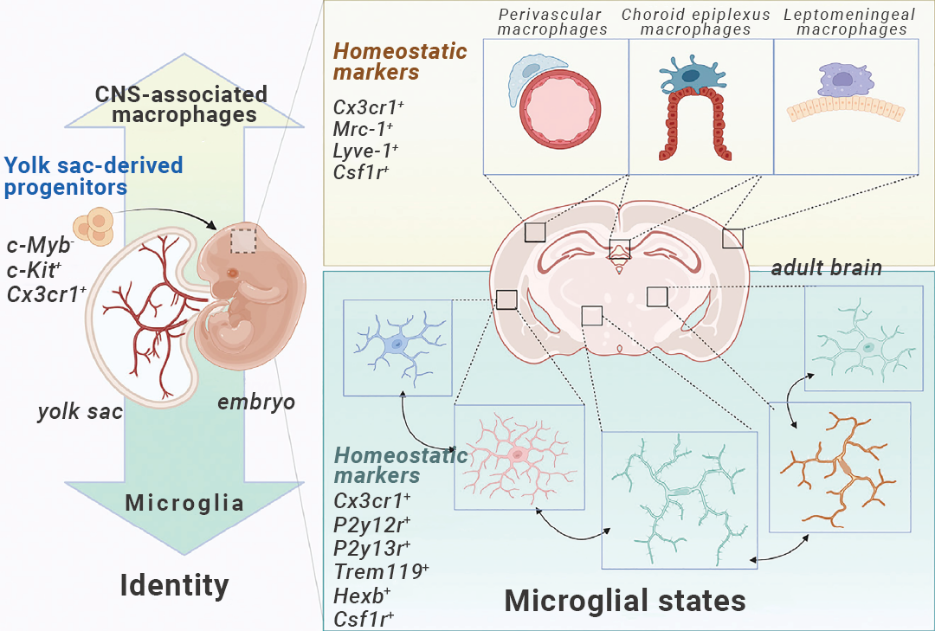
However, with the advent and refinement of two-photon microscopy in recent years, it has become evident that microglia are never truly static. Rather than transitioning from a quiescent to an activated state in response to trauma, injury, infection, or disease, microglia are constantly dynamic and surveillant. Their morphology and functions vary depending on developmental stage, CNS region, species, sex, and physiological or pathological context (Fig. 1).

Therefore, although the terms "resting" and "activated microglia" remain in common use, an increasing body of imaging data has challenged the validity of the "activation" concept[2].


Figure 1. Identity and States of Microglia[2].

In contrast to other CNS-associated macrophages—such as those in the perivascular space, choroid plexus, and leptomeninges—microglia derive early from yolk sac–origin progenitors. Once they colonize and differentiate within the brain parenchyma, they can assume a variety of states dictated by their specific spatiotemporal microenvironment.

Microglia: "M1" and "M2"

At the beginning of the 21st century, immunologists—drawing on findings from in vitro models—classified macrophages into distinct activation states and introduced a new terminology: "M1" and "M2." The M1 phenotype, or classical activation, was described as pro-inflammatory and neurotoxic, aligning closely with the earlier concept of "activated" microglia. In contrast, the M2 phenotype, or alternative activation, was characterized as anti-inflammatory and neuroprotective. These designations were soon widely adopted in microglial research.

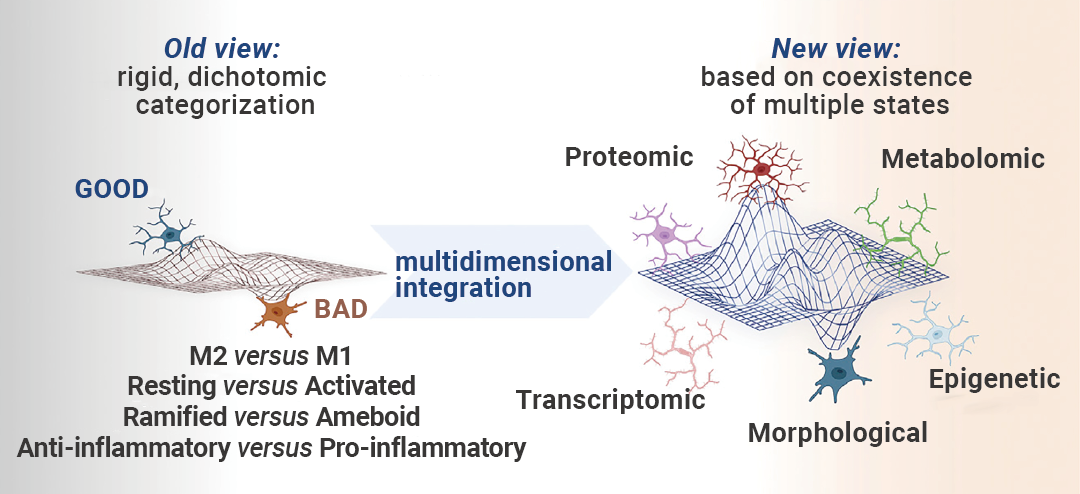
However, subsequent evidence revealed that macrophage responses are far more complex than the binary "M1/M2" model suggests (Fig. 2). In the case of microglia, advances in single-cell technologies have provided clear evidence that in vivo microglia do not polarize neatly into either M1 or M2 categories. Instead, they often co-express markers of both phenotypes simultaneously.

The coexistence states of microglia can now be comprehensively integrated across multiple dimensions, including epigenomics, transcriptomics, metabolomics, and proteomics data[2].


Figure 2.Microglial Nomenclature: Past and Future[2].


Although considerable debate continues within the field, it is anticipated that a standardized and unified nomenclature for microglial populations will be established in the near future.

With this conceptual foundation clarified, we now return to the main subject: as the resident immune sentinels of the central nervous system, microglia constitute the primary line of defense that preserves neural integrity and maintains cerebral homeostasis.

The Brain's "Double-Edged Guardian"

Immune cells are a fundamental component of the body's defense system, residing across virtually all tissues and organs—and the central nervous system (CNS) is no exception. Microglia, as the intrinsic innate immune cells of the CNS, serve as critical mediators of neuroimmune surveillance and homeostasis[3].

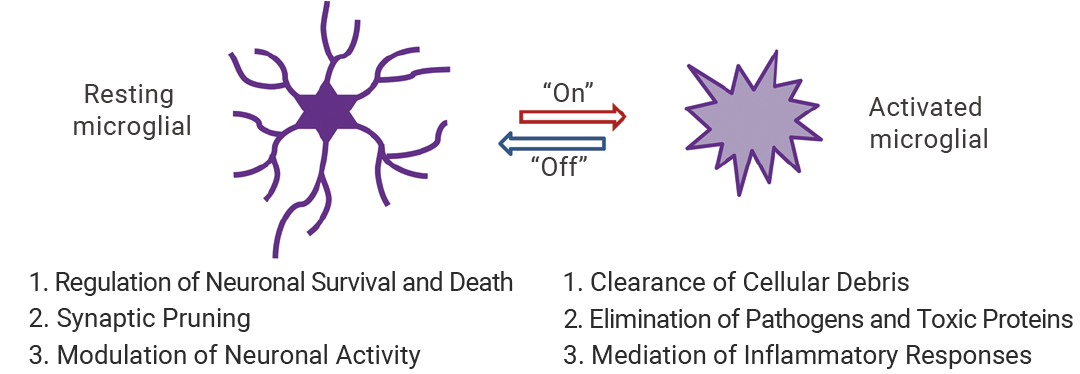
At this point, one might be tempted to label microglia as entirely "beneficial" cells. Indeed, under physiological conditions, microglia play indispensable roles in CNS development, homeostatic maintenance, and disease modulation. They promote synaptic formation and plasticity, while continuously surveying the neural environment and phagocytosing apoptotic neurons and cellular debris. Upon stimulation, microglia can initiate immune responses to maintain the health and stability of the nervous system (Fig. 3).

Figure 3. Activation of Microglia[4].

Under pathological conditions, however, microglia transition into an activated state, releasing reactive oxygen species (ROS) and pro-inflammatory cytokines, which promote neuroinflammation[4]. While microglial activation is initially protective, chronic exposure to inflammatory mediators can lead to neuronal injury and neurodegeneration[5][6][7].

For example, in Alzheimer's disease (AD), microglia respond to pathological hallmarks such as amyloid-β (Aβ) and tau aggregates. In early stages, this response is neuroprotective, as microglia migrate toward and phagocytose these deposits. However, prolonged exposure to such pathological stimuli can drive microglia toward dysfunctional or neurotoxic phenotypes, thereby exacerbating AD progression[8].

Recent studies further suggest that microglial depletion may represent a potential therapeutic strategy[9]. Following depletion, microglia are capable of self-repopulation within the injured CNS, which not only reduces neuroinflammatory responses but also facilitates tissue repair and recovery. Thus, microglial depletion and repopulation models provide valuable tools for elucidating their multifaceted roles in neurodegenerative and neuroinflammatory disorders.

Microglia depletion: CSF1Ri

There are various microglial depletion techniques, including the use of toxins, CSF1R pharmacological inhibitors (CSF1Ri), clodronate liposomes, and genetic models. Each of these methods possesses distinct advantages and limitations.

Among these approaches, CSF1R inhibitors (CSF1Ri)—with representative compounds such as PLX3397 and PLX5622—have gained extensive application for inducing microglial depletion under both physiological and pathological conditions[6].

Advantages of CSF1Ri

• High efficiency and dose-dependent clearance: CSF1Ri can rapidly and effectively deplete microglia, with the extent of depletion precisely adjustable by dosage.

• Favorable safety profile: It does not trigger severe inflammatory responses or disrupt the blood–brain barrier (BBB), nor does it interfere with normal behavioral or cognitive functions.

• Oral bioavailability and BBB permeability: CSF1Ri compounds exhibit good oral activity and brain penetration, enabling long-term and reversible microglial depletion, which facilitates in-depth studies of microglial roles in neurodevelopment, homeostasis, and disease.

But what exactly is the mechanism underlying CSF1Ri-mediated microglial depletion? Is the process reversible? And how do PLX5622 and PLX3397 differ from each other?

Mechanism of CSF1Ri-Mediated Microglial Depletion

Colony-stimulating factor 1 receptor (CSF1R) is a transmembrane receptor tyrosine kinase predominantly expressed in microglia within the central nervous system. The signaling of CSF1R through its endogenous ligands—CSF1 and IL-34—is essential for microglial survival.

Mechanism

In the absence of ligand binding, CSF1R remains in an inactive conformation, maintained through autoinhibitory interactions. Upon ligand engagement, CSF1R undergoes homodimerization, conformational rearrangement, and autophosphorylation of tyrosine residues within its juxtamembrane domain (JMD). This phosphorylation relieves autoinhibition, allowing ATP binding and further phosphorylation of additional tyrosine sites. Consequently, CSF1R becomes fully activated, initiating downstream signaling cascades such as the PI3K/Akt, JNK, ERK1/2, and JAK–STAT pathways. These pathways collectively promote the proliferation, differentiation, survival, and activation of target cells, including macrophages, microglia, and monocytes[5][10][11].

CSF1R inhibitors (CSF1Ri)—such as PLX3397, PLX5622, BLZ945, JNJ-40346527, Ki20227, and GW2580—block the conformational activation and autophosphorylation of CSF1R. By interrupting signal transduction, they deprive microglia of essential survival signals, leading to their progressive depletion. Notably, upon withdrawal of these inhibitors, microglia rapidly repopulate the CNS, indicating that CSF1Ri-induced depletion is reversible.

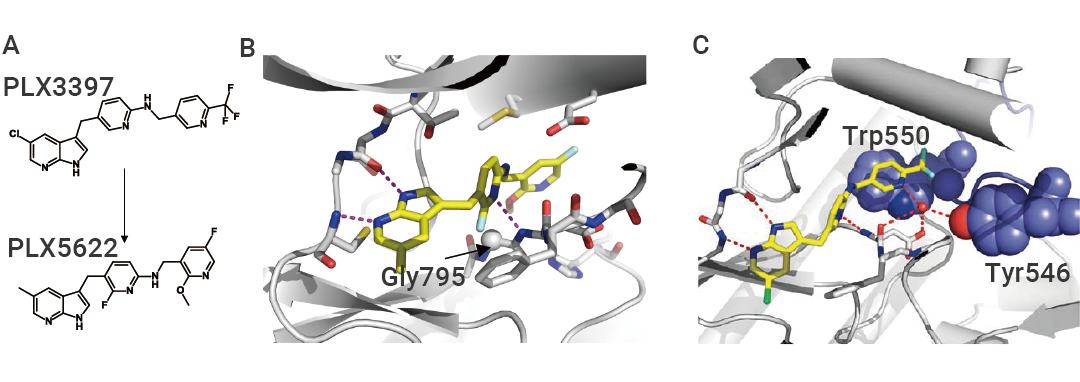
Figure 4. Binding Sites of PLX3397 and PLX5622 with CSF1R[12][13].

A. Chemical structures of PLX3397 and PLX5622. B. X-ray crystallographic structure of the CSF1R-PLX5622 complex. C. X-ray crystallographic structure of the CSF1R-PLX3397 complex. Structural analyses reveal that PLX3397 binds within the JMD of CSF1R, whereas PLX5622 occupies an allosteric pocket formed after displacement of the JMD. Importantly, the 2-fluoro substituent on PLX5622 extends into a region near Gly795, a residue unique to CSF1R (replaced by bulkier cysteine residues in KIT and FLT3). This structural distinction confers steric selectivity, reducing nonspecific binding to KIT and FLT3 and enhancing binding specificity and stability for CSF1R.

Currently, PLX3397 and PLX5622 are widely used CSF1R inhibitors in rodent models and have also been extended to nonhuman primate studies. In 2019, PLX3397 received U.S. FDA approval for the treatment of tenosynovial giant cell tumor (TGCT). As a structural analog of PLX3397, PLX5622 demonstrates superior blood–brain barrier permeability and pharmacokinetic properties, making it particularly suitable for long-term studies of microglial depletion and repopulation[11].

PLX5622 vs. PLX3397

How are PLX3397 and PLX5622 used?

In numerous published studies, both PLX3397 and PLX5622 are commonly administered via ad libitum feeding, typically mixed into a standard AIN-76A rodent diet. Typical formulations include: PLX5622 in AIN-76A Diet (1200 ppm) and PLX3397 in AIN-76A Diet (290 ppm or 600 ppm). These dosing regimens have been shown not to significantly affect the behavioral or cognitive functions of adult mice.

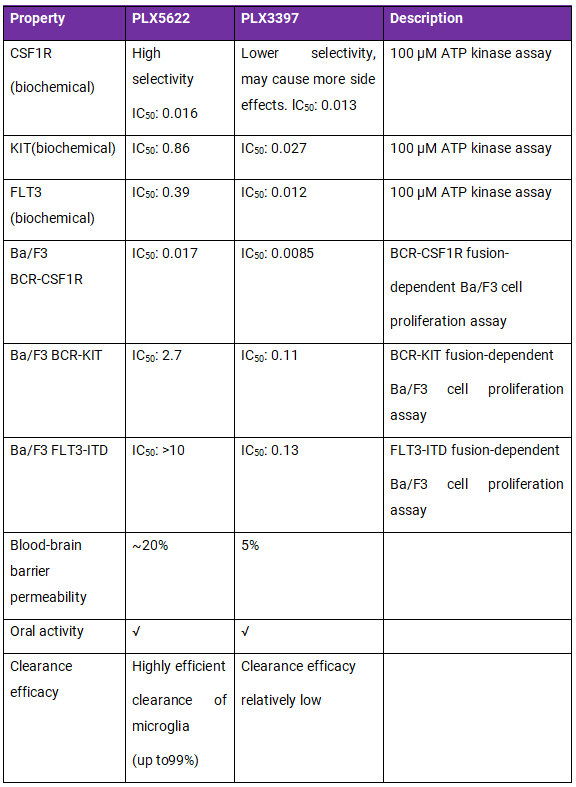
Overall, compared with PLX3397, PLX5622 shows stronger selectivity for CSF1R and weaker inhibitory activity against KIT and FLT3. In CSF1R‑dependent assays, PLX5622 exhibits potency similar to that of PLX3397. However, in KIT‑dependent assays, the potency of PLX5622 is approximately 30‑fold lower than that of PLX3397.

PLX5622 possesses more favorable pharmacokinetic properties and higher blood–brain barrier permeability. It has a lower molecular weight, higher lipophilicity, and good cellular permeability.

MedChemExpress Validation

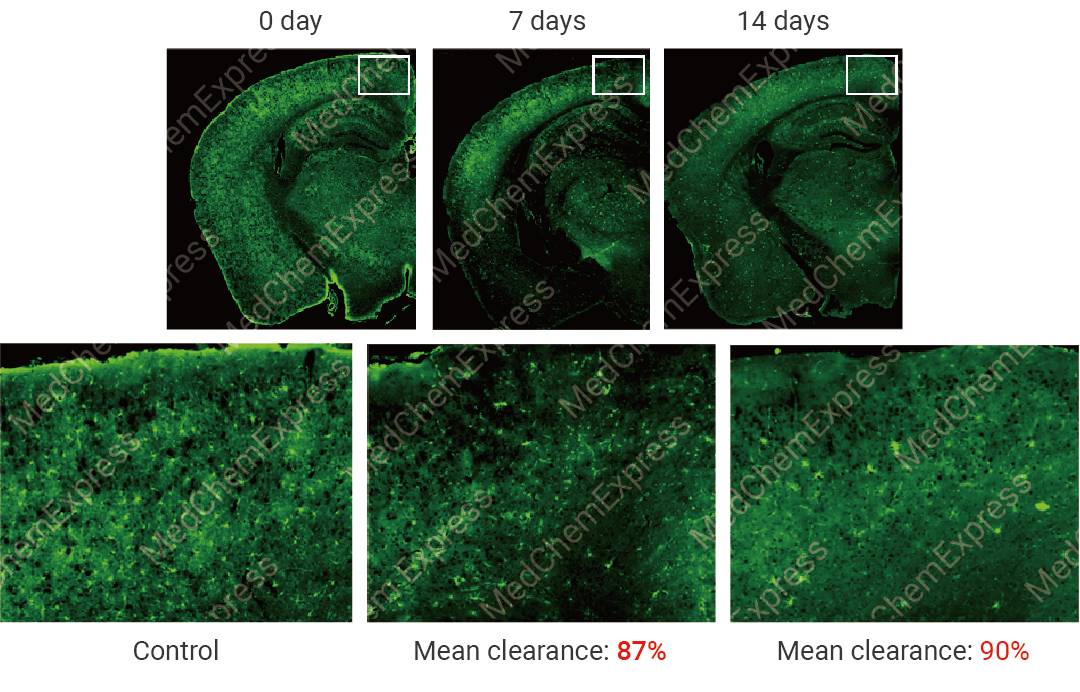
MCE provides high‑purity PLX5622 with highly efficient microglia depletion and excellent lot‑to‑lot consistency. The product has undergone rigorous biological validation in the MCE laboratory, demonstrating microglia depletion rates of 87% after 7 days and 90% after 14 days (Figure 5).

• Experimental animals: male C57BL/6 mice (11-12 weeks of age)

• Dose: ad libitum access to AIN‑76A chow containing 1,200 ppm PLX5622 for 7 or 14 days

• Readout: number of IBA1+ cells (microglial marker) in brain tissue

Figure 5. Validation of the microgliadepleting efficacy of PLX5622 in the brain by the MCE laboratory.
FAQS

Q1 Does PLX5622 only deplete microglia in the brain? Does it affect other macrophages in peripheral tissues?

For a long time, microglia were considered a macrophage subpopulation specific to the central nervous system (CNS). However, in April 2025, the team led by Han-Jie Li published an article in Cell entitled "Peripheral nervous system microglia-like cells regulate neuronal soma size throughout evolution". The study revealed that large numbers of "microglia-like" cells (termed PNS microglia) are present in several peripheral tissues of human embryos, such as the skin, heart, and testis, and that PLX5622 can markedly reduce PNS microglia-like cells. After withdrawal of PLX5622-mediated depletion, both CNS microglia and PNS microglia-like cells are able to repopulate[15].

In addition, other reports have shown that PLX5622 can also deplete lung interstitial macrophages, splenic macrophages, and patrolling monocytes within the CNS, and that PLX5622 alleviates pulmonary fungal infection in mice by depleting MHCII[16].​

Further studies indicate that the inhibitory effects of PLX5622 are not limited to microglia, but also extend to peripheral macrophages in the liver, perivascular macrophages (PVMs), and myeloid and lymphoid cells in the bone marrow, spleen, and blood[17][18].​

Q2 What is the shelf life of PLX5622 when formulated into chow?

Because chow contains substantial nutrients, prolonged storage can lead to the loss of vitamins and amino acids, thereby affecting palatability and nutritional balance. The following recommendations are therefore made:

1. Estimate in advance the total amount of chow required for the dosing period, and replace with fresh chow for the mice every 1-2 days.

2. Expel as much air from the bag as possible and seal it tightly. Store at 4 °C for no longer than one month. Any remaining unopened chow should be stored at −20 °C or −80 °C for up to six months.

Q3 Besides the CSF1R‑mediated signaling pathway, are there other pathways and targets that regulate microglial survival?

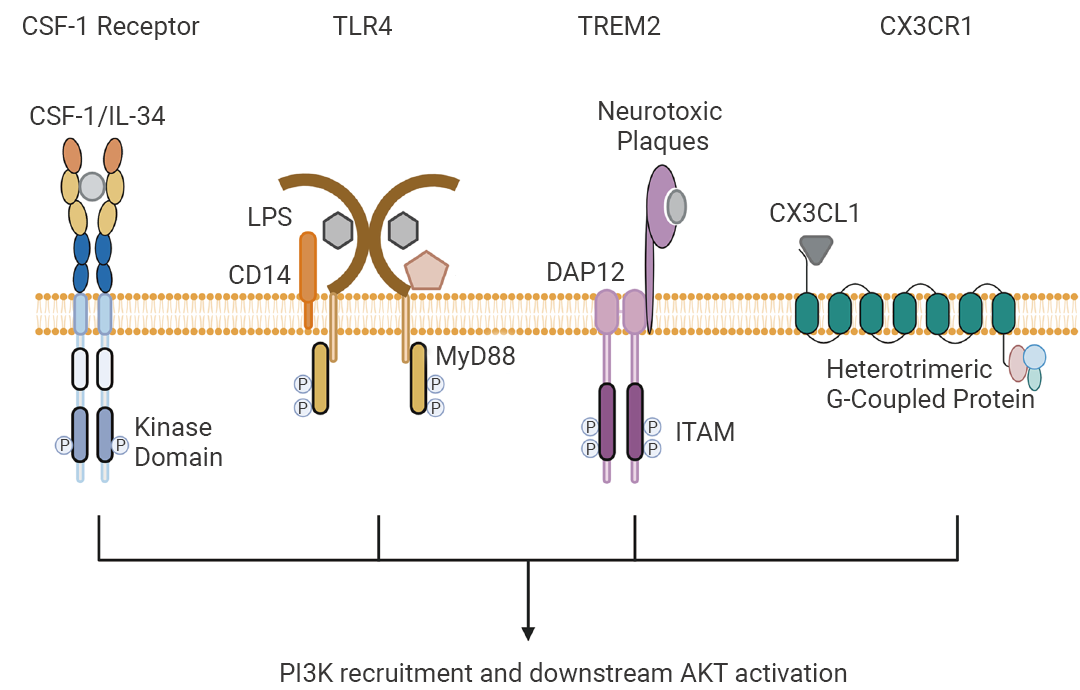
In addition to the major CSF1R pathway, microglial survival is regulated by several other signaling cascades. For example, the TREM2 signaling pathway promotes microglial survival by activating the Wnt/β‑catenin pathway.

Moreover, multiple surface receptors are linked to the PI3K–AKT signaling network. The CD14/MD‑2–TLR4 complex activates PI3K via MyD88, whereas CX3CL1–CX3CR1 binding activates G proteins and transduces downstream signals. These pathways collectively regulate microglial proliferation, differentiation, survival, and responses to neuroinflammation (Figure 6)[19][20].

Figure 6. Key cell-surface receptors in microglia that signal through the PI3K–AKT pathway.​
Section 04

we have reviewed the current terminological discrepancies surrounding microglia, introduced CSF1R inhibitor‑mediated depletion as a commonly used approach for microglial ablation, and provided a detailed analysis of PLX5622, along with answers to frequently asked questions. Of course, if you are interested in purchasing PLX5622, please feel free to contact us!

Recommended Products

Product Recommendation

PLX5622

Selective, brain penetrant and orally active CSF1R inhibitor(IC50: 16 nM), effective microglial cells depletion tool

BLZ945

Selective and brain penetrant CSF-1R inhibitor (IC50: 1 nM)

JNJ-40346527

Selective, brain penetrant and orally active CSF1R inhibitor (IC50: 3.2 nM)

Ki20227

Selective and orally active CSF1R inhibitor (IC50: 2 nM)

GW2580

Selective and orally active c-Fms inhibitor

IBA1 antibody (YA353)

Rabbit-derived and non-conjugated IgG monoclonal antibody, targeting to IBA1

References
[1] Wang Z, et al. An immune cell atlas reveals the dynamics of human macrophage specification during prenatal development. Cell. 2023 Sep 28;186(20):4454-4471.e19.
[2] Paolicelli RC, et al. Microglia states and nomenclature: A field at its crossroads. Neuron. 2022 Nov 2;110(21):3458-3483.
[3] Angiulli F, et al. Blood-Based Biomarkers of Neuroinflammation in Alzheimer's Disease: A Central Role for Periphery? Diagnostics (Basel). 2021 Aug 24;11(9):1525.
[4] LI Hui-Quan, et al. The multiple roles played by microglia. Chinese Bulletin of Life Sciences. 1004-0374(2014)06-0620-06.
[5] Elmore MR, et al. Colony-stimulating factor 1 receptor signaling is necessary for microglia viability, unmasking a microglia progenitor cell in the adult brain. Neuron. 2014 Apr 16;82(2):380-97.
[6] Kim N Green, et al. To Kill a Microglia: A Case for CSF1R Inhibitors. Trends Immunol. 2020 Sep;41(9):771-784.
[7] Sara Bachiller, et al. Microglia in Neurological Diseases: A Road Map to Brain-Disease Dependent-Inflammatory Response. Front Cell Neurosci. 2018 Dec 18;12:488.
[8] Gao, C, et al. Microglia in neurodegenerative diseases: mechanism and potential therapeutic targets. Sig Transduct Target Ther 8, 359 (2023).
[9] Tahmasebi F, et al. The Role of Microglial Depletion Approaches in Pathological Condition of CNS. Cell Mol Neurobiol. 2023 Aug;43(6):2459-2471.
[10] Weyer MP, et al. Repurposing of pexidartinib for microglia depletion and renewal. Pharmacol Ther. 2024 Jan;253:108565.
[11] Xiang C, et al. Targeting CSF-1R represents an effective strategy in modulating inflammatory diseases. Pharmacol Res. 2023 Jan;187:106566.
[12] Spangenberg E, et al. Sustained microglial depletion with CSF1R inhibitor impairs parenchymal plaque development in an Alzheimer's disease model. Nat Commun. 2019 Aug 21;10(1):3758.
[13] Tap WD, et al. Structure-Guided Blockade of CSF1R Kinase in Tenosynovial Giant-Cell Tumor. N Engl J Med. 2015 Jul 30;373(5):428-37.
[14] Han J, et al. Inhibition of colony stimulating factor-1 receptor (CSF-1R) as a potential therapeutic strategy for neurodegenerative diseases: opportunities and challenges. Cell Mol Life Sci. 2022 Apr 2;79(4):219
[15] Wu Z, et al. Peripheral nervous system microglia-like cells regulate neuronal soma size throughout evolution. Cell. 2025 Apr 17;188(8):2159-2174.e15.
[16] Mohamed SH, et al. CSF1R inhibition by PLX5622 reduces pulmonary fungal infection by depleting MHCIIhi interstitial lung macrophages. Mucosal Immunol. 2024 Dec;17(6):1256-1272.
[17] Lei F, et al. CSF1R inhibition by a small-molecule inhibitor is not microglia specific; affecting hematopoiesis and the function of macrophages. Proc Natl Acad Sci U S A. 2020 Sep 22;117(38):23336-23338.
[18] Vichaya EG, et al. Microglia depletion fails to abrogate inflammation-induced sickness in mice and rats. J Neuroinflammation. 2020 May 31;17(1):172.
[19] Zheng H, et al. TREM2 Promotes Microglial Survival by Activating Wnt/β-Catenin Pathway. J Neurosci. 2017 Feb 15;37(7):1772-1784.
[20] Chu E, et al. Dysregulated phosphoinositide 3-kinase signaling in microglia: shaping chronic neuroinflammation. J Neuroinflammation. 2021 Nov 27;18(1):276.