



Oxyntomodulin (human, mouse, rat)

Based on 1 Customer Validation
Oxyntomodulin (human, mouse, rat) (Proglucagon (33-69)) is a dual GCGR/GLP-1 receptor agonist. Oxyntomodulin has EC50 values of 18.2/72.4 pM for human GCGR/GLP-1R, IC50 values of 18.6/33.1 nM for rat, and EC50 values of 6.2/2.5 nM for mouse. Oxyntomodulin activates cAMP/CREB, PKA, and MAPK, but not PI3K; it self-assembles into reversible nanofibers that serve as a sustained-release depot, inhibits food intake, increases energy expenditure, reduces body weight and blood glucose, and improves glucose tolerance. Oxyntomodulin can be used in research on obesity, diabetes, and neurological diseases.
For research use only. We do not sell to patients.
- Purity : 99.69%
- CAS No.: 159002-68-3
- Formula: C192H295N61O60S
- Molecular Weight:4449.83
-
Storage:
Sealed storage, away from moisture.
Powder -80°C, 2 years , -20°C, 1 year* In solvent : -80°C, 6 months; -20°C, 1 month (sealed storage, away from moisture)


To place orders, for customer services and technical support, please contact: MedChemExpress USA
Tel: 609-228-6898 E-mail: [email protected] [email protected]


-
 Biological Activity
-
Chemical Information
-
Solvent & Solubility
- Protocols
- Purity & Documentation
- References
-
 Help & FAQs




Biological Activity
Description
Cellular Effect
|
Cell Line

|
Type | Value | Description | References |
|---|---|---|---|---|
| CHO | EC50 |
96.6 pM
|
Agonist potency of released oxyntomodulin at recombinant human GLP-1 receptor expressed in Chinese hamster ovary CHO cells assessed as cAMP accumulation incubated for 30 mins by HTRF cAMP dynamic 2 assay.
Agonist potency of released oxyntomodulin at recombinant human GLP-1 receptor expressed in Chinese hamster ovary CHO cells assessed as cAMP accumulation incubated for 30 mins by HTRF cAMP dynamic 2 assay.
|
29044101 |
| CHO | EC50 |
72.4 pM
|
Agonist potency of free oxyntomodulin at recombinant human GLP-1 receptor expressed in Chinese hamster ovary CHO cells assessed as cAMP accumulation incubated for 30 mins by HTRF cAMP dynamic 2 assay.
Agonist potency of free oxyntomodulin at recombinant human GLP-1 receptor expressed in Chinese hamster ovary CHO cells assessed as cAMP accumulation incubated for 30 mins by HTRF cAMP dynamic 2 assay.
|
29044101 |
| CHO | EC50 |
2938.3 pM
|
Agonist potency of fibrillar oxyntomodulin at recombinant human GLP-1 receptor expressed in Chinese hamster ovary CHO cells assessed as cAMP accumulation incubated for 30 mins by HTRF cAMP dynamic 2 assay.
Agonist potency of fibrillar oxyntomodulin at recombinant human GLP-1 receptor expressed in Chinese hamster ovary CHO cells assessed as cAMP accumulation incubated for 30 mins by HTRF cAMP dynamic 2 assay.
|
29044101 |
| CHO | EC50 |
26.0 pM
|
Agonist potency of released oxyntomodulin at recombinant human glucagon receptor expressed in Chinese hamster ovary CHO cells assessed as cAMP accumulation incubated for 30 mins by HTRF cAMP dynamic 2 assay.
Agonist potency of released oxyntomodulin at recombinant human glucagon receptor expressed in Chinese hamster ovary CHO cells assessed as cAMP accumulation incubated for 30 mins by HTRF cAMP dynamic 2 assay.
|
29044101 |
| CHO | EC50 |
18.2 pM
|
Agonist potency of free oxyntomodulin at recombinant human glucagon receptor expressed in Chinese hamster ovary CHO cells assessed as cAMP accumulation incubated for 30 mins by HTRF cAMP dynamic 2 assay.
Agonist potency of free oxyntomodulin at recombinant human glucagon receptor expressed in Chinese hamster ovary CHO cells assessed as cAMP accumulation incubated for 30 mins by HTRF cAMP dynamic 2 assay.
|
29044101 |
| CHO | EC50 |
1120.5 pM
|
Agonist potency of fibrillar oxyntomodulin at recombinant human glucagon receptor expressed in Chinese hamster ovary CHO cells assessed as cAMP accumulation incubated for 30 mins by HTRF cAMP dynamic 2 assay.
Agonist potency of fibrillar oxyntomodulin at recombinant human glucagon receptor expressed in Chinese hamster ovary CHO cells assessed as cAMP accumulation incubated for 30 mins by HTRF cAMP dynamic 2 assay.
|
29044101 |
| CHO | EC50 |
2.5 nM
|
Agonist potency against Chinese hamster ovary CHO cells stably expressing murine GLP1R assessed as increase in cAMP levels measured by time-resolved fluorescence energy transfer.
Agonist potency against Chinese hamster ovary CHO cells stably expressing murine GLP1R assessed as increase in cAMP levels measured by time-resolved fluorescence energy transfer.
|
22421924 |
| CHO | EC50 |
6.2 nM
|
Agonist potency against Chinese hamster ovary CHO cells stably expressing murine GCGR assessed as increase in cAMP levels measured by time-resolved fluorescence energy transfer.
Agonist potency against Chinese hamster ovary CHO cells stably expressing murine GCGR assessed as increase in cAMP levels measured by time-resolved fluorescence energy transfer.
|
22421924 |
| CHO | EC50 |
54.8 pM
|
Agonist activity against recombinant human GLP-1 receptor expressed in Chinese hamster ovary CHO cells assessed as cAMP accumulation incubated for 30 mins by HTRF cAMP dynamic 2 assay.
Agonist activity against recombinant human GLP-1 receptor expressed in Chinese hamster ovary CHO cells assessed as cAMP accumulation incubated for 30 mins by HTRF cAMP dynamic 2 assay.
|
37554763 |
| CHO | EC50 |
14.7 pM
|
Agonist activity against recombinant human glucagon receptor expressed in Chinese hamster ovary CHO cells assessed as cAMP accumulation incubated for 30 mins by HTRF cAMP dynamic 2 assay.
Agonist activity against recombinant human glucagon receptor expressed in Chinese hamster ovary CHO cells assessed as cAMP accumulation incubated for 30 mins by HTRF cAMP dynamic 2 assay.
|
37554763 |
In Vitro
Oxyntomodulin (human, mouse, rat) (100 nM) activates the CREB pathway in SH-SY5Y cells, resulting in a 2-fold increase in the pCREB/CREB ratio[8].
Oxyntomodulin (human, mouse, rat) (0-1000 nM; 24-48 h) dose- and time-dependently promotes cell proliferation in SH-SY5Y and SH-hGLP-1R#9 cells, with increases in cell viability enhanced by GLP-1R overexpression[8].
MedChemExpress (MCE) has not independently confirmed the accuracy of these methods. They are for reference only.
-
Cell Line:SH-SY5Y, SH-hGLP-1R#9
-
Concentration:1, 10, 100 nM
-
Incubation Time:15 min
-
Result:Marginally increased cAMP levels in SH-SY5Y cells at the highest doses.
Significantly and dose-dependently increased intracellular cAMP in SH-hGLP-1R#9 cells.
-
Cell Line:SH-SY5Y, SH-hGLP-1R#9
-
Concentration:0, 1, 10, 100, 1000 nM
-
Incubation Time:24 h; 48 h
-
Result:At 24 h, no changes in SH-SY5Y cell viabilities.
Significantly increased cell viabilities in SH-hGLP-1R#9 cells at ≥10 nM.
At 48 h, significantly enhanced cell viability in both SH-SY5Y and SH-hGLP-1R#9 cells at ≥10 nM.
-
Cell Line:BV2 microglial cells
-
Concentration:0.01, 0.1, 1 µM
-
Incubation Time:24 h
-
Result:Did not affect BV2 cell viability at 0.01, 0.1, and 1 µM.
Rescued TNF-α-inhibited cell viability at 0.01, 0.1, and 1 µM.
-
Cell Line:BV2 microglial cells
-
Concentration:0.01, 0.1, 1 µM
-
Incubation Time:24 h
-
Result:Significantly attenuated TNF-α-induced increases in IL-6 and IL-1β mRNA levels at 0.1 and 1 µM.
Parmacokinetics
| Species | Dose | Route | Tmax | T1/2 | F | Bioavailability | T1/2 (Absorption) | Cmax | Serum Concentration | T1/2 (Elimination) |
|---|---|---|---|---|---|---|---|---|---|---|
| Rat[1] | 5 mg/kg | i.v. | / | / | / | / | / | / | / | 13 min |
| Rat[1] | 5 mg/kg | s.c. | / | / | / | ~34 % | 3.29 h | / | / | / |
| Rat[1] | 10 mg/kg | s.c. | / | / | / | ~34 % | 3.29 h | / | / | / |
| Rat[1] | 5 mg/kg | s.c. | / | / | / | / | / | 1.34 nM | 0.48 nM | / |
| Rat[1] | 10 mg/kg | s.c. | / | / | / | / | / | 1.85 nM | 1.16 nM | / |
| Rat[5] | 0.05 mg/kg | i.v. | 5 min | 27.8 min | 13.0 % | / | / | / | / | / |
| Rat[5] | 0.5 mg/kg | i.v. | 5 min | 21.5 min | 12.7 % | / | / | / | / | / |
| Rat[5] | 0.05 mg/kg | i.v. | / | 20.0 min | / | / | / | / | / | / |
In Vivo
Oxyntomodulin (human, mouse, rat) (4200 nmol/kg; i.p.; single injection on days 1 and 3) reduces Kool-Aid intake in a conditioned taste avoidance (CTA) paradigm, but at the lower dose (1400 nmol/kg) that reduces food intake by 30-40%, Oxyntomodulin (human, mouse, rat) does not cause CTA in mice[2].
Oxyntomodulin (human, mouse, rat) (1.1 μmol/kg/day; s.c.; 14 days) produces superior weight loss (14% reduction) and improves plasma metabolic parameters in DIO mice[4].
Oxyntomodulin (human, mouse, rat) (1.1 μmol/kg/day; s.c.; 12 days) decreases body weight in lean mice and partially prevents weight gain in Glp1r−/− mice, indicating that the body weight-lowering action of Oxyntomodulin (human, mouse, rat) is not entirely mediated by GLP1R[4].
Pulmonary delivery of Oxyntomodulin (human, mouse, rat) (0.05-0.5 mg/kg; o.t. spray-instillation; single dose or once-daily; 8 days) produces dose-related, transient 4-6 h food intake suppression of 30-38%, leading to 45.6% reduction in body weight gain by day 8 following once-daily administration[5].
Oxyntomodulin (human, mouse, rat) (1.1 μmol/kg; s.c.; single dose) activates the glucagon receptor in vivo, stimulating hepatic ketogenesis, as demonstrated by increased plasma β-hydroxybutyrate in wild type and Glp1r-/- mice but not in Gcgr-/- mice[11].
Oxyntomodulin (human, mouse, rat) (3.5 nmol/kg/min; i.v. infusion; 60 min during hyperglycemic clamp) improves glucose tolerance in DIO mice during a hyperglycemic clamp as denoted by the increased glucose infusion rate required to maintain hyperglycemia (41.8 mg/kg/min), and acutely stimulates insulin secretion[11].
Oxyntomodulin (human, mouse, rat) (20 μg per rat; i.c.v.; single dose; 15 min before MCAo) significantly reduces cerebral infarction and improves locomotor activity in a rat model of ischemic stroke[8].
MedChemExpress (MCE) has not independently confirmed the accuracy of these methods. They are for reference only.
-
Animal Model:C57BL/6 (20-25 g, singly housed, male and female, fasted overnight)[2]
-
Dosage:800, 1400, 2200, 3800 nmol/kg; 2700 nmol/kg (degradation study)
-
Administration:i.p.; single injection
-
Result:Reduced food intake 0-1 h at 1400 nmol/kg by 25-40% compared with saline control.
Reduced food intake 0-1 h at 800 nmol/kg to 1.22±0.09 g, at 1400 nmol/kg to 0.95±0.07 g, at 2200 nmol/kg to 0.76±0.12 g, and at 3800 nmol/kg to 0.35±0.04 g, compared with saline 1.23±0.05 g.
Reduced food intake for the first hour at 2700 nmol/kg, which was enhanced by coadministration with 75 mg/kg valine pyrrolidide.
-
Animal Model:C57BL/6 (20-25 g, singly housed, fasted overnight)[2]
-
Dosage:4200 nmol/kg; 1400 nmol/kg
-
Administration:i.p.; single injection on days 1 and 3
-
Result:Reduced Kool-Aid intake 0-1 h to 1.03±0.1 mL compared with saline 1.49±0.06 mL at 4200 nmol/kg.
Did not significantly reduce Kool-Aid intake 0-1 h at 1400 nmol/kg, with 1.68±0.11 mL compared with saline 1.93±0.13 mL.
-
Animal Model:C57BL/6 (male, 23 weeks old, ~44 g, diet-induced obese)[4]
-
Dosage:1.1 μmol/kg/day
-
Administration:s.c.; continuous infusion; 14 days
-
Result:Reduced body weight by 14% at the end of the study.
Decreased fat mass.
Lowered cumulative food intake.
Resulted in plasma glucose 88 mg/dl, insulin 4.8 ng/mL, leptin 17 ng/mL, adiponectin 27 μg/mL, FFA 0.4 mmol/l, cholesterol 88 mg/dl, TG 49 mg/dl, and β-HBA 8.8 mg/dl.
-
Animal Model:C57BL/6 (weight-matched, ~30 g, wild-type and Glp1r−/−)[4]
-
Dosage:1.1 μmol/kg/day
-
Administration:s.c.; continuous infusion; 12 days
-
Result:In lean mice, resulted in superior weight loss vs.
OXMQ3E and vehicle.
In Glp1r−/− mice, attenuated weight gain: +0.2% vs. +5.4% for vehicle.
-
Animal Model:Sprague-Dawley (Adult male, 250-275 g)[5]
-
Dosage:0.05-0.5 mg/kg (single dose); 0.5 mg/kg (repeated dose)
-
Administration:o.t. spray-instillation; single dose or once-daily; 8 days
-
Result:Caused significant 30.0 and 24.3% suppression of cumulative food intake at 4 and 6 h, respectively, compared with the saline-dosed control.
Reduced food intake by an average 48.0% at 2 h.
Reduced cumulative food intake at 24 h by an average 10.8%.
Suppressed food intake significantly by 35-38 and 30-35% at 4 and 6 h, respectively, on a daily basis throughout the repeated dosing study.
Suppressed 24 h food intake significantly by 18-35% on day 5 through day 8.
Reduced cumulative body weight gain significantly from day 5, yielding 2.5 g of daily body weight gain during day 5-8, compared with 5.2 g for the saline-dosed control.
Reduced cumulative body weight gain by total 45.6% on day 8 compared with the saline-dosed control.
-
Animal Model:Sprague-Dawley (Adult male, 250-275 g)[5]
-
Dosage:0.5 mg/kg
-
Administration:o.t. spray-instillation; single dose and once-daily; 8 days
-
Result:Caused significant 2.4- and 2.2-fold increased c-fos expression in the ARC and AP regions, respectively, compared with saline-dosed control animals at 4 h following a single OT instillation.
Caused increased c-fos expression in the ARC and AP regions, but not in the PVN region, following 8-day repeated pulmonary administration.
-
Animal Model:Sprague-Dawley (adult male)[8]
-
Dosage:20 μg per rat
-
Administration:i.c.v.; single dose; 15 min before MCAo
-
Result:Increased horizontal activity, movement number, movement time, total distance traveled, vertical activity, vertical movement number, and vertical movement time, and reduced rest time at 2 days after MCAo.
Reduced the extent of cortical infarction at 3 days after MCAo.
-
Animal Model:C57BL/6 (male, ~25 g, wild type, Glp1r-/- and Gcgr-/-)[11]
-
Dosage:1.1 μmol/kg
-
Administration:s.c.; single dose
-
Result:Increased plasma β-hydroxybutyrate to 5.2 mg/dl in wild type mice compared to 3.1 mg/dl for vehicle.
Increased plasma β-hydroxybutyrate to 3.5 mg/dl in Glp1r-/- mice compared to 2.0 mg/dl for vehicle.
Did not increase plasma β-hydroxybutyrate in Gcgr-/- mice (1.9 mg/dl vs. 1.5 mg/dl for vehicle).
-
Animal Model:C57BL/6N (male, diet-induced obese)[11]
-
Dosage:3.5 nmol/kg/min
-
Administration:i.v. infusion; 60 min during hyperglycemic clamp
-
Result:Increased glucose infusion rate to 41.8 mg/kg/min compared to 7.0 mg/kg/min for vehicle and 5.8 mg/kg/min for baseline.
Increased insulin levels to 12.8 ng/mL at 5 min compared to 8.4 ng/mL for vehicle.
Increased insulin levels to 12.8 ng/mL at 5 min compared to 9.6 ng/mL for OXMQ3E.
-
Animal Model:C57BL/6 (male, 8 weeks old, 20 g)[12]
-
Dosage:5 µL of 0.2 µg/µL
-
Administration:i.t.; single dose
-
Result:Decreased the duration of nociceptive behavior compared with TNF-α alone.
Attenuated TNF-α-induced protein expression of IBA1 and NF-κB p-p65.
Attenuated TNF-α-induced IL-6 and IL-1β mRNA expression in spinal cord.


Chemical Information
-
CAS No. 159002-68-3
-
Appearance Solid
-
Molecular Weight 4449.83
-
Formula C192H295N61O60S
-
Color White to off-white
-
Synonyms
Proglucagon (33-69)
-
Sequence
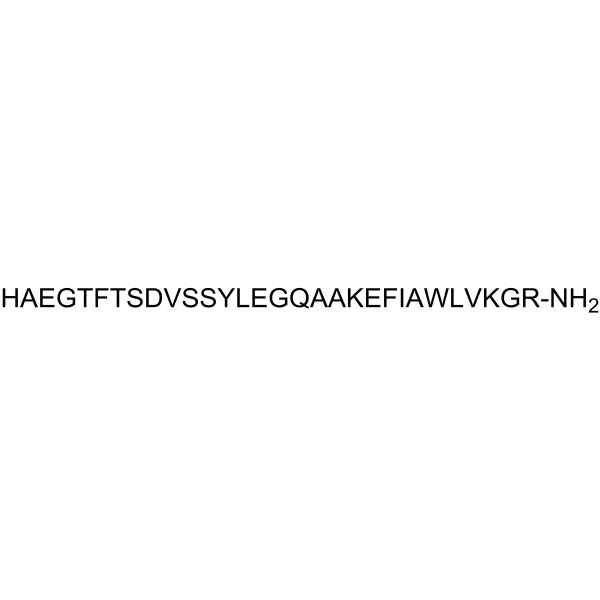
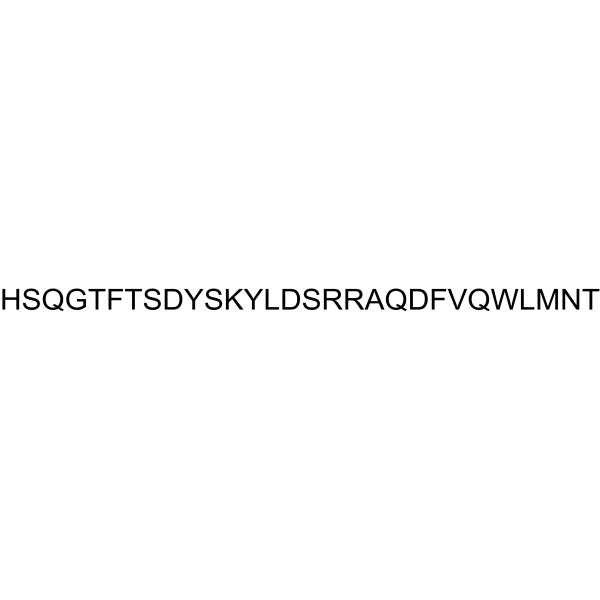
His-Ser-Gln-Gly-Thr-Phe-Thr-Ser-Asp-Tyr-Ser-Lys-Tyr-Leu-Asp-Ser-Arg-Arg-Ala-Gln-Asp-Phe-Val-Gln-Trp-Leu-Met-Asn-Thr-Lys-Arg-Asn-Arg-Asn-Asn-Ile-Ala
-
Sequence Shortening
HSQGTFTSDYSKYLDSRRAQDFVQWLMNTKRNRNNIA
-
Shipping
Room temperature in continental US; may vary elsewhere.
-
Storage
Sealed storage, away from moisture
Powder -80°C 2 years -20°C 1 year * In solvent : -80°C, 6 months; -20°C, 1 month (sealed storage, away from moisture)


Solvent & Solubility
In Vitro:
DMSO : 100 mg/mL (22.47 mM; Need ultrasonic; Hygroscopic DMSO has a significant impact on the solubility of product, please use newly opened DMSO)
H2O : ≥ 100 mg/mL (22.47 mM)
* "≥" means soluble, but saturation unknown.
Please refer to the solubility information to select the appropriate solvent. Once prepared, please aliquot and store the solution to prevent product inactivation from repeated freeze-thaw cycles.
Storage method and period of stock solution: -80°C, 6 months; -20°C, 1 month (sealed storage, away from moisture). When stored at -80°C, please use it within 6 months. When stored at -20°C, please use it within 1 month.
* Note: If you choose water as the stock solution, please dilute it to the working solution, then filter and sterilize it with a 0.22 μm filter before use.
Concentration (start) × Volume (start) = Concentration (final) × Volume (final)


Purity & Documentation
-
Data Sheet (295 KB)
-
SDS (252 KB)
- English - EN (252 KB)
- Français - FR (252 KB)
- Deutsch - DE (252 KB)
- Norwegian - NO (252 KB)
- Español - ES (252 KB)
- Swedish - SV (252 KB)
- Italian - IT (252 KB)
- Korean - KR (252 KB)
- Portuguese - PT (252 KB)
-
Handling Instructions (2659 KB)
References


Complete Stock Solution Preparation Table
Please refer to the solubility information to select the appropriate solvent. Once prepared, please aliquot and store the solution to prevent product inactivation from repeated freeze-thaw cycles.
Storage method and period of stock solution: -80°C, 6 months; -20°C, 1 month (sealed storage, away from moisture). When stored at -80°C, please use it within 6 months. When stored at -20°C, please use it within 1 month.
| Optional Solvent | Concentration Solvent Mass | 1 mg | 5 mg | 10 mg | 25 mg |
|---|---|---|---|---|---|
| DMSO / H2O | 1 mM | 0.2247 mL | 1.1236 mL | 2.2473 mL | 5.6182 mL |
| 5 mM | 0.0449 mL | 0.2247 mL | 0.4495 mL | 1.1236 mL | |
| 10 mM | 0.0225 mL | 0.1124 mL | 0.2247 mL | 0.5618 mL | |
| 15 mM | 0.0150 mL | 0.0749 mL | 0.1498 mL | 0.3745 mL | |
| 20 mM | 0.0112 mL | 0.0562 mL | 0.1124 mL | 0.2809 mL |
* Note: If you choose water as the stock solution, please dilute it to the working solution, then filter and sterilize it with a 0.22 μm filter before use.


Oxyntomodulin (human, mouse, rat) Related Classifications
HY-P4796 Related Classifications
 Powered by Bioz