



ALDH1A1 Protein, Human (His)

Based on 1 Customer Validation
ALDH1A1 Protein, Human (His) is a human recombinant ALDH1A1 with an N-terminal Met and His tag produced in E. coli. ALDH1A1 Protein, Human (His) contains 501 amino acids (1-501 a.a.).
- Species: Human
- Source: E. coli
-
Storage:Stored at -80°C for 1 year from date of receipt. It is stable at -20°C for 3 months after opening. It is recommended to freeze aliquots at -80°C for extended storage. Avoid repeated freeze-thaw cycles.


To place orders, for customer services and technical support, please contact: MedChemExpress USA
Tel: 609-228-6898 E-mail: [email protected] [email protected]


-
 Biological Activity
-
Technical Parameters
-
Product Properties
- Documentation
- References
- Help & FAQs




Biological Activity
Description
ALDH1A1 Protein, Human (His) is a human recombinant ALDH1A1 with an N-terminal Met and His tag produced in E. coli. ALDH1A1 Protein, Human (His) contains 501 amino acids (1-501 a.a.).
Background
Aldehyde Dehydrogenase 1-A1 (ALDH1A1) is part of the aldehyde dehydrogenases family. Human ALDH1A1 is a cytosolic homotetramer expressed in several tissues (skin, eyes, liver, kidney, testis and brain). ALDH1A1oxidizes a broad range of aliphatic and aromatic aldehydes including those formed endogenously such as retinalsand 3,4-dihydroxyphenylacetaldehyde (DOPAL), xenobiotics such as benzaldehyde or those produced during lipid peroxidation[1].
Verified Bioactivity
Measured by its ability to produce NADH during the oxidation of propionaldehyde. The specific activity is 77.63 pmol/min/µg, as measured under the described condition.
MCE Validation Data
-
Purity - SDS-PAGE
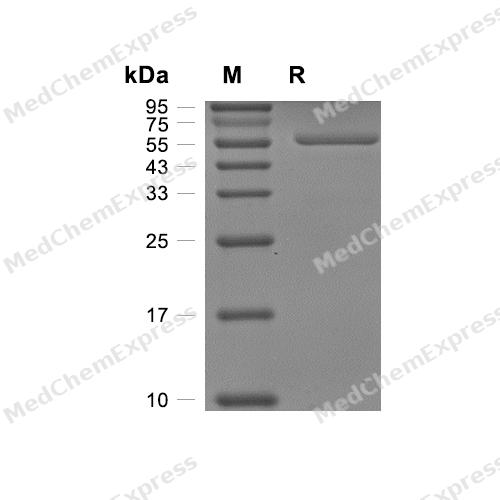
Purity - SDS-PAGE

Assay Procedure
Materials
ALDH1A1 Protein, Human (His) (HY-P7474)
Detection Diluent: Ultra-pure water
1 M Tris Solution, pH 8.5
2 M KCl Solution
1 M DTT Solution
200 mM Propionaldehyde
100 mM β-NAD
Procedure
1. Dilute Human ALDH1A1 protein to 20 μg/mL with pure water.
2. Prepare substrate mixture: Mix 100 μL of 1 M Tris (pH 8.5), 50 μL of 2 M KCl, 50 μL of 20 mM β-NAD, 50 μL of 40 mM DTT, 50 μL of 200 mM propionaldehyde, and 200 μL of pure water.
3. Add 50 μL of 20 μg/mL Human ALDH1A1 protein to a 96-well plate, then add 50 μL of substrate mixture to initiate the reaction. The blank group contains substrate mixture without the target protein.
4. Zero the microplate reader using the OD value of the blank group, and read the absorbance at 339 nm for 5 min in kinetic mode.
5. Calculate the specific activity:
Specific Activity (pmol/min/μg) = | Adjusted Vmax* (OD/min) x well volume (L) x 1012 pmol/mol |
| ext. coeff ** (M-1cm-1) x path corr. *** (cm) x amount of enzyme (μg) |
*Adjusted for substrate blank
**Extinction coefficient: 6220 M-1cm-1
***Path correction: 0.32 cm
Per Well:
Human ALDH1A1: 5 μg
β-NAD: 1 mM
Aldehyde: 10 mM


Technical Parameters
-
Species Human
-
Source E. coli
-
Tag N-6*His
-
Accession
P00352 (M1-S501)
-
Molecular Construction
-
N-term
-
6*His
-
ALDH1A1 (M1-S501)
Accession # P00352 -
C-term
-
-
Protein Length
Full Length
-
Synonyms
ALDH1A1; Aldehyde Dehydrogenase 1 Family, Member A1; Prev. ALDH1; Aldehyde Dehydrogenase, Liver Cytosolic; Prev. PUMB1; Aldehyde Dehydrogenase 1, Soluble; RALDH1; Aldehyde Dehydrogenase, Cytosolic; 3-Deoxyglucosone Dehydrogenase; Aldehyde Dehydrogenase (N
-
AA Sequence
MSSSGTPDLPVLLTDLKIQYTKIFINNEWHDSVSGKKFPVFNPATEEELCQVEEGDKEDVDKAVKAARQAFQIGSPWRTMDASERGRLLYKLADLIERDRLLLATMESMNGGKLYSNAYLNDLAGCIKTLRYCAGWADKIQGRTIPIDGNFFTYTRHEPIGVCGQIIPWNFPLVMLIWKIGPALSCGNTVVVKPAEQTPLTALHVASLIKEAGFPPGVVNIVPGYGPTAGAAISSHMDIDKVAFTGSTEVGKLIKEAAGKSNLKRVTLELGGKSPCIVLADADLDNAVEFAHHGVFYHQGQCCIAASRIFVEESIYDEFVRRSVERAKKYILGNPLTPGVTQGPQIDKEQYDKILDLIESGKKEGAKLECGGGPWGNKGYFVQPTVFSNVTDEMRIAKEEIFGPVQQIMKFKSLDDVIKRANNTFYGLSAGVFTKDIDKAITISSALQAGTVWVNCYGVVSAQCPFGGFKMSGNGRELGEYGFHEYTEVKTVTVKISQKNS
-
Molecular Weight
Approximately 60 kDa, based on SDS-PAGE under reducing conditions.
-
Purity
≥ 95%, as determined by reducing SDS-PAGE.


Product Properties
Solution
1.Supplied as a 0.22 μm filtered solution of 20 mM Tris-HCl, 150 mM Nacl, 20% glycerol, 1 mM DTT, pH 8.0.
2.Supplied as a 0.22 μm filtered solution of 20 mM Tris-HCl, 150 mM NaCl, 20% glycerol, 1mM DTT, pH 8.0.
3.Supplied as a 0.22 μm filtered solution of 50 mM Tris-HCl, 300 mM NaCl, pH 7.4, 20% glycerol, 1 mM dithiothreitol.
Please refer to the lot-specific COA for specific buffer information.
Note: For SPR assay, please replace the buffer. Primary amine components (e.g., Tris, imidazole) can affect protein-coupled chips.
<1 EU/μg, determined by LAL method.
Stored at -80°C for 1 year from date of receipt. It is stable at -20°C for 3 months after opening. It is recommended to freeze aliquots at -80°C for extended storage. Avoid repeated freeze-thaw cycles.
Shipping with dry ice.


Documentation
-
Data Sheet (264 KB)
-
SDS (254 KB)
- English - EN (254 KB)
- Français - FR (254 KB)
- Deutsch - DE (254 KB)
- Norwegian - NO (254 KB)
- Español - ES (254 KB)
- Swedish - SV (254 KB)
- Italian - IT (254 KB)
- Korean - KR (254 KB)
- Portuguese - PT (254 KB)
-
Handling Instructions (2659 KB)


References

Calculators
Concentration (start) × Volume (start) = Concentration (final) × Volume (final)


 Powered by Bioz

